Category: Writing

  • Vulgarity

    When friends ask where they can pick up one of my novels I always have to preface the conversation with; “I apologize in advance for the language.”

    This is because most of these friends are asking around the pot-luck table at church or something and I feel a need to cushion them from the reality of what I’ve written. I don’t want to shock them or make them feel uncomfortable, so I figure it’s best they know walking into the book that there will be some rough language.

    So why don’t I exclude vulgar language from my novels?

    Easy … because it’s not realistic.

    Let’s face it, we all know curse words. Some of us even pride ourselves in new and creative ways to utilize expletives. I had a Drill Sergeant in the Army who knew how to insert four letter words inside other four letter words — a feat that requires no small amount of talent, I assure you — and who woke us all in the early morning by flicking on the light switch and shouting; “Get the f**#* out of bed.”

    Charming, I know. But also quite effective.

    Cursing seems to be a staple of adult life. There are very few of us who can say they’ve never, ever used a curse word in their lives so it is unrealistic to exclude such language in fiction. That said, there is a difference between using said words naturally, and using them for shock factor.

    I’m just going to go ahead and admit that if I feel the words on the page are there deliberately to shock me, I’m putting the book down.

    Yes, I’m offended by that, but not because of the words themselves. I’m offended because the author thinks that’s the only way to get my attention.

    Trust me, there are better ways to shock and awe your audience.

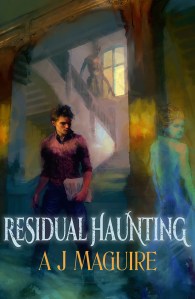
    Cover Art by Chris Howard
    Cover Art by Chris Howard

    Residual Haunting (which just posted Chapter 2 this morning) has some swear words in it. Mostly there’s slang (frigging and freaking and all variations thereof) but the vulgar words are in there and I’m sure people will notice.

    Authors have to tread a fine line between keeping true to character voice and trying not to offend their readers. It’s awkward — especially around the pot-luck table — but I’ve noticed that every time I apologize in advance, my friends just chuckle and shrug.

    They get it.

    They live here too.

  • Writing Spooky Stuff

    Residual Haunting may be my first quasi-ghost story/science fiction attempt but it’s not the first time I’ve ever used a ghost. In fact, my first published novel, Sedition, featured a ghost that popped up every now and then. And Witch-Born had that boy, Baldemor Delgora, who haunted the shores of Witch-Eater Lake.

    So I think it’s safe to say that I like using the paranormal in my work. Residual Haunting just ajmaguire-ResidualHaunting-COVERhappens to be the first book that centers on such things.

    I’m not sure why I have this attraction to these spooky, unsettling, and often tragic themes, but I do. In my defense, William Shakespeare loved using them too. Macbeth and Hamlet are just two that I can name without having to do any research.

    Granted, his culture and time period was very superstitious so it’s really no surprise that ghosts were used to help facilitate a story line.

    Still, it’s a grand tradition. Writing creepy things, telling ghost stories or anything that makes the hair on the back of your neck stand on end, is rooted into our culture. I mean, Stephen King is like the poster boy for all things that go bump in the night.

    We all know him regardless of whether or not we’ve read him before. In fact, some people avoid reading any Stephen King precisely because they don’t want to be scared out of their wits.

    I know I did for a while. (Oh, come on. If the clown from It didn’t scare you, you’ve lost your mind.)

    In any case, I believe I am in good company writing spooky stuff. Even if I don’t intend to enter the horror genre itself, there’s still plenty of room for the supernatural to find its way into my work.

  • Residual Haunting is now Live

    Cover Art by Chris Howard
    Cover Art by Chris Howard

    Welcome to October!

    As promised, Residual Haunting — my first ghost/semi-horror/paranormal story — has found its way onto Wattpad and its own Story Blog. (Take a moment to admire Chris Howard’s amazing artwork on the cover! I absolutely love it!)

    Now then …

    Why am I posting a draft of this novel online for free?

    It seems like a silly thing for an author, who wants to make money on telling stories, to post their work before any real editing can come of it (thus subjecting any Readers who dare to take the trip to a rough ride of possible typos and awkward wording) and to do so for free.

    Well, there are a couple of reasons.

    First, Residual Haunting is a grand experiment for me. It’s an exercise in whether or not I can write something completely on the computer (normally I hand write everything first) and I know I’m going to learn quite a bit in the process. (Honestly, I already have but we’ll get to that later.)

    If by some chance my experience with Residual Haunting can somehow aid a fellow writer then I would like to share it. Thus, we find the serialization process begun. I’ll go through a focused dissection of the experience when we’ve reached the end.

    Second, I love the history of serializations in general. I got to play Beth in “Little Women” when I was in high school so the concept of serializing stories gives me fond memories. (If you remember, Jo had her stories serialized in the paper.)

    And Third, it’s fun.

    No, really. It’s fun. I had a blast with Persona last year and promised myself that I would do it again once I found a suitable book (one not on contract and focused on learning something about the craft) and Residual Haunting fits that bill.

    So! If you like the paranormal and are adventurous enough to embark on this journey with me then welcome to the experiment! Follow the links above to find the story in your preferred format (Wattpad or Blog) and let’s get started!

  • September Round Robin – Abandoned Places

    Sawtooth City is a ghost town hidden in the mountains several hours from where I live. I stumbled on it many, many years ago while camping with my family and it has held my imagination ever since.

    Dilapidated houses, really little more than one room cabins with potbelly stoves, spread across the mountainside in a haphazard pattern. None of them have rooftops anymore and walking through them is hazardous due to rotting wood. It’s a rarity to find one with all its walls up.

    You have to walk because the pathway is too narrow in places for any sort of vehicle, even the off-road sort. I imagine you could get there in the winter with snow shoes and the like but that would be rather pointless as several of the houses would be buried in snow to the point you couldn’t see them.

    I’ve always gone in the summer, when the trees are full and green and the full extent of nature’s power can be seen overtaking where man once lived. There’s a wide, open glen higher up the mountain that is full of yellow flowers and I can imagine children used to play there. And there’s a spot on the stream that cuts between mountains perfect for romance; a cool, shaded place hidden from prying eyes.

    And then there is the mine.

    I’m not sure what sort of mine it is, but it dives deep into the mountain. There are signs warning people from going inside but … Well, I’m an adventurous spirit.

    The wood is rotted here, too. Moisture and time has eaten through it, making the act of climbing inside quite dangerous. Once inside there is a distinct chill that catches you, like the core of the mountain is leaking out and clashing against the summer air. Uneven walls are held up by unsteady beams and the very real risk of collapse becomes an ever-present itch just between your shoulders.

    And that’s when I start to see them, the people who once worked here.

    I’m not crazy. I don’t actually see them. But I do imagine them, and they fascinate me.

    The nonchalance with which they enter the mine, each knowing that there is a chance there might be a cave-in today and still they go. They’re men, of course, so they can’t reveal their fears to anyone else, but each of them has to have it. Each of them has to have that same itch between their shoulders, the one that tells them how many tons of earth and rock are leaning into those beams every second of every day.

    I love that mine. I love the questions it gives me, the characters that populate my mind every time I go there. I’ve always intended to write a western novel based around a mine and I’m happy to say that this year, starting in November, I’ll be doing just that. I’ll be using Idaho City instead of Sawtooth City, for historical purposes, but I’m definitely bringing that mine.

    Check out what my fellow authors have to say about Abandoned Places for September’s Round Robin Blog Tour!

    “http://www.skye-writer.com/blogging_at_the_beach” Skye Taylor
    “http://www.helenafairfax.com/” Helena Fairfax
    “http://connievines.blogspot.com/” Connie Vines
    “http://the-doodling-booktease.tumblr.com/” Rachael Kosnski
    “http://www.marcibaun.com/” Marci Baun
    “http://annestenhousenovelist.wordpress.com” Anne Stenhouse
    “http://lynx-sis.blogspot.com/” Judith Copek
    “https://ajmaguire.wordpress.com/” A.J. Maguire  (You are HERE)
    “http://mizging.blogspot.com” Ginger Simpson
    “http://beverleybateman.blogspot.ca/” Beverley Bateman
    “http://rhobinleecourtright.com” Rhobin Courtright

  • Gutter Space

    Last year I made a few print copies of Persona for my family. (No, it is not for sale. Yet.) But anyway, I discovered this rather annoying problem with my Word program when it came to converting the text for printing.

    Every page needed a designated amount of “gutter space.” This is the space that you see right in the middle of the book when you open it up, the little “gutter” that is created where the binding comes together. For whatever reason, my Word program could not target even versus odd pages, forcing me to spend FOUR HOURS going through each individual page and shifting them over.

    As evidenced by what happened next, shifting text is quite boring.

    “Gutter space” sounded so … sordid. Kind of seedy, you know?

    I decided that what “Gutter Space” really stood for was that place where all rejected novels go, and for four hours that late November night I let my creative brain run rampant. It was quite entertaining. I had a main hero named Partial (standing for Partially Formed Idea) who was met by several different novels, all of them with some form of book disease.

    My personal favorite was Multiple POV Disorder where the inflicted novel kept switching characters mid-sentence.

    In any case, I sort of let “Gutter Space” fade away after I finished shifting text but this week I caught myself in that weird transitional period between projects. And, lo and behold, Gutter Space came back to mind. As much as I loved the concept of Partial being introduced to every manner of writing mistake (like Purple Prose Syndrome, which was so full of unnecessary description that it continued to just describe things around it rather than address anything of worth to the plot) I’m not quite ready to write that short story.

    But trust me, I will.

    For now, I’ve decided that “Gutter Space” will be anything and everything that my brain needs to clean out before it’s ready to start on a new project.

    So what is my “Gutter Space” comprised of today?

    Well … Here’s my line-up …

    1) Residual Haunting — needs completion (But it’s also my next project so I don’t need to worry so much.)

    2) Persona — needs a new ending (Already got this baby scheduled.)

    3) Usurper — needs an edit or … uh … 5 (Pardon me as I hide from all Trenna fans. I already promised it would be out in 2015!)

    4) Primal — needs re-written or … brainstormed or … something

    5) Dead Weight — needs completion

    6) The Abolitionist — needs research

    … My car needs cleaning too.

    And I should wash my carpets ’cause … Winter is coming.

    And there you have it … That’s what’s in my Gutter Space today. Starting next week I’ll be diving headlong into Residual Haunting and posting it, as promised, for free on Wattpad. It will be completed by the end of October, which frees up my November for NaNoWriMo where I will either be working on Primal or The Abolitionist.

    We’ll see.

  • Research as a Writer

    Writers are really life-long scholars. Sure, we get to play around in fiction and make up rules in our fantasy worlds sometimes, but when push comes to shove we are constantly having to “Google” one thing or another. Whether we’re researching words (Hello, online Thesaurus) or we need to find out just how far away Pluto is from Earth (NASA has a really cool site for that) the research of a writer never seems to be done.

    With each book comes a new set of questions, new things we need to know to make the novel believable because the last thing we want to do is insult our readers.

    Science Fiction authors find themselves having to explain gravity on a ship. Historical Fiction authors need to know their time period well enough to keep readers rooted in the story. Crime writers need to know police procedure and proper investigative techniques. And the list goes on.

    The bottom line is, if you’re a writer then you’re a researcher too. There’s just no getting around this work.

    Now, I’ve heard horror stories of authors who get lost in the library, researching so much that they never actually start to write the story. When I started my first historical fiction (Persona) I was seriously afraid of this happening.

    I absolutely love history. It would have been easy for me to get sucked into all the facts and true stories about what happened in WWII and I knew it. So I made a list of rules for myself before I started the project and, because I’m about to start my second historical fiction (The Abolitionist) in November, I thought I would share those rules today.

    1) Write the Character First

    Before I did any research I had to have my main character firmly in my sights. With Persona this was Megan Crossweathers, and I wrote the entire first chapter before I began researching. Now, I did have to go back and edit that chapter quite a bit after I’d done my research, but that first chapter helped me ask very specific questions for my research.

    Example: After writing that first chapter I knew I had Megan on a boat that was about to sink. So I researched boats that sank until I found the S.S. Ceramic (No, really, that’s its name) which sank right about where I needed it to and had only one reported survivor. 

    2) Know What You Need

    I’m pointing to the first rule up there “Know your character” again because if you know your character and the story you’re meaning to tell then you won’t get lost in a sea of information as you’re writing. As much fun as it is to learn about history (or science or crime or whatever your passion is) there’s only so much that’s actually going to be useful.

    So, you need to know what you need.

    Example: During my recent editing of Tapped I found my characters walking on Pluto. (The dwarf planet, not the Disney character or the Roman god of the Underworld.) In order to do that I needed to know the climate of the dwarf planet (which is very, very cold by the way) and the terrain and … you get it. 

    Generally speaking, you come up with these questions as you write which brings me to my third and final rule …

    3) Keep Writing 

    Many things constitute as research in my book. Preparing for The Abolitionist, I’ve begun watching movies centered on the Civil War (just watched Gettysburg this weekend) and gathered documentaries which I will slowly begin to consume. These help me two-fold because documentaries let me get my learning on (I totally love The History Channel) while also seeing the styles (hair, clothing, weaponry) right in front of me.

    Here’s the thing …

    All that information is useless unless I have someplace to put it. And I’ll never find a place to put it unless I’m still writing.

    So for every hour I spend watching a documentary, I have to spend an hour writing too. Sometimes I start the day writing and then watch a documentary, other times I watch first and then write. Either way, I’m researching as I go.

    Disclaimer

    I’m one of those bizarre hybrid writers who can never start a novel with an outline. The first dozen chapters are what I like to call “cause and effect” writing, which presents the character and a particular problem and then watching said character try to resolve that particular problem. But I can’t finish a novel without an outline either.

    By the middle of the book I have a firm enough grasp on the character, theme, and plot of the novel that I can write a sketchy outline to help me reach the end. I call this “Muse Central” because I go about a week or so where I don’t write anything on the novel itself, but instead let my Muse take control to write the outline.

    These are just my rules. It’s not a “one size fits all” thing here.

    Authors who like to have an outline from the get-go probably won’t benefit here. Discovery writers (writers who don’t use an outline) might.

    Maybe.

    I don’t know. I’m really just winging it here. These are rules that helped me and on the off chance that they might help someone else, I decided to share them. Writing is a craft, after all, and no one way is going to work for everybody.

  • Clearing Off the Cork-board

    Early Thursday afternoon — on my lunch break, no less — I was able to type “The End” on Tapped. This was my most extensive round of edits. I solicited an editor to help me develop the story and couldn’t be happier with the results. Gabriel Fitzpatrick helped me see the strengths and the weaknesses in the manuscript and it is now totally awesome. 

    Ahem.

    Well, after a lot of blood, sweat, and tears it’s really quite a lot better than it was.

    In a week I’ll probably hate it, but I’ve come to expect the roller-coaster that is the author’s psyche. One week I love it, the next week it’s dribble not worth looking at.

    Whatever.

    This week it’s awesome and I have happily cleared off my cork-board, making way for the next project. All of the 3×5 cards with plot notes, sketched outlines, and character questions have been tossed into recycling. It is now a blank bit of brown cork with festively colored push-pins just waiting to be used again.

    ajmaguire-ResidualHaunting-COVER
    Cover art done by the amazing Chris Howard!

    And what is that next project?

    Residual Haunting!

    The original plan was to serialize Residual Haunting through the summer because I had so much fun bringing Persona into life that way. (Why yes, Persona has seen an editor and I will begin brushing it up in January. I’ll be completely changing the ending since the editor sorta … uh … hated it. No, I mean it, he HATED it.)

    AJMaguire-PersonaCover-1280h
    Remember Persona? It’s cover art was done by Chris Howard!

    Anyway … Residual Haunting is in a sorry state of incomplete and since it is another one of my experiments in genre/POV/and all things the craft of writing, it meets my arbitrary qualifications for serialization.

    So! Starting October 1st, 2014 I will be posting a chapter a week on Wattpad  — because Wattpad is awesome and I totally love it —  and on a story blog of its own — because I like to accommodate people who either do not use or do not understand how to use the Wattpad site.

    This is FREE! Yes, absolutely free. I will post links to each site (Wattpad and Blog) every time a new chapter goes up. Just like Persona, this is a draft and it is subject to massive amounts of change. Also like Persona, after its completion it will be removed while it undergoes said change.

    What does that mean?

    It means it will only be up for a limited time after the final chapter has been posted. If you follow along week by week you have nothing to worry about. If you wait until it’s all up there, you’ll only have three months to read it before I remove it from the public eye.

    And now I’ll leave you with a blurb telling you what Residual Haunting is all about. 

    Follow Doctors Jared Foster and Cal Murphy as the infamous Residual Haunting Museum is hijacked by ghosts, a witiko, and a girl named Rachel who is trying very hard to retire from all things supernatural.

    As Cal works hard to decipher his newest “Print” — or ghost — things inside the museum start to go haywire; the ghosts inside their exhibits disappear, power fluctuates and threatens to poison them all with the gases used to maintain each exhibit, and Cal finds himself doing the impossible by speaking to a ghost. But there’s far more going on than the mystery of just one ghost and the closer Cal comes to understanding how this woman died, the closer he comes to the real danger hunting them all inside the museum.  

  • Nearing “The End”

    By the close of this week I will have finished the edits on Tapped. I started this book two years ago for Camp NaNoWriMo and sent its second draft to a wonderful editor by the name of Gabriel Fitzpatrick. (Authors, if you ever see him advertising to do some work, take him up on it. He’s professional and he’ll infuse you with the belief that your book can conquer the world when it’s finished.)

    My original deadline for completing these edits was the beginning of May, but I was still in school and things got a trifle crazy and an avocado bested me during a salad-making contest.

    Yes, I’m talking about stabbing myself in the hand. And I’ll say it again — I really do know how to core an avocado. I was just in a hurry and wasn’t paying enough attention.

    Still, the damage done to my hand in that escapade was extensive enough to make typing (a core element of the writing craft) really frigging hard, thus throwing my deadline back even further.

    But I am not one to go quietly into the night.

    Which is why the draft will be complete this week.

    I’m not sure if I’m the only one who has this problem but sometimes, particularly in the last week of a novel, I want to finish so badly that I actually have to coach myself to slow down. So this week is all about taking my time to get it right. These last two chapters include a space battle where the ship we’ve been traveling on for several hundred pages now finally gets to show us what she’s capable of, and resolution moments for a couple of subplots.

    And if I don’t get both of them right then the entire book is a wash.

    So here’s me, rolling up my sleeves and preparing for the week-long plunge into all things “climax” and “conclusion.” I’ll see you all on the other side.

  • Meet My Character Blog Tour

    Shen Hart tagged me in the “Meet My Character Blog Tour” and I’ve been sitting on this for a couple of days, trying to decide who I was going to “tag” in response. I’ve decided on Lisa (LJ) Cohen, RJ Blain, and Skye Taylor. Good luck and have fun! 

    1) What is the name of your character?  Is she fictional or a historic person?

    Johanna Rorry — otherwise known as Jorry. She is purely fictional. 

    2) When and where is the story set?

    The story is set many, many, many years into the future. We get to go spelunking on Pluto, lay siege to a space station orbiting Neptune, and infiltrate a military base on Europa but in between all of that the characters are on board the hauler-class vessel known as the Zephyr. 

    3) What should we know about him?

    Ahem. You mean “her.”

    And you should know that when she sets her mind to something she doesn’t waver. She’s a complicated mix of soldier and mother, capable of hacking into computer systems and constantly focused on the safety of her family. 

    4) What is the main conflict? What messes up his her life?

    Her son Devon wants to go to University, but because Jorry and her counterpart (Seach Barlow) are both deserters from the military this poses many problems. Sending Devon to school could reveal their whereabouts to the military they’ve been running from. So Jorry makes a black market deal to get Devon some security tags that won’t alert the Universe that she’s still alive and still allow him to go to school. 

    And … you know … things go very, very wrong. 

    5) What is the personal goal of the character?

    She wants to see her son safe and happy. 

    6) Is there a working title for this novel, and can we read more about it?

    The tentative title is Tapped and you can read a snippet of it on my main website ajmaguire.com. (HINT: It’s under the science fiction tab.)

    7) When can we expect the book to be published?

    Well, I have a rule that I send out everything to the traditional market first and if it doesn’t get any bites then I look into Indie publishing. So I’m really not sure. It could be out sometime in 2015 or it could be later.


  • Writing Hard Scenes

    For the past several weeks I have agonized over one particular scene. It’s an important scene. Plot happens. Torture happens. Characters react in various ways to said torture, thus revealing more about who they are as people and making the book quite a bit more profound than it would have been otherwise. 

    One problem. 

    I don’t know how to torture someone. 

    Honestly, there’s a part of me that’s quite annoyed at having researched proper torture techniques. I mean, who wants to know that stuff?

    This scene was extremely difficult to write both because I didn’t know anything about torture and because I didn’t know how to properly convey someone being tortured. I almost tried scrap the scene, to just “fade to black” and let the Reader’s imagine what was going on, then come back later during the rescue. 

    But I couldn’t do that because the scene really does reveal more about the relationship between our hero and the antagonist. It shows how far both are willing to go to get what they want.

    And I knew that if I scrapped it, I would be cheating myself out of a growth moment as a writer.

    Writing the hard scenes is what helps challenge us as writers.

    Yes, we need editors to help us do that too. Yes, we need to read books that help us grasp story structure and characterization.

    But we also need to face those scenes that frighten us because it is only through those scenes or genres or points of view that we can truly take ownership of our craft.

    So.

    I wrote a torture scene.

    It took me several weeks and I cringed while I was doing it, but I know (and the Readers will know) just who these two people are because of it.