Tag: Authors

  • Vulgarity

    When friends ask where they can pick up one of my novels I always have to preface the conversation with; “I apologize in advance for the language.”

    This is because most of these friends are asking around the pot-luck table at church or something and I feel a need to cushion them from the reality of what I’ve written. I don’t want to shock them or make them feel uncomfortable, so I figure it’s best they know walking into the book that there will be some rough language.

    So why don’t I exclude vulgar language from my novels?

    Easy … because it’s not realistic.

    Let’s face it, we all know curse words. Some of us even pride ourselves in new and creative ways to utilize expletives. I had a Drill Sergeant in the Army who knew how to insert four letter words inside other four letter words — a feat that requires no small amount of talent, I assure you — and who woke us all in the early morning by flicking on the light switch and shouting; “Get the f**#* out of bed.”

    Charming, I know. But also quite effective.

    Cursing seems to be a staple of adult life. There are very few of us who can say they’ve never, ever used a curse word in their lives so it is unrealistic to exclude such language in fiction. That said, there is a difference between using said words naturally, and using them for shock factor.

    I’m just going to go ahead and admit that if I feel the words on the page are there deliberately to shock me, I’m putting the book down.

    Yes, I’m offended by that, but not because of the words themselves. I’m offended because the author thinks that’s the only way to get my attention.

    Trust me, there are better ways to shock and awe your audience.

    Cover Art by Chris Howard
    Cover Art by Chris Howard

    Residual Haunting (which just posted Chapter 2 this morning) has some swear words in it. Mostly there’s slang (frigging and freaking and all variations thereof) but the vulgar words are in there and I’m sure people will notice.

    Authors have to tread a fine line between keeping true to character voice and trying not to offend their readers. It’s awkward — especially around the pot-luck table — but I’ve noticed that every time I apologize in advance, my friends just chuckle and shrug.

    They get it.

    They live here too.

  • September Round Robin – Abandoned Places

    Sawtooth City is a ghost town hidden in the mountains several hours from where I live. I stumbled on it many, many years ago while camping with my family and it has held my imagination ever since.

    Dilapidated houses, really little more than one room cabins with potbelly stoves, spread across the mountainside in a haphazard pattern. None of them have rooftops anymore and walking through them is hazardous due to rotting wood. It’s a rarity to find one with all its walls up.

    You have to walk because the pathway is too narrow in places for any sort of vehicle, even the off-road sort. I imagine you could get there in the winter with snow shoes and the like but that would be rather pointless as several of the houses would be buried in snow to the point you couldn’t see them.

    I’ve always gone in the summer, when the trees are full and green and the full extent of nature’s power can be seen overtaking where man once lived. There’s a wide, open glen higher up the mountain that is full of yellow flowers and I can imagine children used to play there. And there’s a spot on the stream that cuts between mountains perfect for romance; a cool, shaded place hidden from prying eyes.

    And then there is the mine.

    I’m not sure what sort of mine it is, but it dives deep into the mountain. There are signs warning people from going inside but … Well, I’m an adventurous spirit.

    The wood is rotted here, too. Moisture and time has eaten through it, making the act of climbing inside quite dangerous. Once inside there is a distinct chill that catches you, like the core of the mountain is leaking out and clashing against the summer air. Uneven walls are held up by unsteady beams and the very real risk of collapse becomes an ever-present itch just between your shoulders.

    And that’s when I start to see them, the people who once worked here.

    I’m not crazy. I don’t actually see them. But I do imagine them, and they fascinate me.

    The nonchalance with which they enter the mine, each knowing that there is a chance there might be a cave-in today and still they go. They’re men, of course, so they can’t reveal their fears to anyone else, but each of them has to have it. Each of them has to have that same itch between their shoulders, the one that tells them how many tons of earth and rock are leaning into those beams every second of every day.

    I love that mine. I love the questions it gives me, the characters that populate my mind every time I go there. I’ve always intended to write a western novel based around a mine and I’m happy to say that this year, starting in November, I’ll be doing just that. I’ll be using Idaho City instead of Sawtooth City, for historical purposes, but I’m definitely bringing that mine.

    Check out what my fellow authors have to say about Abandoned Places for September’s Round Robin Blog Tour!

    “http://www.skye-writer.com/blogging_at_the_beach” Skye Taylor
    “http://www.helenafairfax.com/” Helena Fairfax
    “http://connievines.blogspot.com/” Connie Vines
    “http://the-doodling-booktease.tumblr.com/” Rachael Kosnski
    “http://www.marcibaun.com/” Marci Baun
    “http://annestenhousenovelist.wordpress.com” Anne Stenhouse
    “http://lynx-sis.blogspot.com/” Judith Copek
    “https://ajmaguire.wordpress.com/” A.J. Maguire  (You are HERE)
    “http://mizging.blogspot.com” Ginger Simpson
    “http://beverleybateman.blogspot.ca/” Beverley Bateman
    “http://rhobinleecourtright.com” Rhobin Courtright

  • Research as a Writer

    Writers are really life-long scholars. Sure, we get to play around in fiction and make up rules in our fantasy worlds sometimes, but when push comes to shove we are constantly having to “Google” one thing or another. Whether we’re researching words (Hello, online Thesaurus) or we need to find out just how far away Pluto is from Earth (NASA has a really cool site for that) the research of a writer never seems to be done.

    With each book comes a new set of questions, new things we need to know to make the novel believable because the last thing we want to do is insult our readers.

    Science Fiction authors find themselves having to explain gravity on a ship. Historical Fiction authors need to know their time period well enough to keep readers rooted in the story. Crime writers need to know police procedure and proper investigative techniques. And the list goes on.

    The bottom line is, if you’re a writer then you’re a researcher too. There’s just no getting around this work.

    Now, I’ve heard horror stories of authors who get lost in the library, researching so much that they never actually start to write the story. When I started my first historical fiction (Persona) I was seriously afraid of this happening.

    I absolutely love history. It would have been easy for me to get sucked into all the facts and true stories about what happened in WWII and I knew it. So I made a list of rules for myself before I started the project and, because I’m about to start my second historical fiction (The Abolitionist) in November, I thought I would share those rules today.

    1) Write the Character First

    Before I did any research I had to have my main character firmly in my sights. With Persona this was Megan Crossweathers, and I wrote the entire first chapter before I began researching. Now, I did have to go back and edit that chapter quite a bit after I’d done my research, but that first chapter helped me ask very specific questions for my research.

    Example: After writing that first chapter I knew I had Megan on a boat that was about to sink. So I researched boats that sank until I found the S.S. Ceramic (No, really, that’s its name) which sank right about where I needed it to and had only one reported survivor. 

    2) Know What You Need

    I’m pointing to the first rule up there “Know your character” again because if you know your character and the story you’re meaning to tell then you won’t get lost in a sea of information as you’re writing. As much fun as it is to learn about history (or science or crime or whatever your passion is) there’s only so much that’s actually going to be useful.

    So, you need to know what you need.

    Example: During my recent editing of Tapped I found my characters walking on Pluto. (The dwarf planet, not the Disney character or the Roman god of the Underworld.) In order to do that I needed to know the climate of the dwarf planet (which is very, very cold by the way) and the terrain and … you get it. 

    Generally speaking, you come up with these questions as you write which brings me to my third and final rule …

    3) Keep Writing 

    Many things constitute as research in my book. Preparing for The Abolitionist, I’ve begun watching movies centered on the Civil War (just watched Gettysburg this weekend) and gathered documentaries which I will slowly begin to consume. These help me two-fold because documentaries let me get my learning on (I totally love The History Channel) while also seeing the styles (hair, clothing, weaponry) right in front of me.

    Here’s the thing …

    All that information is useless unless I have someplace to put it. And I’ll never find a place to put it unless I’m still writing.

    So for every hour I spend watching a documentary, I have to spend an hour writing too. Sometimes I start the day writing and then watch a documentary, other times I watch first and then write. Either way, I’m researching as I go.

    Disclaimer

    I’m one of those bizarre hybrid writers who can never start a novel with an outline. The first dozen chapters are what I like to call “cause and effect” writing, which presents the character and a particular problem and then watching said character try to resolve that particular problem. But I can’t finish a novel without an outline either.

    By the middle of the book I have a firm enough grasp on the character, theme, and plot of the novel that I can write a sketchy outline to help me reach the end. I call this “Muse Central” because I go about a week or so where I don’t write anything on the novel itself, but instead let my Muse take control to write the outline.

    These are just my rules. It’s not a “one size fits all” thing here.

    Authors who like to have an outline from the get-go probably won’t benefit here. Discovery writers (writers who don’t use an outline) might.

    Maybe.

    I don’t know. I’m really just winging it here. These are rules that helped me and on the off chance that they might help someone else, I decided to share them. Writing is a craft, after all, and no one way is going to work for everybody.

  • Clearing Off the Cork-board

    Early Thursday afternoon — on my lunch break, no less — I was able to type “The End” on Tapped. This was my most extensive round of edits. I solicited an editor to help me develop the story and couldn’t be happier with the results. Gabriel Fitzpatrick helped me see the strengths and the weaknesses in the manuscript and it is now totally awesome. 

    Ahem.

    Well, after a lot of blood, sweat, and tears it’s really quite a lot better than it was.

    In a week I’ll probably hate it, but I’ve come to expect the roller-coaster that is the author’s psyche. One week I love it, the next week it’s dribble not worth looking at.

    Whatever.

    This week it’s awesome and I have happily cleared off my cork-board, making way for the next project. All of the 3×5 cards with plot notes, sketched outlines, and character questions have been tossed into recycling. It is now a blank bit of brown cork with festively colored push-pins just waiting to be used again.

    ajmaguire-ResidualHaunting-COVER
    Cover art done by the amazing Chris Howard!

    And what is that next project?

    Residual Haunting!

    The original plan was to serialize Residual Haunting through the summer because I had so much fun bringing Persona into life that way. (Why yes, Persona has seen an editor and I will begin brushing it up in January. I’ll be completely changing the ending since the editor sorta … uh … hated it. No, I mean it, he HATED it.)

    AJMaguire-PersonaCover-1280h
    Remember Persona? It’s cover art was done by Chris Howard!

    Anyway … Residual Haunting is in a sorry state of incomplete and since it is another one of my experiments in genre/POV/and all things the craft of writing, it meets my arbitrary qualifications for serialization.

    So! Starting October 1st, 2014 I will be posting a chapter a week on Wattpad  — because Wattpad is awesome and I totally love it —  and on a story blog of its own — because I like to accommodate people who either do not use or do not understand how to use the Wattpad site.

    This is FREE! Yes, absolutely free. I will post links to each site (Wattpad and Blog) every time a new chapter goes up. Just like Persona, this is a draft and it is subject to massive amounts of change. Also like Persona, after its completion it will be removed while it undergoes said change.

    What does that mean?

    It means it will only be up for a limited time after the final chapter has been posted. If you follow along week by week you have nothing to worry about. If you wait until it’s all up there, you’ll only have three months to read it before I remove it from the public eye.

    And now I’ll leave you with a blurb telling you what Residual Haunting is all about. 

    Follow Doctors Jared Foster and Cal Murphy as the infamous Residual Haunting Museum is hijacked by ghosts, a witiko, and a girl named Rachel who is trying very hard to retire from all things supernatural.

    As Cal works hard to decipher his newest “Print” — or ghost — things inside the museum start to go haywire; the ghosts inside their exhibits disappear, power fluctuates and threatens to poison them all with the gases used to maintain each exhibit, and Cal finds himself doing the impossible by speaking to a ghost. But there’s far more going on than the mystery of just one ghost and the closer Cal comes to understanding how this woman died, the closer he comes to the real danger hunting them all inside the museum.  

  • How to Write a Dude

    Devon Barlow is a headstrong young man nearing his twenty-first birthday. He’s highly intelligent, very physically active (he goes spelunking on Pluto, how cool is that?) and he has a strong suspicion that his parents might just be pirates. Save for brief forays on Mars or Earth during the holiday seasons, Devon has lived the bulk of his life on board Zephyr, a hauler-class space ship. 

    I am a thirty-something single mother who reads too much and spends an embarrassing amount of time on video games. (Hey, games help keep my creative brain fresh and stuff. Don’t judge.)

    So how does a thirty-something single mother find the “voice” of a twenty-year-old boy in order to believably display his character on the page?

    Well … I read a lot. 

    I did say I read too much, didn’t I?

    In this case I deliberately hunted for books with young male points of view (really not that hard to do, you can find them in just about every book you pick up) and I studied them. I looked at what they thought or felt or did differently from how I might have reacted in any given situation and I jotted it down in a notepad. 

    I also talked to guy friends. If there was a situation happening on Zephyr in the book that could be easily translated into day-to-day life, I would nudge a guy and ask; “Hey, when you were twenty what would you have done if …”

    Disclaimer: These friends know I am an author. They find it highly amusing when I quiz them about what it’s like to be a dude and are more than happy to help out. However … most of them still think I’m crazy so … do this at your own peril. 

    That said, Devon Barlow might be a twenty-year-old young man but he is also a human being. He may think and feel differently from me but that does not mean I cannot relate to him. (Except for the pirate thing. I never suspected my parents of being pirates.)

    Fiction is the place where we can mind-meld with the world around us. It helps us understand people precisely because we find ourselves relating to characters vastly different from us. It teaches us to look at the core motivation in people because we know that, male or female, that motivation is what’s going to define them as a person.

    So!

    How to write a dude when you’re a girl?

    1) Read. (You should be doing this anyway if you’re a writer.)

    2) Observe and/or ask your guy counterparts.

    3) Find the core motivation.

    … and if anyone else has tricks to writing the opposite gender I’m happy to hear them. I’m sure I missed a few.  

  • Attack of the Secondary Character – Round Robin Discussion

    The beast roared again.

    It knew Relo was there.  It had known the moment he’d walked into the cave, its heightened sense of taste and smell had alerted the beast to this trespass.  But Relo had anticipated this.  In thirty-four years as a Tapped Acolyte he’d hunted every species Nellis had to offer.  He knew each weakness, each strength, and when Nellissian people were threatened, he had no qualms about exploiting such knowledge.  This, after all, was not a matter of fair play but a matter of survival.

    Me: Relo … huh … that’s an interesting name. Sounds kinda like “reload” which makes sense given the whole science fiction element, right?

    Cat: meow?

    Me: (Because I really am crazy enough to discuss these things with my pets) I know, I know. Relo … what? Relo Bomani? Sounds exotic and … you know … they’re on an alien planet and all … OK. So … the hero’s name is Relo Bomani.

    …. approximately 700 words later ….

    “I see I missed the action,” Seach said.  Most of his face was still in shadow but Relo knew the man was frowning.

    “It was a surprisingly fast battle.” Relo looked down at his thigh and tried to determine how bad the wound was.

    Seach walked to him, fixing the light on his wounded leg. “But not uneventful. Sit still.”

    “Actually, I think I cut myself on its tail when I tried to get out of the way.” Relo took the phosphorous light from Seach and angled it so his friend could work.

    Seach snorted his amusement as he crouched beside him, slipping the pack off his shoulder as he did so. “Serves you right for coming out here alone. I swear, sometimes I think you are trying to die.”

    Me: … huh … I like this Seach fellow.

    Cat: (just purrs cause by now he’s laying on my feet)

    … 3000 words later …

    Me: Ugh. I hate this book. I do not like the way it’s going. Relo is too … just too … strong. Not enough vulnerability in him. And he’s not funny.

    Cat: (lots of meowing cause he’s crazy enough to think I can understand him)

    Me: I know! Seach is so much more interesting. He makes me laugh. And he’s not afraid to fail. I totally love him.

    Cat: (stops meowing because I’m scratching under his chin and he’s in kitty heaven)

    Me: But you know, I’m not liking much of this plot either. Let’s change everything. We’ll make Seach the hero. Keep Jorry as the female lead. Relo can be the secondary.

    Cat: (suddenly bops me on the hand because he’s had enough attention for one day but he’s too lazy to move out of hands reach)

    … About a year later … 

    “You know Jorry won’t drink that,” said a familiar voice.

    Seach relaxed and glanced at Lieutenant Cavil as they continued through the D-Fac. Her black hair was shaved close and he could see little spirals of dark curls pressed up against her scalp. She grinned at him, her teeth bright white against the backdrop of her ebony skin. Cavil was beautiful in that hard way that military officers could be. It was like all the training and battle she had seen managed to sharpen her appeal and for half a second he forgot the danger they were in.

    “Lieutenant Cavil,” he said with a smile. In his peripheral view he saw Jo look up from her computer. “It’s been a while. Decided you were ready to tell me your first name?”

    “It’s been two years and eight months,” Cavil said and laughed. “I thought you would have lost interest by now.”

    “Lost interest in a beauty like you?” Seach clucked his tongue and winked at her. “Never.”

    … So … Have I ever had a secondary character steal a book from me?

    Yes. Very much so. I revamped all of Tapped to accommodate a new hero in Seach and I have never regretted it. He’s funny and vulnerable and he really made the story for me. He even counterbalances Jorry as the lead female character precisely because of those traits.

    Hop over to some of my fellow authors to see if they’ve ever dealt with a scene-stealing secondary character before!

    Marci Baun  http://www.marcibaun.com/
    Anne Stenhouse http://annestenhousenovelist.wordpress.com
    Fiona McGier http://www.fionamcgier.com
    A.J. Maguire https://ajmaguire.wordpress.com/ (YOU ARE HERE)
    Beverley Bateman http://beverleybateman.blogspot.ca/
    Diane Bator http://dbator.blogspot.ca/
    Margaret Fieland http://margaretfieland.com/my_blog
    Victoria Chatham www.victoriachatham.webs.com
    Connie Vines http://connievines.blogspot.com/
    Geeta Kakade http://geetakakade.blogspot.com/
    Rhobin Courtright http://rhobinleecourtright.com

  • Terraforming Mars

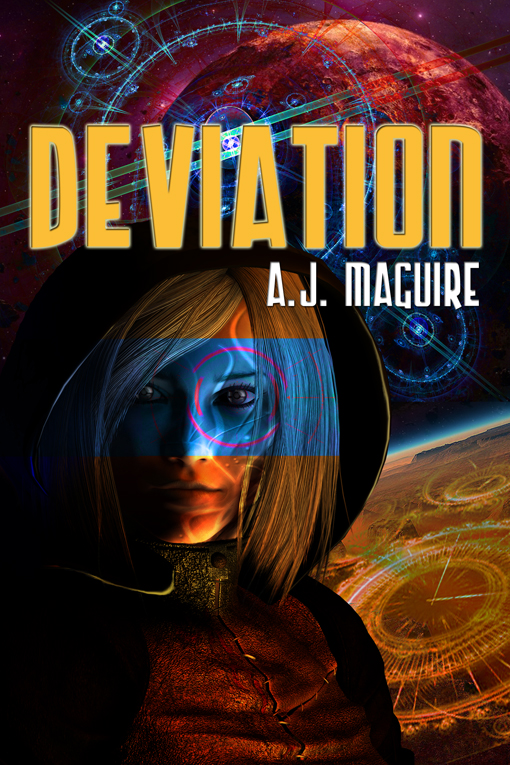
    Deviation, my newly released science fiction, lands smack dab on Mars.

    In spite of the massive amounts of research I had a lot of fun on Mars. Actually, scratch that.

    Because of the massive amounts of research I had to do, I had a lot of fun on Mars. Astronomy fascinates me. I think stars are cool and pictures of nebula are awesome and … yeah, I’m a nerd. So it’s only natural that my first science fiction novel actually features another planet.

    Mars is the planet we tend to like the most when it comes to the idea of relocating the human race. (Or at least branching out. Earth still needs our tender loving care.)

    planet-mars1There are many reasons for this but in the interest of this post I’m just going to direct you to HowStuffWorks.com because they already have an awesome article on the hows and the why’s of it. (Yay! Kevin Bonsor!)

    Now, I understand that I cheated a bit when it came to terraforming Mars in my book, but that all boils down to story. I wasn’t writing a guidebook to terraforming a planet, I was writing a story about redemption and grief and relationships.

    That said, I still wanted to make it believable.

    I also wanted to give the information without overwhelming readers with technical jargon. So I made a timeline with news articles. Readers will notice that there’s a snippet of a news article at the beginning of every chapter. That’s where I provided information both on what happened to the female race and how humanity reached Mars.

    First we bombed the core … cause Earth’s weird half-molten center is what gives us the tectonic plates, which is what gives us the magnetic field and atmosphere that keeps us … you know … alive and stuff. There’s probably a lot of things wrong with the theory of bombing the Martian core but the very concept made my creative brain go into hyper-drive, so I used it.

    Then, because things weren’t growing fast enough for us, we built a mirror-like greenhouse thing around Mars. (No, really, check out the HowStuffWorks.com article. It’s totally plausible.) Mars is further away from the sun so we needed to catch all that heat and redirect it to the planet’s surface.

    And then … and this is my favorite part … we “seed bombed” the planet’s surface.

    Yes, that’s right. Seed bombs. They are exactly what they sound like; bombs with seeds and fertilizer and all the good stuff plants need to get started.

    Add a little water, a little time, and a lot of luck and viola! Terraforming!

    Now then … scientists across the globe are likely to slaughter me for turning Mars purple and genetically altering animals to live on the planet. Those are all story elements. I rely heavily on the fact that I am not a scientist, I am a novelist. In those instances I would hope that people remember they are reading a work of fiction and focus instead on the characters rather than the mechanics.

    Deviation-510Honestly, I think we’ll live on Mars one day. It won’t be tomorrow, but some day.

  • Deviation Release!

    If I had spaceship shaped confetti I would totally be throwing it everywhere right now!

    My first ever science fiction, Deviation, has been released by Double Dragon Publishing. For right now I only have the publisher’s purchase link but as soon as it becomes available on Amazon and Barnes&Noble I’ll be certain to shove those links up everywhere.

    Look at the pretty, shiny cover!

    Look at all the pretty colors!

    See the pretty shiny blurby thingy! (OK, so this is the longer version. You can see the shorter version everywhere else.)

    On the brink of a religious war between Makeem and Novo Femina, Celeocia Prosser’s struggle for gender equality leads her to Reesa Zimms; the one woman in all of history who can identify the first Mavirus victim. Believing the information surrounding this patient zero to be pivotal in the fight against the Makeem, Celeocia sets her sights on Reesa Zimms, also known as Caresse Zimmerman.

    There’s just one problem; Reesa Zimms is a science fiction novelist who lived and died hundreds of years in the past.

    Utilizing wormhole travel and antimatter discs, Celeocia sends her son Hedric and the crew of the Lothogy careening through time. When Hedric finds Reesa, the novelist is accompanied by her best friend Kate, who just happens to look like his recently murdered wife.

    Stunned and reeling, Hedric abducts both women, bringing Reesa and Kate on a not­so­gentle ride into the future.

    Time travel might be easier for Reesa to accept because Hedric Prosser, the High Priestess, and the very ship they’re traveling on, all belong in Reesa’s novels. Confused and pretty sure she’s going insane; Reesa tries to prepare her friend Kate for the very male­dominated society they’ve been dumped into. When she finds herself abandoned by Hedric, Reesa must rely on Matthew Borden, the villain of her books, to rescue Kate and fight their way home.

    Hear my squeal of delight to finally see this work out in the open!

    No, seriously, Deviation and I have a rather long history. I started writing it in 2008 through Lazette Gifford’s Two Year Novel Course — which I highly recommend for anyone who has been toying with the idea of writing a novel but feels they don’t have the time.

    I actually took the class, which started the first week of January so when I say I started writing it in 2008 I really mean I started writing it in 2008. Which means I’ve been working on/editing/shopping this book around to various publishers for six years now.

    Six!

    I could blame this on the fact that I was in school for three of those years, but the truth is that I was just nervous. This is my first science fiction ever and I wanted to at least try to get it right.

    So … I did a lot of research. Granted, I deliberately ignored some of said research because … you know … FICTION … and I needed things to work with the story. But still, I did a LOT of research.

    Mars in particular was fun but I’ll make a whole post dedicated to Mars and all the things I broke while trying to make the planet habitable.

    Not today, though.

    Today I’m throwing confetti and marveling at the artistic talents of my publisher and enjoying general revelry.

  • Favorite Scenes — Dead Magic Edition

    I promised I’d post my favorite scene from the upcoming novel Dead Magic so … here we go.

    Once again, I’m not one of those people who likes spoilers  … Unless I get invested in a character, then I have to know if they survive the book/story. No, really, I flip to the end of books and hunt for names just to make sure they’re still there. I won’t read the whole thing, I’ll just check if they still have dialog and then go back to reading like normal.

    I know, I’m terrible.

    Anyway, I won’t give any spoilers but I will post my favorite scene. I’ll give the barest amount of setup for this one — this scene happens early(ish) in the book and I cut it off before anything major can be revealed. Fans of Witch-Born will recognize the two characters (Dorian and Elsie). These two do play a major part in Dead Magic but as I’ve said before the book itself is more focused on Winslow Agoston and Valeda Quinlan.

    Why do I love this scene in particular?

    I think because it’s honest. Dead Magic takes place eight years after the ending of Witch-Born. Things have changed. Relationships have strained and while the love between Elsie and Dorian is still every bit as strong as in Witch-Born, all is not perfect.

    Please note that this is an unedited version of the scene. 

    Dead Magic: 

    “Why would you promise that woman something you know you can’t give her?” Dorian half chased Elsie around the western perimeter of the ark, thoroughly annoyed that he’d been forced to hunt her down again.

    “Who says I can’t give her what she wants?” Elsie kept a brisk pace, lithely avoiding the overgrowth of jungle around them. Her black hair was pinned up in a tight bun, making the exotic, angular curves of her face more prominent. If he hadn’t been suppressing the desire to strangle her Dorian might have given her a compliment.

    “The Council says you can’t.” He had to catch himself on a fallen bit of tree when she abruptly stopped. The moist ground slid away from his left foot and he quickly found a better standing spot.

    The ark was built precariously close to the edge of the ridge-line, its entire circumference taking up a four mile wide, three and a quarter mile long declivity in the mountain range. The egg-shaped monolith of iron and steel was far enough from any towns that it looked like a shadowed lump of hillside at a distance. Up close, however, it was big and bulky and looked quite impenetrable. Which, he thought with a frown, was the point.

    Elsie turned to an iron ladder built into the side of the wall and prepared to climb. Dorian grabbed her elbow to stop her. There would be people wherever she was heading and they needed to do this conversation in private.

    “You promised, Elsie.”

    “No,” she said. “As I recall it, you are the one who promised silence, not me. I stood there like an idiot, trying to remind myself why I didn’t kill them all where they stood.”

    “Elsie. Think of the hysteria that would happen if word got out.” Dorian moved closer to her, glancing at her gloved hand and preparing himself for the battle he’d just stepped into. “If Valeda Quinlan publishes the fact that Magic is dead, the Untalented will panic. There will be riots and mayhem and a lot of innocent lives will be lost.”

    “Even the Witch-Born will panic, Dorian. Talented or not, all of Magnellum’s fate rests on the Warding Pillars. Panic is exactly how the people should be reacting.” Elsie scowled at him but didn’t move, still poised to climb the ladder. “The Wild is coming, Dorian. It’s coming and there’s very little we can do about it.”

    “The Wild has been ‘coming’ for eight years now, Elsie!” Exasperated, he let go of her and shoved his fingers through his hair. “By Fates! I’ve been listening to you for eight long years. I’ve watched you build this … this …” He waved at the side of the ark in frustration, “this insanity using resources you shouldn’t have. Don’t try to deny it, either. Delgora was rich when you ascended to House Witch, but it wasn’t this rich. You’ve been spending more money than we’ve got, insistent that world is about to end, and for what?”

    Elsie blinked up at him, her caramel eyes glimmering with an emotion he couldn’t recognize.

    “The Warding Pillars haven’t failed, Elsie. There’s peace in Magnellum right now. You cannot overturn society on a whim.”

  • Favorite Scenes — Deviation Edition

    Someone asked me what my favorite part of Sedition was the other day and I sort of stood there, struggling for an answer. I finally said that Trenna was my favorite part of the book, but she shook her head and asked for a specific scene and then proceeded to tell me hers.

    Which, let’s be honest, flattered me beyond all hope because Sedition has been out for several years now and she’s still gushing to me about it. (And berating me for not having Usurper in her hot little hands yet. I promise, it’ll be out next year.) It was a nice little ego-stroke and I’m trying hard not to let it get to my head.

    At the risk of spoiling the beginning of the novel I’m going to go ahead and say what my favorite scene of Sedition is. Well, it’s not much of a spoiler because it is so early in the book and it doesn’t give much away. My favorite scene is when Trenna gets knighted and tells Nelek he’s going to regret it.

    But I have loads of favorite scenes in all of my books. It’s why I keep writing, these scenes just keep cropping up. (I think that’s normal, actually. If I didn’t have a ton of favorite scenes then I wouldn’t be able to write the books.)

    Since Deviation and Dead Magic will be coming out this month I’ve decided to post snippets of my favorite scenes from both. We’ll start with Deviation today. I’m not going to give any setup for the scene because that might spoil the book, and I’m not going to explain why I love this scene so much because honestly … I’m not sure myself.

    Deviation:

    Reesa swallowed hard and forced herself to look him in the face.

    He had read the book.

    His blunt jaw was held tight, his lips pressed so hard that the edges went white with strain, and there was the tell-tale tick at the corner of his left eye.  God help her, she knew him well enough to know that her life was in danger.  Flawed characters made the best characters, so she’d made Hedric a mess of reckless behavior.  He was an unstable, quixotic, volatile, walking bringer of death.  Mesa had been his saving grace, a counterbalance, and now she was gone.

    For long minutes he just stood there, probably hoping she would fall over dead with the way he was looking at her.  Misery and torment contorted the long, jackal-like features she’d made him famous for.  She needed to do something, explain herself, apologize, anything to ease him before he struck her.

    When he finally spoke, hoarse and low, she felt fear like a rod of lightening in her spine. “You did this,” he said.

    Because she didn’t know what to say, Reesa lifted her chin and fought for a brave glare.

    “How could you?” he asked.  When she still didn’t respond he closed the gap between them, slamming a fist into the wall behind her with enough force to make it dent. “How could you?” he shouted again.

    “It was a book! Fiction!”

    Hedric gripped her tank-top and lifted until she lost footing, levering her body against the wall and bringing his face inches from her own. “Does this feel like fiction to you?”

    ***

    And … I’ll stop you right there, because I’m cheeky like that. When the book comes out you’ll get to see where in the story that scene is.