So there I was trying to write a straight romance novel for National Novel Writing Month in 2008, bored to tears because … well, I guess I’m just not made to write romance novels … when my friend suggested I make the story “steampunk.”
I had no idea what “steampunk” was at the time, but in the spirit of NaNoWriMo I took up his challenge. The world of Magnellum, where Witch-Born and Dead Magic take place, was given a distinctly “steampunk” flavor in all its trains and dirigibles and telegrams, but it does fall short of being an actual “steampunk.”
Real steampunk would focus more on the steam-powered technology and how it works and how it affects the characters and … you get it. Witch-Born and Dead Magic do not do this. They focus more on the magic in the world, thus detracting from the steam-tech on the page.
That being said, I enjoyed the flavor. It opened me up to new possibilities within the novels like the dirigible — because who doesn’t love a good dirigible? And it gave me Valeda Quinlan.
Valeda is a newspaper reporter. The distinctly steampunk flavor of the novels sort of threw the concept of a reporter at me. I mean, if they have telegrams then they have newspapers. If they have newspapers then they have reporters.
Yes, Valeda is unabashedly a character trope. She’s as nosy and tenacious as they come. But she gets thrown into a situation where her talents as a reporter can’t help her, which is what makes her so fun. I do love “fish-out-of-water” stories.
Valeda is also more at home with the steam-technology prevalent in her world. Where the Witches of Magnellum tend to avoid mechanical contraptions, Valeda sees nothing wrong with them, so Dead Magic explores these things a trifle more.
The original draft even had a massive clock with all its gears and shifts for me to play with, but in the end that was edited out of the book. It distracted from the main storyline and had no real purpose than to blare “STEAMPUNK FLAVOR” at you.
In fact, there were many such instances like that one where I had to walk the tightrope between too much flavor and not enough. Perhaps one day I will make a revised edition of Dead Magic that puts all of that flavor back in, should Readers desire it and I feel so inclined. For now, however, the work will stand as it is.
Who would win in a space battle; the Millennium Falcon or the U.S.S. Enterprise?
I know, I know, that’s basically asking if a smuggler can best an explorer when the guns are drawn. Not to mention it dives headlong into the rift of animosity between Star Wars and Star Trek fans. (Personally I enjoy both, but whatever.)
Whichever space ship you believe would win they both bring to mind a particular structure, a particular image that has become iconic in the science fiction industry. And one of the unique challenges of writing science fiction (space travel science fiction, anyway) is making sure that you don’t copy what has already been done.
Plus … you know … maintaining some form of realism within the book.
This requires answering a list of questions from “how does your ship have gravity” (if it has it, of course) to “where’s the restroom” and “what powers the ship” and … The list goes on.
In the movies we don’t really get those questions answered. Not in specifics anyway.
Does the Millennium Falcon have gravity? Well, they’re walking normal and there are no floating Wookies so … yeah, it does.
In books we aren’t given quite as much freedom. While there are some assumptions that can be made, relying on those assumptions too heavily can be seen as lazy writing. Now there are arguments to be made between “soft” and “hard” science fiction, but no matter how “soft” your novel is you still have to walk the tightrope between fiction and reality here.
There’s only so much a Reader can take before their “suspension of disbelief” is irrevocably lost. Don’t insult their intelligence. They know people can’t breathe in the vacuum of space without some help. They know another planet is going to have a difference in gravity. And they know a space ship has to be uniquely designed for space travel.
When beginning work on Deviation I knew I was going to have to build a space ship. A ship capable of flight both in the atmosphere and out of it. Thus was born the Lothogy. I do all sorts of things wrong with it and I know it. (I even take the silly thing under water, though in my defense I do address how wrong it is for the ship to go there.)
I will confess to cheating. My two main characters (Reesa and Kate) are not scientists and are fairly thrown into the world against their will. Most scenes dealing with how the ship functions are done through their point of view because they are really clueless.
And when things got really tough and my research was making me twitch and I didn’t know how to explain it all, I went back to Kate’s core motivation — getting home to her son alive — which meant she really didn’t care how it worked so long as it didn’t explode around her.
(Writer’s Cheat #1 — when all else fails, focus on your character instead.)
That’s right … I have TWO books coming out next month. I’m not even sure what order they’ll be in. I do know I wrote Deviation first, which probably means Dead Magic will come out first … just cause that’s how things go most of the time.
Dead Magic is the sequel to Witch-Born. That’s my steampunky fantasy thing about … you guessed it … witches.
Well, not the sorts of witches you and I might be accustomed to. When I set out to write the book I was tired of the stereotypes witches tend to be sequestered to. You know; old, warty, pointed hats, eating children. I was even tired of the beautiful and misunderstood witch constantly having to hide who they were to avoid burning at the stake.
So! I made my witches nobility. Not only were they revered as the upper echelon of society, their magic had a purpose — sustaining the wards that kept the people safe.
Witch-Born was a joy to write. I wrote it for the 2008 National Novel Writing Contest and, funnily enough, it was the first year I won. (Brief shout-out, if you don’t know about NaNoWriMo then please, please click through. Go see what they’re about. Because they’re awesome.)
I had no intentions of making a sequel to Witch-Born, really I didn’t. Until one day I was fiddling with an old pocket watch and it broken in my hands. I know that seems like an odd reason to start a sequel but … hey, I’m a writer. I can’t explain why inspiration hits when it does. All I know is that I was staring at the little cog-work bits in my hands and Lord Winslow Agoston’s plight against the Wild began telling itself in my head.
As far as sequels go, Dead Magic was supremely difficult to write. I knew that I wanted it to conclude the story I began in Witch-Born, I didn’t want it to be a massive series like Sedition and Tapped are turning out to be. I wanted a pair of books that fit neatly together, but I also wanted to tell a fresh story.
So, while Dorian and Elsie have a major part to play in Dead Magic, this is mostly Winslow and Valeda’s story. Fans of Witch-Born will recognize Winslow’s name, but Valeda is a new creature entirely. She’s a newspaper woman hunting down the story of Magic’s disappearance. I fell in love with her from the first scene I wrote and I hope readers will feel the same way. She’s spunky and strong without being one of those overt-fighter-women that … ahem … I tend to write a lot of.
I learned a lot of things while writing Dead Magic but perhaps the most important aspect was the issue of time. Magnellum (the world in which Dead Magic and Witch-Born takes place) has changed in years between each book. There are new buildings and new people and new conflicts brewing throughout. Focusing on how Magnellum had changed helped me immensely as I was writing, but focusing on how those changes affected each character helped the world come to life.
Every writer has to ask themselves the question of what makes their book different from everyone else’s work. What makes their style stand out, or why should anyone get interested in the book they’ve written.
Bear in mind that I do not mean the internal critic that is always saying the work isn’t good enough. Every writer has this irritating voice in their head saying that their work is crap and needs to be burned in the nearest available metal container.
No, what I mean is the honest, professional question; What makes this story different?
Well, for Deviation I’m going to have to say the characters.
We have time travel and space travel and terraformed Mars and big beasties trying to eat people, but the core of this story is about two women. (That in and of itself might be different from the typical science fiction novels out there since much of science fiction seems to revolve around men and their exploits across galaxies. Or at least, that’s the science fiction I have encountered. I would be happy and excited if someone could point me to some stories that hedge outside of this stereotype.)
So what makes Reesa and Kate different from other science fiction heroines?
Well, they’re both kind of anti-heroes. Reesa is a novelist on the brink of a nervous breakdown and Kate is mother desperately trying to get home to her son. Neither wanted adventure, nor were they prepared for it, and yet they find themselves ripped out of time and space into a dramatically different world.
But if we’re completely honest then we can see that most books have anti-hero’s in them; people who did not go out seeking whatever trouble they happen to be in, but are dealing with it just the same. (That’s using a very loose definition of the word “anti-hero” and I know it, but you get what I mean.)
Still, even with character tropes and stereotypes I think it’s the characters on the page that make every story different. I hope that’s what sets Deviation apart in readers minds. There’s plot-stuff like the male versus female war going on, genocide, business morals conflicting with humanity, and the bottomless pit of grief in the book, but when push comes to shove it’s all about two women trying to get home.
So for any writers out there I would ask you the same question; What makes your story different? Are you concentrating on that aspect of the book? If not, I think you might be missing the whole point of writing it in the first place.
My first official Science Fiction will be released next month through Double Dragon Publishing. (That’s Deviation, for those of you just joining us.) Also, the sequel to Witch-Born will be released next month as well through the same publisher. (That’s Dead Magic.)
One science fiction, one fantasy. (Yes, I count Dead Magic as fantasy even though it has steampunk tendencies in it. I mean, it deals with witches and magic, it just makes sense.)
It’s interesting to me to see the differences between Science Fiction and Fantasy. I know that you can find both right next to each other in the bookstore. They’re categorized as Speculative Fiction and in some cases you can find them all on the same shelf/shelves.
But they are very, very different to write.
That’s probably obvious since they’re also very different when you’re reading them. Still, there are unique challenges in both genres when you’re writing. For example, you have a little more leeway in Fantasy. Everything still has to make sense, you can’t just explain everything away through magic. Magic itself should have rules and everything in your fantasy world reacts to those rules.
However, the cultures, lands, people and other aspects of a fantasy world are primarily yours to decide. You just have to stick to your set of rules.
With Science Fiction — or at least the science fiction I found myself writing — there are already rules and parameters that you have to stick to. Such as our planetary system. I only visit one other planet, Mars, but trust me … the research involved in knowing that planet well enough to put people on it was astronomical. (You can kill me for the pun later.)
Mars is a real place. It has terrain. It has features. (It has Mount Olympus. Seriously. Look it up. It’s this volcano that just kept erupting and grew to a major height. I totally swiped it for the book.) But because Mars is a real place all those features, all that terrain, had to be taken into account. I did terraform the planet to sustain life in the book, which altered the terrain a bit (aka — gave it plant life) but the mountains and the ridges and the canyons are all still there.
This isn’t to say that you can be lax in Fantasy. If you build a world and put The Lonely Mountain on one section of the map, you certainly cannot go relocating that mountain halfway through the book.
It’s more like this; in Fantasy you’re creating everything. In Science Fiction you’re finding ways to break or otherwise mold what already exists.
As pointed out in my previous post, I made a stupid mistake with an avocado and managed to cut the nerves in two of my fingers. Given my chosen profession, this has been problematic.
While I can hand-write everything still fine (because I’m right-handed and all that), I cannot type with the speed and duration that I used to. The Doctor said it would be six weeks to three months before I started to feel anything in those fingers.
(Yes, apparently I was really, really aggressive with that stupid avocado. What can I say? I was hungry.)
The plans I had to start serializing Residual Haunting on June 1st obviously didn’t work out. I’ve decided instead to begin serialization in October. Which, let’s be honest, is likely a better choice given the theme of ghosts and what have you.
Editing has been slow-going.
And I do mean slooow going. However, I am beginning to make progress again. All those lovely words I have on paper are coming to the screen. I have, in short, managed to train myself into typing sans two fingers. It’s been difficult, but I’ve managed it.
Here’s what else I’ve managed to train myself to do without two fingers;
1) Wash my hair.
Believe it or not, this is a very difficult process when you’re missing two fingers. I no longer have the full-on scalp massage during the soaping process and must compensate with the other hand in order to make sure everything gets clean.
2) Drive.
Now, let me explain that.
The location of the puncture wound was in my palm, about three-quarters of an inch below the two offending fingers. For a very long time I found myself having to use the heel of my palm to drive. More often than not I drove with one hand, but turning the vehicle became slightly more difficult.
3) Wrestle with my son.
He’s a boy. He’s active. He likes to play. For the first little bit I had to learn to wrestle one-handed since … you know … bumping a puncture wound kinda hurts. Now it’s a lot easier. I just can’t feel those fingers and have to be certain nothing untoward happens to them mid-play.
4) Carrying in Groceries.
Mhmn. This was a pain. But I worked out a system where I looped several bags on the left forearm and went from there.
5) … Type.
I already said it but it can be said again. This was the real kicker, after all. Learning to type without two fingers was quite difficult. There were moments where this really horrible ache would set in and I would have to sit back for a minute or two. That ache is mostly gone now, which is why I’m able to start working again.
So! This is me … halfway through 2014 and way behind on all my writing deadlines. But I think with a little determination and a couple dozen sleepless nights I might catch up again.
Deviation and Dead Magic will both be released in August. Persona still has a tentative release date of December 2nd, though for marketing purposes and what have you I might delay that release in 2015. (Hey, it’s my first self-published. I get to pick the time-frame.)
Usurper is in the middle of the editing process. Sorry, Trenna fans, you’re gonna have to wait a little bit longer.
And Tapped … Oh, my. Tapped is nearly finished with this latest round of edits. Once that is done, I’m sending it out on submission.
Yes, good old fashion submission. Because I love rejection. It’s like my favorite thing in the whole world and I can’t get enough of it.
Family gathered. I walked the stage (even though I felt a trifle out of place since I’d conducted all of my schooling online). And then I took the rest of May off from writing and responsibility. There was much Game of Thrones to catch up with (still working on that) and many nights of actual cooking (yes, cooking, and I didn’t burn the apartment down).
I knew when June started that I was going to have to hit the grind hard to catch up on writing deadlines and what have you, but I felt I deserved the break. And then … last week … I decided to knife myself in the palm while wrestling with an avocado.
Yes, you read that right. Me and an avocado had a bout and I lost.
Yes, I know the proper way to get the core out of an avocado. (And if I didn’t before, I certainly do now thanks to family and friends sending me instructional video links.) But for one reason or another I didn’t do it the proper way this time. I was in a hurry or something.
The knife slipped off the core and stabbed right into my palm. It hit the bones. I know because I felt it.
Yes, you really do feel that when it happens. Writers take note: it’s a funny reverberating sensation, like hitting a long steel bar and feeling the shock rumble through it.
I drove myself to the ER — because that’s just me — and they gave me fun medicine and serious instructions on how to care for it. (Along with several more suggestions on the appropriate means of coring an avocado.)
However, I cannot feel two fingers in my left hand. This makes typing a bit of a bear. (Not to mention the wound is still healing so there’s that lovely pain on top of things.) With my publication schedule this year, and the writing schedule I had divvied out for myself way back in December, I find myself behind.
I mean, really, really behind.
It’s insult to injury.
Not only am I in pain, my pride is taking a beating thanks to my new-content deadlines being missed.
And all because I was in a hurry with an avocado.
Take it from me … it’s worth the time to do it right. If you must, use a spoon. Those avocado’s will get you.
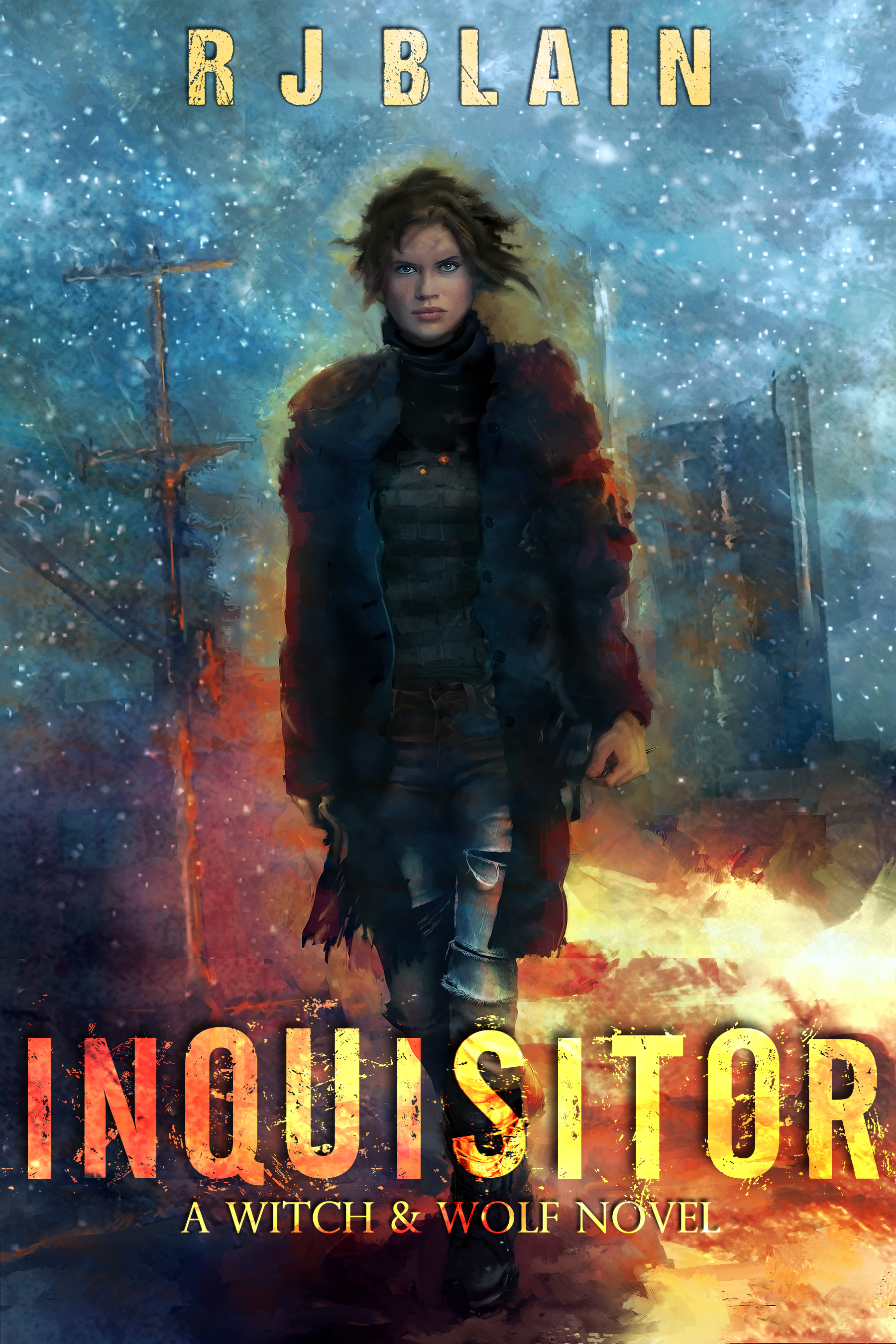
Cover Art by Chris Howard. (Seriously, this dude’s got talent.)
Today I have a guest post from RJ Blain, author of the newly released Inquisitor. There’s all sorts of goodies in this post, including a book blurb and excerpt, so I won’t be too long-winded in my introduction.
I asked Ms. Blain about how she made her werewolves different from other werewolves within the genre (since Inquisitor deals heavily with werewolves, as I’m sure you guessed) and this is her rather eloquent response …
Werewolves are one of the most frequently written about paranormal creatures in urban fantasy novels, second to the vampire. Writing unique werewolves is difficult. There are concepts that are considered appropriate for werewolves, and straying from these concepts can either confuse readers or earn the author scorn.
After all, wolves have Alpha, Submissive, and Omega ranks in the wild. It just makes sense that these variants exist in urban and paranormal fantasies. How these ranks are executed are one of the ways you can help make your werewolves become unique compared to the ones already out there.
Just remember, there’s nothing wrong with writing a stereotypical werewolf if you’re writing great, unique characters. Werewolves are a species, like humans. Look at how diverse people are.
There is no reason you can’t make your werewolves unique to you.
When I approached my werewolves, I knew I wouldn’t make a completely unique beast. After all, there are (realistically) a limited number of combinations you can use with werewolves and still make them werewolves. Most lycanthropy lore involves the stages of the moon, which adds a nice edge to the curse. Most myths and legends refer to lycanthropy as just that: a curse.
I like blending history and the myths and legends with my own take, so in order to create my werewolves, I had to research lycanthropy, history, and wolves. What sort of people would become werewolves? Why? Could my werewolves be created by choice rather than by random attack?
Those were the first questions I asked, and that’s how I started building my werewolves. I decided that the ritual needed to become a werewolf was a choice. But if lycanthropy is a choice, where did the first werewolf come from?
I then had to think about how a werewolf might come into existence naturally.
This became the foundation of my werewolf society. There are two types of known werewolves in the world: Natural born ones – wolves born to human parents – and changed ones. In Inquisitor, it is revealed there might be a third type of werewolf. I won’t spoil that, though.
Once I figured out what the dynamic between these subspecies of werewolves were, I looked at the type of real werewolves in the world, and decided that the breed of wolf made an impact on the type of werewolf created. Arctic werewolves are considered to be among the rarer breeds of werewolves, matching the rarity of their wild cousins. Grey wolves are the most common type. European werewolves align with European wolves.
The pedigree of werewolf created, I decided, would be determined by the pack transforming the new wolf, predominantly the breeding of the Alpha male and female of the pack. Because it’s a mix of the genetics of the pack as a whole, hybrids between species isn’t uncommon. Purebred wolves are far rarer on account of this, and prized by packs wishing to introduce a strong association with a specific type of wolf.
So, what’s the point of all of these details? What makes a werewolf unique in a world where there are hundreds (if not thousands) of werewolf stories is the details. The little things that make your werewolves unique to you is what is truly important.
Some things are difficult to avoid. Omegas serve a very specific role in canine packs. They serve this same role, amplified, in werewolf packs. How they do it is where the differences often lie. It is the same with submissive wolves and dominant wolves. How they function within the pack is the difference, not their specific function. If you stray too far from the natural roles of wolves within the pack, you end up with a werewolf that doesn’t feel like a werewolf.
Go ahead and write your werewolves. Just make sure you ask yourself what the details are that make them unique to you.
Author Information
RJ Blain suffers from a Moleskine journal obsession, a pen fixation, and a terrible tendency to pun without warning.
When she isn’t playing pretend, she likes to think she’s a cartographer and a sumi-e painter. In reality, she herds cats and a husband. She also has a tendency to play MMOs and other computer games.
In her spare time, she daydreams about being a spy. Should that fail, her contingency plan involves tying her best of enemies to spinning wheels and quoting James Bond villains until she is satisfied.
Inquisitor Blurb
When Allison is asked to play Cinderella-turned-Fiancee at a Halloween ball, the last thing she expected was to be accused of murder on the same night. She has to find the killer and quick, or she’ll be put to death for the crimes she didn’t commit. To make matters worse, the victims are all werewolves.
On the short list of potential victims, Allison has to act fast, or the killer will have one more body to add to his little black book of corpses.
There’s only one problem: One of the deaths has struck too close to home, and Allison’s desire for self-preservation may very well transform into a quest for vengeance…
— EXCERPT—
It was well enough our ‘relationship’ was nothing more than make-believe. Our friendship wasn’t much better off, either. Unfortunately, Mark didn’t know that. I shook my head to clear it, staring down at my watch.
3:59 pm.
I glanced eastward, at the glass-lined wall of the jewelry store I was in. Shoppers hurried about their business in the broad mall hallways, chatting to each other or talking on their too-expensive cell phones. Beyond the walls of the building, I could already feel the moon calling to me, birthing shivers under my skin. In a little over an hour, it would start to rise. I made a thoughtful sound, turning my attention back to the glass case in front of me.
It was a full moon on Halloween. Some people would don masks, confident in their superiority as a human, never realizing how close they’d tread to a very violent and bloody end. Others would remove the masks they normally hid behind, rejoicing in their one night of freedom.
A sad few would have no idea what horrors they had sowed come morning.
I was in a lot of trouble. My fellow boogeymen didn’t frighten me all that much. It was Mark who worried me. Mark, as well as the other humans he’d subject me to before the night was done. I hadn’t lost control in years — I doubted Mark’s mother had been born since the last time it’d happened.
But that didn’t change the fact that it could happen.
Old or not, I was still a bitch. Without pack or mate, it was only a matter of time before I lost control.
Mark wouldn’t stand a chance, and when I finally lost my grip on sanity, I wouldn’t even remember killing him. Why hadn’t I said no? Why had I agreed to travel to New York on Halloween? What had I been thinking?
I hadn’t been, and that was a big problem.
“Is there something I can help you with, miss?” A woman asked from beside me. I about jumped out of my skin.
Shit. I swallowed back my heart and improvised. Without really seeing the jewelry beneath the glass, I pointed at something shiny, and hoped it was a necklace. “May I see that please?”
“That’s a very expensive piece, ma’am.”
I glanced at the woman out of the corner of my eye. A pastel pink blazer was matched with a pencil skirt that showed off thin legs and knee-high black boots. Glittering bracelets clung to her wrists. “Is that so,” I murmured, focusing my attention on the piece I pointed at.
Rubies and diamonds winked at me, woven together in a Celtic knot trapped in the center of a web of delicate diamond-encrusted chains. My cheek twitched.
No wonder the woman was skeptical and eying me suspiciously. Here I was, in some luxury jewelry store poking around to waste time, dressed in a beat-up leather coat, a baggy sweater, and worn jeans, complete with mud splatter from my walk in Central park. As my luck had it, I pointed out a necklace worth more than any car or house I’d ever seen in person, let alone owned.
I felt the eyes of every customer in the store settle on me. Great. Just what I needed. An audience.
Maybe I should’ve acted more indignant. Maybe I should’ve walked away. Instead, I took out my wallet, pulled out my black platinum Amex card, and tossed it on the counter. “May I see that please?”
The sales woman stared at the card and then at me, her eyes narrowing. “Do you really think I’m going to believe this is your card?”
Half of the customers in the store cleared out in the time it took the sales woman to pick up my card.
“Is there a problem?” A man dressed in a business suit stepped forward. His blue eyes took in my clothes before settling on the black credit card in his coworker’s hand.
The woman glared down her nose at me, her gaze settling on my beat-up jacket. “I do believe we have a stolen credit card here, sir.”
The manager snatched my credit card. “Is this true, miss?”
Oh hell no. I felt my cheek twitch again. “It’s not. I’ll just take my card to a different store, then.”
“I think this can be resolved quickly and easily, miss,” the man replied. He frowned at me. “Can I see your ID please?”
I showed him my license. The manager winced. “I’m sorry, there have been a lot of theft of valuable jewelry lately by those with fraudulent credit cards and out of state driver’s licenses. This will only take a few minutes as I verify this is a real card.”
Well, at least he wasn’t going to call the police on me right away. I sighed. “Since when hasn’t my driver’s license been sufficient proof? What is this? LA?”
The totally amazing C.J. Brightly hosted me on her blog this week!
If you are thinking about writing a sequel or are currently writing one, have a peek at some of the things I’ve learned about how to do them without going completely insane.
A lot of people have been asking me about Usurper lately. Which, let’s be honest, makes me happy since it means everyone really, really likes Trenna’s stories and wants to see what happens next.
So! For this week’s post I’m going to go ahead and give an update on where I am and … because everyone has been so very patient … I’ll include a snippet at the end.
I am right at the end of Usurper. And I do mean right at the end.
All the pieces are in place. All the characters have made it to their destinations and are gearing up for the final battle. All I need to do now is finish that final battle. But battle scenes take the longest for me to write.
They’re also my favorite bits to write, but they still take the longest because it’s hard to bring clarity in the middle of swords clashing, people screaming, and wounds being inflicted. Every character has a different set of motivations that become all the clearer amidst bloodshed — remember the end of Sedition?
I will have Usurper’s draft completed by the end of April. It will go in to my publisher/editor people on May 1st. After that, we’ll be waiting on the publisher and all that jazz, but this publisher tends to be very quick about getting things done so … Yes, you will (should, most probably) have Usurper in your hot little hands before 2015.
But I should warn you … there’s a lot of action in this one. Trenna’s back at her prime and getting her hands dirty.
Well … see for yourself … (Please remember, this has not been edited yet. Any and all grammatical errors are the hazards of the craft.)
She spotted the assassin first. Sitting at the table nearest to the hearth, Faxon Mylonas was profile to her, looking almost exactly as he had twenty-odd years prior. Trenna felt real fear curl in her gut at the sight of her son and husband sitting near the man, but her anger overtook that emotion when she spotted Troy. Trapped between the assassin and a woman whose occupation could only be that of a Blood Mage, Troy’s eyes were puffed and swelling and he was holding a bloodied handkerchief to his face.
Liana was moving before Trenna could stop the girl. She saw Faxon tense and knew he was preparing for Liana’s advance.
“Big T, thank gods,” Barmy stood from his stool. “I tried to warn them …”
“Thank you, Mister Friggs. May I borrow your stool?”
“My stool?” Barmy’s face creased in puzzlement.
Liana drew her cutlass, which sent a hiss of alarm through the already tensed room.
“Well, yes, I suppose …” Barmy stopped when he spotted Liana’s advance, gasping with further horror.
“Thank you.” Trenna grabbed the stool and started forward. She waited until Faxon stood, until he had his full focus on intercepting Liana, before she flung the chair over her shoulder with all her might.
It struck the Blood Mage on the side of her head, startling everyone at the table. Trenna took her advantage and rushed forward. The red-headed Mage fell against the table, dazed enough that she wasn’t prepared for Trenna’s second assault. She got to the table before the mage could find her wits, grabbed a fistful of spiky red hair and slammed the woman’s head into the hard, pitted surface.
With the flick of her wrist, Trenna snagged the dagger from her belt loop and held it to the unconscious woman’s throat in clear warning.
Faxon didn’t move. Whatever attack he’d planned against Liana had ceased and his wild, golden eyes fastened on Trenna. Nelek, Kaden and Troy had moved during the attack. Nelek stood with the boys flanking him, not entirely out of harm’s way, but at least they’d have a sporting chance now. Liana’s advance had been stalled as well. Trenna saw her slide toward Troy.
“Hello, Trenna.” Faxon still didn’t move. “Nice to see you haven’t lost your civilized touch.”
(And to answer … yes, I mean the Faxon you met in Sedition.)