Tag: Historical Fiction

  • Birthday Shenanigans and Release Buzz

    I know, I know. I probably should have mentioned all the birthday shenanigans over the last week but … Hey, I was busy doing fun things.

    Like visiting Craters of the Moon and going to the movies and eating steak and having pie. (I maintain that pie is better than cake.)

    But in the middle of all of that, I also have been reminding people about Persona’s May 1st release date. 

    Persona took me over a decade to write.

    That’s right, over a decade. I started writing it when I was 19-20 years old and then life happened and I stopped writing and while this could have been considered a “trunk novel” … I just couldn’t let it go.

    If you’re not familiar with the concept of a “trunk novel” I’ll go ahead and explain. You see, there are many professionals out there who say you need to write a couple of novels to get the feel of storytelling and learn the mechanics of the writing craft. These beloved little first creations are known as “trunk novels” because they are supposed to be buried inside a trunk and never see the light of publication.

    The general consensus seems to be 5 trunk novels, with the 6th novel you write coming close to publication quality. And once those five are written, you bury them and/or burn said trunk, thereby assuring that your terrible first-tries never tempt you into touching them again.

    Persona, whose title underwent many changes over the last decade, would have been my 2nd attempt at novel writing.

    Now, I’m not vain enough to say that the early drafts of this book were any good. In fact, they were awful. So very, very awful. And if I were going solely on the plot concept, this book would have been burnt with the other trunk novels.

    But … Megan was too compelling a character for me.

    She is an independent, strong character without moving into the cliches of the woman-warrior. In fact, she doesn’t fight … not physically, anyway.

    Her choices are what make her strong.

    So, back in 2013, I decided to pick her up again. While I kept the novel based in WWII, 98% of the plot was altered. I kept only Megan and a handful of characters from the first work, which I imagine means I burnt the trunk novel after all.

    I’m not sure what I did here could be considered a “rewrite” given how much of the story changed. Still, her beginnings were in my youth and I remember those first attempts with a great deal of fondness.

    Writing Persona taught me quite a lot about being an author. I learned to cut things I held dear and to dig deeper into the minds of my characters – even the ones I never gave a true voice in the work.

    I am proud of Persona, both because I love the story and because it is a clear map of my improvement as an author. I hope many other people can be inspired by Megan’s journey to understand herself and the world around her.


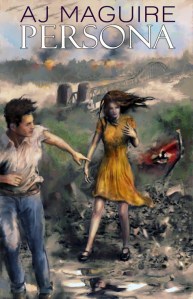
    AJMaguire-PersonaCoverArt-ChrisHoward_rev28_ART_ONLYNothing is more important than who you choose to be, and for Megan Shepherd that choice has never been more important or more terrifying. In the middle of WWII, her ship is sunk in the Atlantic and all of her hopes and dreams for a new life translating papers for the JTLS in Britain sink with it. When she’s picked up by Germans she discovers that her understanding of the language is the only thing keeping her alive.

    While under the scrutiny of the local SS, Megan’s plot to escape the country is derailed when escaped POW Sam Layton lands on her doorstep.  As the Allied Advance begins to box in the Third Reich, Megan and Sam make a mad dash for the Swiss border. But the truth never stays buried for long and those Megan has tricked are out for vengeance.
  • Fact vs. Fiction – Historical Novels

    Persona is my first attempt at the historical fiction genre and while I love history, I found writing within the confines of known facts difficult. This isn’t too surprising given all my other novels are fantasy or science fiction, but it was still an eye-opener for me.

    Take, for instance, the very first chapter of the novel.

    Without giving too many spoilers, I can tell you that my main character – whose name underwent several changes throughout the editing process – is traveling to England. Young Megan Shepherd couldn’t stay home, not with her father breathing down her neck about the engagement she just called off, so she answers the call to help translate papers for the war effort in Europe.

    The very first version of this novel had Megan in a big, noisy, military airplane.

    Said airplane was shot down. There was a lot of action in that first chapter. It was exciting and fun and I loved it.

    But …

    Given that Megan is not in the military, she would not have been on such a plane. And even if she had been in the military, they did not often fly personnel like Megan to and from their respective workplaces.

    SO … I had to change it.

    Thus, the opening chapter of Persona has Megan on board a boat – the SS Ceramic.

    And yes, that’s a real boat. I know the name is a trifle alarming. I’m not certain I would have boarded a boat called Ceramic, but it existed and it became one of the wonderful things I learned about while researching for this book.

    Still, this serves as an example of one of the things History made me change about the novel. While I was able to stretch a few things elsewhere in the book or gloss over some of the others, I couldn’t risk losing the reader’s trust in the very first chapter of the novel. I had to find an alternative, something to show that I really had done my homework and that I was going to be respectful both to the history I was working in and to the reader’s intelligence.

    I admit that historical fiction feels like more of a gamble to me than many of the other genres. When we’re dealing with science or fantasy, readers automatically walk into it with the sense that they are going to “suspend disbelief” for a portion of the book. They accept that they are walking into the fictional world and want to see what we can make of it.

    Not so with historical fiction, and especially not so with something as well known and documented as World War II. While I need the reader to suspend disbelief a little, to accept that Megan Shepherd is not a real person, many of the events she walks through ARE real. And I had to treat them real.

    Because people died there.

    A lot of people died there, actually. And to treat it with anything less than the utmost respect would have been wrong.


    Persona is scheduled to be released on May 2, 2017


  • The Countdown

    I am now exactly three months away from Persona’s publication date.

    What does this mean for me?

    AJMaguire-PersonaCoverArt-ChrisHoward_rev28_ART_ONLYWell, it means a lot of work, actually. I have a list of things that need to be done like … hunt for virtual space (AKA – look for people online who wouldn’t mind me commandeering their blog/site for a day) and prepping advertising spots and getting reminder letters ready for all the wonderful people who agreed to advance review the book and … so much more.

    SO. Much. More.

    Side Note: Thank you so much to all of my advanced readers. I’ve heard from most of you already and I really, really appreciate the time it takes to sit down and read a book these days. You’re all awesomesauce on toast and I uber love you.

    What happened to the Kindle Scout Campaign?

    As predicted, this was not the right fit for me. Kindle Scout is made for people who really don’t mind shouting over and over and over again that their book is up and needs votes. I am not that sort of person.

    Granted, if I were that sort of person it is entirely possible that I would sell a lot more books. The tactic seems to work very well for a lot of people. For my part, I cannot justify being that much of a pest. And if I spend all my time promoting, I get no writing done. (I am a single parent. My time is limited.)

    Having re-read the manuscript hunting for any last-minute errors and the like, I have to say that Persona is a favorite of mine. While I may have bemoaned all the research I had to do writing a historical fiction, it is still one of my favorite stories. Megan is a gentle hero, which I believe to be one of the more common and less noticed heroes in the world today.

    In any case … the countdown has begun! Three months and two days and this novel will finally be out for sale. It’s been a long but very satisfying road to see it get to this point and I’m excited for the next step.


  • Kindle Scout

    Alright, so we’re sort of in a mid-way point with the Kindle Scout campaign for Persona and I figured I’d do a little update to give you the sense I’m getting of this thing.

    If you didn’t know already, I’m pretty awful at marketing.

    Let’s just be honest with that one. I’d rather go to the dentist and have teeth pulled sans Novocaine than market myself. I do the bare minimum by announcing book releases and sales on FaceBook and here on this Blog.

    I don’t know why that is, it just is, which makes this Kindle Scout campaign significantly harder for me.

    Why?

    AJMaguire-PersonaCoverArt-ChrisHoward_rev28_ART_ONLY
    Cover Art by Chris Howard, who is absolutely amazing.

    Well, because if you want to win this campaign, you’ve got to market it. You have to blast your friends, neighbors, strangers on the street, EVERYONE with news about the campaign for the entirety of the 30 days your stuff is running.

    30 days of me shouting to check out my campaign and please, please, pretty please vote for it?

    Yeah, no. I can’t do that.

    It’s not that I’m not confident in Persona.

    I love this book. I love where it started and I adore where it ended. It is a solid book. My style has grown and my understanding of the craft has become such that I know it’s better than anything I’ve written in the past.

    So it’s not that I don’t think the book is good enough to be marketed. It is. It really, really is.

    The problem is that, in our virtual society today, shouting at everyone for 30 whole days to nominate your campaign is … well … rude.

    I know I get annoyed when someone is telling me the same thing over and over again. That little snarky judge that needles at my brain says; “Geez, vain much?” Or … “Ugh, I heard you the first time.” Or … “There’s a fine line between confidence and arrogance, my friend. Be careful cause I think you’ve crossed it.”

    She’s a mean voice. I really try not to listen to her.

    But she’s also a voice that I’m pretty sure exists in everyone’s head. So if I’m thinking that about other people … well … Obviously other people are going to think that about me should I start following suit.

    Which leaves us to the problem at hand …

    How do you market a Kindle Scout campaign for 30 whole days, keeping it fresh in everyone’s heads while not becoming that annoying, arrogant voice that everyone wants to shut out?

    …….. I have no idea.

    But then, I also have no idea how to really market my books either. So if you, brave author, already have a marketing plan in place and know how to use it, then Kindle Scout might actually work for you.

    Because I’m like … 95% sure it’s not working for me.

    Doesn’t mean I won’t try it again in the future, just means that next time I’ll know what I’m walking into and how to prepare for it.

    Oh … and … um … here’s the campaign again. (See? Told you I was bad at this.)


  • Prepping for Launch

    Gutter space and margins … check.

    Cover art … check. (FYI, Chris Howard is still a genius.)

    Back blurb … hmmm … that’s gonna change a couple more times, I’m sure.

    (Pause to remove new kitten from the desk. He’s too curious for his own good and he’s constantly attacking my hands while I’m using the mouse. I’ve decided to call him Nuisance even though he’s my son’s pet.)

    Font size and spacing for both print and ebook versions … check and check.

    Re-read the manuscript for the zillionth time and STILL find a typo on page 96 … ugh, check.

    Dedication … aw, that’s easy … totally check. DSCN5894

    Acknowledgements … er … hmn. That one’s a little more tricky. I’ll probably add a few people before the December launch date.

    IMG_0051(Pause again because kitten is now attacking my ankle and his little kitten claws hurt. Try to convince him that he should be playing with Pest, my cat, who eyes me with frank disgust but … everyone’s gotta compromise here.)

    Go back to my regularly scheduled writing … I’m on chapter 10 of Dead Weight now, so it’s coming along nicely. I’m not sure I’ll make the three month deadline for a first draft, but I’ve had to swap between writing on the computer and writing by hand a couple of times so I won’t feel bad if I stretch it for another month.

    Four months to write a rough draft isn’t too bad.

    And really, I’m not JUST writing a rough draft, as evidenced by all the book preparation I’m doing. Persona will be my second attempt at launching a book on my own and I’m trying to remember all the mistakes I made last time — such as working while under the influence of cold medication and accidentally launching the book 2 weeks early.

    And forgetting to adjust line spacing for the print version, leaving one truly massive novel that cost an arm and a leg to ship.

    And not justifying the text.

    And … er … so many other things.

    Here in the next couple of weeks I’m supposed to start marketing for Persona, letting people know the exact date it will be out (December 6th 2016) and what the book is about (historical fiction/romance/women’s fiction/ … this one I probably need to narrow down a bit more).

    Which means that, on top of all of the above, I have to research venues (blogs, magazines, etc.) that might be willing to host me and give me a second to promote the novel before it comes out and during the first two weeks of its launch.

    … I think I’d rather have the kitten attack my ankles some more.


  • Missed Deadlines and Fighting the Muse

    I know there are a lot of writers out there that just go with the flow, throwing out however many words a week at sporadic intervals, relying on their Muse to get them through.

    Wait, you actually thought you'd be writing today?
    Wait, you actually thought you’d be writing today?

    I envy these people. I imagine their Muse sitting right beside them, nagging them at all hours of the day to get their work done because there’s sooooo much more to be done.

    My Muse …

    My Muse is that fat, lazy cat licking herself in the corner. She really couldn’t be arsed to move herself, let alone nag me about anything. If I relied solely on her, I would never get anything done.

    So I have to make deadlines. Deadlines motivate me, force me to go to the corner and pick up the lackadaisical Muse and pester her until something resembling a plot starts to show up. This is why first drafts take me so long and why editing has become my favorite thing ever, because editing relies more on style and craft than it does on my capricious Muse.

    This is also why a missed deadline drives me to hiding in a make-shift couch fort, gorging myself on chocolate.

    Now then, I have missed several deadlines for Persona. At first this was because of the Great Avocado Incident of 2014 wherein I managed to stab myself through the hand.

    Yes, I really did that. Yes, I lost feeling in three of my fingers on my left hand and the Doctor’s weren’t sure if I’d ever get it back. It was awful, I tell you; awful.

    However, it is now nine months into 2015, I have full functionality with my left hand (hurray!) and I have still managed to miss nearly every deadline I’ve given myself with Persona.

    Why?

    Several reasons …

    1. Because I missed the first deadline.
    2. Because I MISSED THE FIRST DEADLINE.
    3. Because life happens sometimes and there were family issues I needed to attend to.
    4. BECAUSE I MISSED THE FIRST DEADLINE.
    5. Because this is the single hardest piece I have ever written.

    I think you get the point. While there were other elements that got involved here, the main problem is that I let that first deadline slip away from me. I lost my momentum, my drive, and it took forever to get it back.

    So if you’re like me and your Muse is a fat orange cat whose back is constantly turned to you, make deadlines.

    And then KEEP those deadlines. Your couch fort and chocolate will only sustain you for so long.

  • Working with Historical Timelines – Persona Version

    WWII is heavily documented. I have volumes and volumes of historical content that have helped me better understand how and why events took place throughout the war.

    No, really. Volumes.

    I also have several Documentaries on DVD which have helped shed some light on the timeline forAJMaguire-PersonaCover-1280h Persona and the general feel of what was rationed and what was needed and how transportation worked and …

    You get it.

    All this history is wonderful. I love history. It makes me all giddy inside to research it.

    The feeling I get when I find something within my research that perfectly fits the story and adds another level of authenticity is … Well, it’s better than a stack full of York Peppermint Patties. (And I do so love York Peppermint Patties.)

    I also hate history.

    Discovering something in my research that contradicts the story-line I’ve created is frustrating to the extreme. I research as I go, so there tends to be a lot of revision precisely because of this.

    Example: 

    The original opening scene for Persona had Megan on a plane. But it was discovered that planes were generally only used for transporting military personnel and often the wounded for relocation, so it was more likely that she would have been on a passenger ship.

    Insert weeks of research hunting for a passenger ship that, for plot purposes, had to be sunk. Eventually I found the SS Ceramic and there was much rejoicing.

    Today I find myself in a similar pickle. The outline that I have ends Megan’s story on a very particular date because (without going into too much detail and spoiling the whole book) things happened on that date, in that place, and it brings her story a certain sense of cohesion.

    However …

    That date is several months away from the current chapter.

    There are a couple of ways I can handle this and, as an author who really, really doesn’t want to miss another deadline with this particular book (seriously, I’ve passed several of them already and I’m not even sure why. I’m normally very strict with deadlines) I need to make my mind up by Sunday.

    1. I can rearrange the timeline of the whole book, extending Megan’s stay and bringing things closer to what I want. (Not a bad plan, though a moderate amount of work.)
    2. I can slow this chapter down, be all artsy-crafty-clever with the passage of time. (I’m not very good at this sort of thing, though. It’s an area I need to improve on.)
    3. I can ignore the historical timeline. (I don’t like this plan. I did all the research for a reason, after all.)
    4. I can stretch out the inevitable scenes at the end (which I can’t explain for fear of spoiling things) and lengthen Megan’s time in a very bad place. (Not sure I like this plan either because it draws out the tension too much at the end.)

    So many choices. 

    As an author these sorts of problems happen all the time. And I imagine when I tackle my Civil War story (likely sometime next year) that I’m going to have a lot of these timeline problems show up.

    The core of the issue is that I want to have that authenticity, the reality of what happened integrated seamlessly into the work, but I also want to tell Megan’s story. Megan is fictional. Her story is about who she is as a person, not what happened during WWII.

    With that in mind, option 3 becomes more visible. Although I’ve done the research, the research is not the book, and I think that’s really what I have to keep in mind here.

    Megan is the story.

    As the author, I have to decide which option tells her story best.

  • Historical Fiction and the Suspension of Disbelief

    When I first made the decision to try my hand at historical fiction I knew there would be a lot of research involved. But since I find WWII fascinating I imagined this would not be such a big issue for me. And it wasn’t. I enjoy hunting through history to find little tidbits that I can put in my fiction.

    That being said, I recognize that the opening chapters of Persona require the reader to suspend disbelief in a major way. While the SS Ceramic was a real ship that was sunk by a German U-Boat in December 1942, Megan Shepherd is a fake creation and her survival of said sinking is absolutely made up.

    That isn’t so much where the suspension of disbelief comes in, though. It’s when she’s picked up by the enemy and said enemy doesn’t immediately ship her off to a work camp somewhere that I know I’m walking a very, very tight line.

    There’s a part of me that keeps suggesting I scrap the first few chapters and have Megan already in Germany when war breaks out. That would take care of the belief problem. She was in Germany, the war began. Borders closed. She was stuck.

    But when push comes to shove, this book isn’t really about WWII. It’s about one woman having to decide who she is. WWII is just the vehicle by which she arrives at her decision making point and what better way to start her on that journey than by making the war very vivid and very real right up front?

    Historians and such might murder me for it, just like scientists would likely enjoy stringing me up for the space travel I created in Tapped and Deviation, but this is just one of those places where my instincts are telling me I need to bend the rules a bit.

  • Research as a Writer

    Writers are really life-long scholars. Sure, we get to play around in fiction and make up rules in our fantasy worlds sometimes, but when push comes to shove we are constantly having to “Google” one thing or another. Whether we’re researching words (Hello, online Thesaurus) or we need to find out just how far away Pluto is from Earth (NASA has a really cool site for that) the research of a writer never seems to be done.

    With each book comes a new set of questions, new things we need to know to make the novel believable because the last thing we want to do is insult our readers.

    Science Fiction authors find themselves having to explain gravity on a ship. Historical Fiction authors need to know their time period well enough to keep readers rooted in the story. Crime writers need to know police procedure and proper investigative techniques. And the list goes on.

    The bottom line is, if you’re a writer then you’re a researcher too. There’s just no getting around this work.

    Now, I’ve heard horror stories of authors who get lost in the library, researching so much that they never actually start to write the story. When I started my first historical fiction (Persona) I was seriously afraid of this happening.

    I absolutely love history. It would have been easy for me to get sucked into all the facts and true stories about what happened in WWII and I knew it. So I made a list of rules for myself before I started the project and, because I’m about to start my second historical fiction (The Abolitionist) in November, I thought I would share those rules today.

    1) Write the Character First

    Before I did any research I had to have my main character firmly in my sights. With Persona this was Megan Crossweathers, and I wrote the entire first chapter before I began researching. Now, I did have to go back and edit that chapter quite a bit after I’d done my research, but that first chapter helped me ask very specific questions for my research.

    Example: After writing that first chapter I knew I had Megan on a boat that was about to sink. So I researched boats that sank until I found the S.S. Ceramic (No, really, that’s its name) which sank right about where I needed it to and had only one reported survivor. 

    2) Know What You Need

    I’m pointing to the first rule up there “Know your character” again because if you know your character and the story you’re meaning to tell then you won’t get lost in a sea of information as you’re writing. As much fun as it is to learn about history (or science or crime or whatever your passion is) there’s only so much that’s actually going to be useful.

    So, you need to know what you need.

    Example: During my recent editing of Tapped I found my characters walking on Pluto. (The dwarf planet, not the Disney character or the Roman god of the Underworld.) In order to do that I needed to know the climate of the dwarf planet (which is very, very cold by the way) and the terrain and … you get it. 

    Generally speaking, you come up with these questions as you write which brings me to my third and final rule …

    3) Keep Writing 

    Many things constitute as research in my book. Preparing for The Abolitionist, I’ve begun watching movies centered on the Civil War (just watched Gettysburg this weekend) and gathered documentaries which I will slowly begin to consume. These help me two-fold because documentaries let me get my learning on (I totally love The History Channel) while also seeing the styles (hair, clothing, weaponry) right in front of me.

    Here’s the thing …

    All that information is useless unless I have someplace to put it. And I’ll never find a place to put it unless I’m still writing.

    So for every hour I spend watching a documentary, I have to spend an hour writing too. Sometimes I start the day writing and then watch a documentary, other times I watch first and then write. Either way, I’m researching as I go.

    Disclaimer

    I’m one of those bizarre hybrid writers who can never start a novel with an outline. The first dozen chapters are what I like to call “cause and effect” writing, which presents the character and a particular problem and then watching said character try to resolve that particular problem. But I can’t finish a novel without an outline either.

    By the middle of the book I have a firm enough grasp on the character, theme, and plot of the novel that I can write a sketchy outline to help me reach the end. I call this “Muse Central” because I go about a week or so where I don’t write anything on the novel itself, but instead let my Muse take control to write the outline.

    These are just my rules. It’s not a “one size fits all” thing here.

    Authors who like to have an outline from the get-go probably won’t benefit here. Discovery writers (writers who don’t use an outline) might.

    Maybe.

    I don’t know. I’m really just winging it here. These are rules that helped me and on the off chance that they might help someone else, I decided to share them. Writing is a craft, after all, and no one way is going to work for everybody.

  • The End & Thoughts on Serializing Novels

    Well, Persona is finished.

    Or at least a draft of Persona is finished. Here in the next couple of weeks I’ll be searching for an appropriate editor to go through it, and then I’ll edit and edit and … edit some more.

    Until then, I’m in celebratory mode. I’ve got Nantucket Dark Chocolate cookies (from Pepperidge Farm) and I intend to go see Thor 2 at some point over the weekend. I highly encourage everyone to do the same … If not go see the movie, then at least get some cookies.

    It has been quite a journey since June. For those of you who remember or were following along, I started serializing Persona on Wattpad and its own story blog back in June and I posted one chapter per week until … well … until this week.

    So for a little over five months I was committed to drafting a chapter, revising a chapter, and posting a chapter every week. This was, as you can imagine, quite a hectic schedule for someone who already works full time, goes to school full time, and is a single parent.

    Still, it was fun.

    I enjoyed the interaction with readers and I liked the challenge of the schedule (at least at first.) When school starting taking over the bulk of my time I found myself having to be far more lax with the revision portion of the week than I wanted.

    The original plan was to have a blog post once a week with the research information I’d had to look up, but eventually I had to let that go in favor of just getting the next chapter written. I do intend to fix that.

    In fact, after Persona has been properly edited and I can release it as a full book, I thought I’d go ahead and make a “Fact vs. Fiction” edition that will take the chapter by chapter research I’ve done and put it down as a sort of weird appendix thingy.

    So! In reviewing the last five months I can say that I truly enjoyed this process. I’ll probably do it again in the future — after I graduate and preferably with an already completed novel. (Persona was a re-write, and I ended up only using 2 of the original chapters I had written.)

    Also, as a reader myself I can admit that I prefer to have my books all at once. And I know I’m not the only one because there were many people who let me know they wanted to wait until the whole thing was up before they read it. There are even more who want to wait for the physical copy to be available.

    Which, I think, just goes to show you that readers come in all shapes and sizes. Some like the chapter a week approach because it fits into their schedule better. Some like to race through a book over their weekend. Some like to use their Kindles, Nooks, and iPad’s, while others want the feel of paper in their hands.

    I know there are lots of debates about the publishing industry and what books are going to look like in the future, but I think many of these marketers and such are forgetting something very important; there is no one-size-fits-all box for readers to fit in. We are as varied and unique in our reading habits as we are in our personalities.

    For everyone who read Persona on a weekly basis — I uber loves you all! Thank you for sticking with the story for so long!

    For everyone who is now reading it on their digital devices — I uber loves you all! I hope you enjoy Megan’s story and hope to hear from you. (Here is the link, just in case you need it — Persona.)

    For everyone who is waiting for the physical copies — I uber loves you all! I promise I’ll work hard to polish the manuscript and get it to you soon.

    Now, I’m going to run off and keep plugging away at my NaNoWriMo project. With any luck, I’ll actually win this year!