Tag: Novel

  • Making Time to Write

    Between work, school and being a single parent I’m told that it is impossible for me to have the time to write as well.  And I suppose for a lot of people that might be true, but the sad fact of the matter is that I just can’t function properly without some story going on inside my head.

    I call it my “back reel” — that weird, unidentifiable space in my brain that is constantly collecting story ideas, running through plot fragments, snagging hold of a stranger’s face for use in a description and … well … pretty much always driving me insane.  The point is, it’s always running and if I don’t get it out on paper I think I could explode or something.

    So how do I write while attending school, working full-time and being a parent?

    Well, the first thing I do is listen to music at work.  Right now I’m rocking the Pacific Rim soundtrack because it totally revs me up for the edit on Tapped I’m going to be doing here in a few weeks.  I haven’t actually started on those edits, but I do keep some paper nearby for any instant inspirations that hit me.

    Now, I’m lucky enough to have a job that allows me to put my headphones in and pretty much ignore everyone else while I get my work done.  This gives my muse plenty of space to run in and by the time I get home and the kiddo in bed I’m ready to start writing.

    Yes, I do the writing thing before I do my homework.  I have to.

    If I didn’t do it this way I’d be distracted from my homework.  Plus, it gives my brain a chance to acclimate from the work scene to the home scene.  So by the time I’m done with my writing hour I’m ready to do my homework.

    After I’ve gotten up and done some dishes, swapped out the laundry and checked on the kiddo, of course.  And at the very end of the night, when the homework is done and the writing is carefully tucked away, I watch something.  That’s what gets my brain to stop thinking so hard so that I can get a good night’s sleep.

    It amuses me when someone says they really want to write but don’t have the time for it.  To be really harsh about it, they’ll never have the time to write if they continue to think like that.  You have to make it a priority.  Once you do that, you’ll find a way.

  • Round Robin – How I Unwind

    This month we’re talking about what we do to unwind in our Round Robin!  Which is really a fun question to answer because I do all sorts of things to refresh my creative mind.

    At the risk of sounding like a nerd … Well, I am a nerd, so I guess there’s no hiding it … I totally play Star Trek Online.  This game is immensely helpful when I need to get into the science fiction groove without actually writing.  (Though the writer in me has to question some of the things they make us do there.  Such as the control panel for a shield device sitting right next to the shield you want to take down.  I mean … smart money is on putting the control panel on the inside of the shielded area so the enemy can’t get in.)

    I tried playing Star Wars Republic but it just didn’t have the same feel to it, you know?

    When I’m in the middle of a fantasy novel and I need to unwind, I’ll play Dungeon Siege or Arcanum, depending on the level of my frustration.

    Oh!  And I have a ton of Dungeons & Dragon’s manuals that I’ll flip through for ideas.  The pictures alone set my creative mind to buzzing.  (I know, my nerd-factor just rose by about ten notches, didn’t it?)

    I go to the gym every other day — when my car is working — or enjoy time with my son at the park, but I don’t really consider those “unwind” moments.  Jogging is for my health and time with my son is for my soul.

    Still, I have noticed that my writing is clearer and my creative muse more willing to get to business when I’ve kept my exercise schedule and had time with my son.

    And, of course, there is the ever-ready movie to watch or book to read.  But I tend to view movies and books as investments since I’m always learning new and better ways to tell a story through them.

    That’s it!  Those are the things I like to do when I need to step back and relax.  Thank you for joining me and I’d like to encourage you to take a look at what author Ginger Simpson does to unwind as the Round Robin continues.  Here’s her link!  http://mizging.blogspot.com/

  • Writing In A Different Genre

    I am primarily a Fantasy and Science Fiction author.  The three books I have out for sale right now are all fantasy and I do have a science fiction scheduled to be released next year.  So when I started work on my historical fiction novel Persona I felt like a fish out of water.

    Suddenly moving shadows had nothing to do with lurking monsters.  And the idea of genetic enhancements stretching the limitations of the human body wasn’t an option.  Suddenly I had to deal with real people, real problems, and real settings.

    To make matters worse, I chose to limit my point of view character.  Normally I write within two or three characters, but in Persona I limited myself to just one, just Megan.  Because I wanted this to be a “Who am I?” story I wanted the so-called camera lens to be focused entirely on Megan as she struggles through Nazi Germany.

    And these were the best decisions I could ever have made.

    Let me tell you what I’ve learned about the writing craft through this experiment.

    1) My other writings are severely lacking in setting.  Yes, you can see some imagery and I give a sketch of what you’re looking at, but the settings in my other books don’t have the character that it should.

    2) I have learned how to reach deeper into the personality of a character through Megan.  By limiting myself to Megan I can now see how very vague I’ve been with other characters.  (Even my beloved Trenna, though I think she’s purposefully private in many matters.)

    3) The use of a theme-based outline has been supremely enlightening.  Rather than just following the plot to its conclusion, this outline has been able to focus my writing on Megan’s journey to self-discovery.

    I’ll use an example from this weeks posted chapter.  We’re in chapter seven and Megan comes home to find a POW hiding in her bathroom.  That’s all plot and action.  My outline goes further to the main question of the scene; What will Megan do with this man, and what does it say about her when she does it?

    There are more practical issues that I’ve learned during this process as well, most of them having to do with taking ownership of the story and my craft.  But the main thing I want to say is that this decision, to write something outside of my comfort zone, has been incredible.  I highly recommend any author to try it.

    Pick a genre outside of what you normally write and commit yourself to it.  If it’s just a short story then that’s fine, the point is to look at how writing within this new genre is different.

  • Fact vs. Fiction – Chapter Five – Persona

    Well, I hope everyone in America had a fabulous Fourth of July.  I think it’s fairly obvious that I took some time off last week since I didn’t even put up the Fact vs. Fiction page last week.

    And since Chapter 6 goes up bright and early tomorrow morning I figured I’d better get this done.

    So!

    Fact: Ulm Minster is a real place.  Here … take a look …

    250px-UlmMinster0042
    Thank you, WikiPedia.

    Fiction:  VanBuren’s house, like VanBuren himself, is completely made up.  To be honest, I sort of envisioned the Von Trapp family home from Sound of Music when I was writing this.

    I love The Sound of Music.  I watched it religiously as a kid.  My parents say I watched it and Mary Poppins over and over again.  Much like my son watches Lego Ninjago now.  

    Fact:  You’ll notice the name “Gunter” has a cool little accent over it sometimes.  That’s the umlaut and it alters the pronunciation of certain vowels … such as “u”.

    We can thank my German teacher for that little tidbit staying with me.  However, you’ll also notice that I don’t always use it.  That is because this particular chapter is one of the ONLY chapters that even has a fragment of the original text in it.

    Honestly … I couldn’t remember how to put the umlaut on there again.  (It’s alt +0252 according to my research just now.)  And since I already changed vernacular like “Frauline” to “Miss” for my primarily English audience, I figured it was unnecessary.

    Fiction:  The town of Ulm itself has been described based off pictures I reviewed recently.  That means these pictures are of New Ulm, which had to be completely reconstructed after WWII thanks to a bombing that happened at … uh … um … NO SPOILERS!

    If you know you’re history then you know when it’s coming.  If you don’t, then I’m not going to spoil it for you.  Suffice to say, I picked Ulm for a reason.

    But anyway, I have no idea what Ulm actually looked like prior to the bombing.  So the description there is primarily fiction.

  • Fact vs. Fiction – Chapter Four (Persona)

    All right!  Just a quick heads up for anyone who doesn’t know what this is about … My WWII story Persona is being serialized and posted online for free via Wattpad and its story blog.

    Because this is historical fiction I’ve had to do quite a bit of research to help me wade through it.  I know I’ve only touched the surface of what I should know about that time period, but in the meantime this is what I’ve got so far.

    Fact vs. Fiction – Chapter Four

    Fact: Vernacular … you’ll notice VanBuren called Megan Frauline Vonclese in Chapter Three, but here in Chapter Four I’ve dropped it to call her “Miss Vonclese”.  I did that on purpose.  As I’m writing primarily for an English-speaking audience — I speak English, I write in English, I understand things in English — I thought it best to help equate what ‘Frauline’ means roughly in … you guessed it … English.

    Way back in Chapter Two I used the word “Nein” as well, because I wanted to make it clear who was plucking her out of the ocean.  I use German sporadically throughout the book but don’t want to frustrate readers with too much of it. (Remember, I’ve got a primarily English-speaking audience.)

    Fiction:  I don’t go into too much detail with the port authority and everything.  This is for two reasons; one, I’m really not familiar with how the Nazi party would have handled this particular situation; and two, VanBuren is rich enough to circumvent the normal processes anyway.

    However, it’s safe to say that if Megan were a real person and had somehow been rescued by a German vessel in the middle of WWII, she would not have been show this much lenience.  She’d likely be sent to a camp somewhere to wait out the war.  I acknowledge this and then point emphatically at the word “fiction”, asking for … well … some suspension of disbelief.

    Fact:  Frostbite!  This was actually researched for Chapter’s 3 & 4 due to Megan’s lengthy stay in the water.  I learned that, in the event of frostbite, you actually have to keep appendages (such as Megan’s poor feet) in water and slowly acclimate them to warmth over a period of time.

    Also, those parts of the body that have suffered frostbite cannot be used until they are completely healed.  (Which explains why Megan was in bed for all of Chapter Three.)

    Having never suffered frostbite myself, I am only imagining that two to three weeks after the injury Megan would still feel some tenderness on her rescue toes.  Especially given she hasn’t actually been allowed to walk for much of that time while the feet were healing.

    Fiction:  The bakery scene.  Honestly, I’m not sure how good Wilhelmshaven looked after the 1941 bombing of the port town.  I’m not certain they would have kept a bakery open in such a targeted area during the war.

    But I needed a place for Megan to meet up with Schuler.  It’s possible that I could alter this scene in a future revision to show Megan and VanBuren making their way to the train depot instead.

    Author’s Note:  Now that I look at it, the depot does seem like a better place to send her.  I will likely change it. 

  • What I Love to Read – Round Robin Blog Post

    I have boxes of books everywhere in my apartment.  Some are hidden in my closet, some in the storage unit outside, and there’s even one under my bed.  I normally rotate the books on my shelves twice a year just to keep my library choices “fresh”.  So it goes without saying that I love to read.

    When I visit the bookstore I tend to linger in the fantasy/science fiction section.  (That makes sense since I am primarily a fantasy/science fiction author.)  There’s just something about walking on another planet that appeals to me.  I love seeing familiar things made unfamiliar.

    Like dragons, for instance.  How many different variations of dragons are out there now?  Eragon gave us a feathery version, The Smoke Thief gave us a strange misty-version, and there was one I read a while back that had a really cool wyrm hiding in the center of the earth.  (Forgive me, I can’t remember the title of that one.  It’s in one of my buried boxes and I won’t get it out until October.)

    But as much as I love science fiction and fantasy, I also love Ken Follett and all his World War II books like The Key to Rebecca or The Eye of the Needle or, my particular favorite, Jackdaws.  Mr. Follett has a real grasp of strong, complicated women.

    Oh!  And I can’t talk about my favorite books without mentioning Diana Gabaldon and the Outlander series.  Those books let me walk in another time and really breathe life as it once was.

    And finally, when I want to laugh and escape for a little while, I’ll buy a Jennifer Crusie novel.  She’s a romance author but her characters have so much sass and approach life with enough verve that I actually want to sit down and have lunch with them.

    Round Robin Continues!

    Billie A. Williams is a mystery suspense author.  Check out what she loves to read on her Blog at http://printedwords.blogspot.com/.

  • Fact vs. Fiction — Chapter Three (Persona)

    For those following along with the serialization of Persona, here is the Fact vs. Fiction page for Chapter Three.

    So far this whole experience has been incredibly fun!  If you’re just hearing about it, Persona is my WWII novel that is currently being serialized online for free.  You can find it at its Wattpad address or at its story blog.

    But here’s the battle of Fact vs. Fiction in Chapter Three!


    Chapter Three – Fact vs. Fiction


    Fact:  When I was in high school I took German as my second language.  (We totally watched The Sound of Music and The Great Escape during school.  It was awesome.)  But I remember our teacher Mr. Vanburen (yes, I totally snagged his name because he was one of my favorite teachers and I wanted to immortalize him somehow) said that there were different dialects in the German language.  It is much like anywhere else, I imagine, with different accents coming out.


    Doctor Who fans will remember the Ninth Doctor being accused of coming from the north (of Britain) and his response was; “Lots of places have a north!”


    So!  The idea of Uncle George’s “language game” isn’t too far-fetched.  It’s a little weird, but that gets explained as time goes on.  Uncle George isn’t the most honest of fellows, after all.


    Fiction:  I shoved Megan into a converted storage room on board the ship because I really didn’t know where they would keep a stranded girl on board.  I always imagined it was positioned just beside or inside the sick bay so that Herr Schuler could see to her.  Let’s face it, this sequence of events is very fictional and I doubt they had a manual for what to do when they picked up a half-drowned woman.


    Fact:  There really is a place called the Jade Bight.  In Germany it’s called Jadebusen and it’s a bay just south of Wilhelmshaven.  I had to mention it somewhere because, quite frankly, that’s the coolest sounding name in the world.


    Fiction:  This is only a quasi-issue because Megan isn’t in the military and really doesn’t know what’s going on, but in the event someone was taken on board a ship like this they would most likely be kept alive.  The whole “remand her into custody of the port authority” is semi-realistic.  VanBuren would need to give her to his superiors, who would then direct her to military intelligence for interrogation and then relocation to a camp.  (More about this in Chapter Four.)


    Fact:  My original draft of this story had four other POW’s on board the ship, which Megan was kind of interrogated through because Wycoff forced her into the same room with them and then listened to see if she revealed anything.  She then set about trying to help rescue these four men, which she managed during a bit of a battle, but she still got stuck going to Germany because she had to act as a distraction in order for the men to run.


    It was a fun sequence, but after quite a bit of research I dug up the fact that it was very unlikely for prisoners to be taken on board ships like this.  Which meant if I had Megan rescued then I had to dump the other four guys.  I mean, I was already stretching the whole suspension of disbelief, so I needed to trim it down.


  • Story Bibles (aka – Consistency, People!)

    A friend of mine uses a Wiki to keep all her files straight while she’s writing a book.  I’ve seen software designed to help maintain little “sticky-notes” to help authors as they’re in the middle of creating their fiction.  Both would fall under what I define as a “story bible”.

    Basically, that’s the spot the author goes to in order to remember all the crap … uh … I mean brilliant details … they have written to help keep their story feeling real.  Because those details are important.  Details are what keep us grounded in a particular work.

    (I heard a rumor George R.R. Martin got skewered for renaming a beloved horse in one of his books.)

    Easy example … Harry Potter’s round-framed glasses.  If those glasses had changed at any point in the books I think Rowling would have been deep-fried by her fans.  You see those glasses and immediately you’re on the lookout for jumping chocolate frogs (also a detail) and people running for a brick pillar, heading for Hogwart’s train (yet another detail).

    Now then … Until I started writing sequels to my books I never kept a story bible.  The characters and worlds were fairly clear in my head and I was stupid enough to think I wouldn’t really need one.

    Saboteur isn’t really a good example of my needing a story bible because it took place in a part of the Dyngannon world that I’d never visited before.  But as I am currently writing the third book in the series (Usurper) and I am revisiting places both in Saboteur and Sedition

    Yeah.

    I’m wishing I’d went ahead and written one out.

    It’s not so much the characters that worry me — I know who I want to show up where and why and what impact that’s going to have on the story — but the descriptions, the landmarks … those I might have some trouble with.

    My solution?  A notebook.

    I love that people can use technology to make Wiki’s and such, but there is just something about having my scribbles in weird margins, writing running vertical across the page, and using multiple colors that just appeals to me.

    What can I say?  It’s a jumbled mess in my head, it’s going to come out bizarre on the page, too.

    The only exception I have here is the notebook for Tapped.  That story bible is far more organized than any of my others.

    Then again, it does have the outlines and big plot points for 7 novels and novellas in it.  That’s right.  I said 7.  There might even be more than that.  I’m not sure.  I think I could do it in 6 but the whole series has a very episodic feel to it.

    And I’m looking forward to the novellas.  There are at least two of them.  So, technically, I could do the series in 4 books with 2 novellas tacked on.

    I think.

    But really, who wants to put a limit on a series about rescuing refugees?

  • Fact vs. Fiction Chapter Two – Persona

    Chapter Two – Fact vs. Fiction


    Fiction:  I have Megan on board the SS Ceramic and for all intents and purposes she’s headed for London to meet her Uncle George.  However the SS Ceramic was actually headed toward Australia, not England.  Which, of course, is a bit of a problem.  But because I wanted to highlight the tragedy of the Ceramic I went ahead and kept it.

    Fact:  The SS Ceramic had just gone past the Azores when it was hit.  Here’s another little site about this event in history — It even has a big picture for you.


    Fiction:  Here in Chapter Two I have Megan picked up by the Germans.  Let’s go ahead and admit that this was unlikely to happen.  Granted, Henke of the U-515 did pick up Mr. Munday, but that wasn’t a normal scenario.  (Note that in Chapter One Denton does mention to Megan that prisoners were not often taken on board a ship.)  But as this is a fiction book, I went ahead with this section in the hopes that readers could suspend their disbelief long enough to get Megan into Germany.

    Author’s Note:  Because of how controversial the whole sinking scenario felt to me as the writer, I do have a draft of this novel where Megan is shown already in Germany when the war starts.  I have her in a big rush for the border but by the time she gets there everything has closed down.  However, I like this opening better  and since I’m giving it away for free it I decided to keep it.  

    Fact:  The fate of Sapper Eric Munday!  After being rescued from the sea by the enemy, Sapper Munday was interrogated and then taken as a Prisoner of War, where he remained until the end of the war.  There are some books out there about him (which I admit I have not read but fully intend to.)

    Fiction:  The timeline of the sinking is off.  Apparently Ceramic sustained its first hit somewhere around 8 PM but didn’t actually sink until the final torpedo’s struck it around midnight.  Also, here in the second chapter I have the storm abating in the morning when in fact it was around 8 AM when the really big winds started up and the stranded passengers started capsizing.

  • Quests

    So there I was trying to take a nap because I’m either coming down with something nasty or have finally developed allergies — Hopefully I’m just getting sick.  I really don’t want to look forward to a seasonal allergy every year — when I opened my eyes and saw something strange on my bookshelf.

    Image

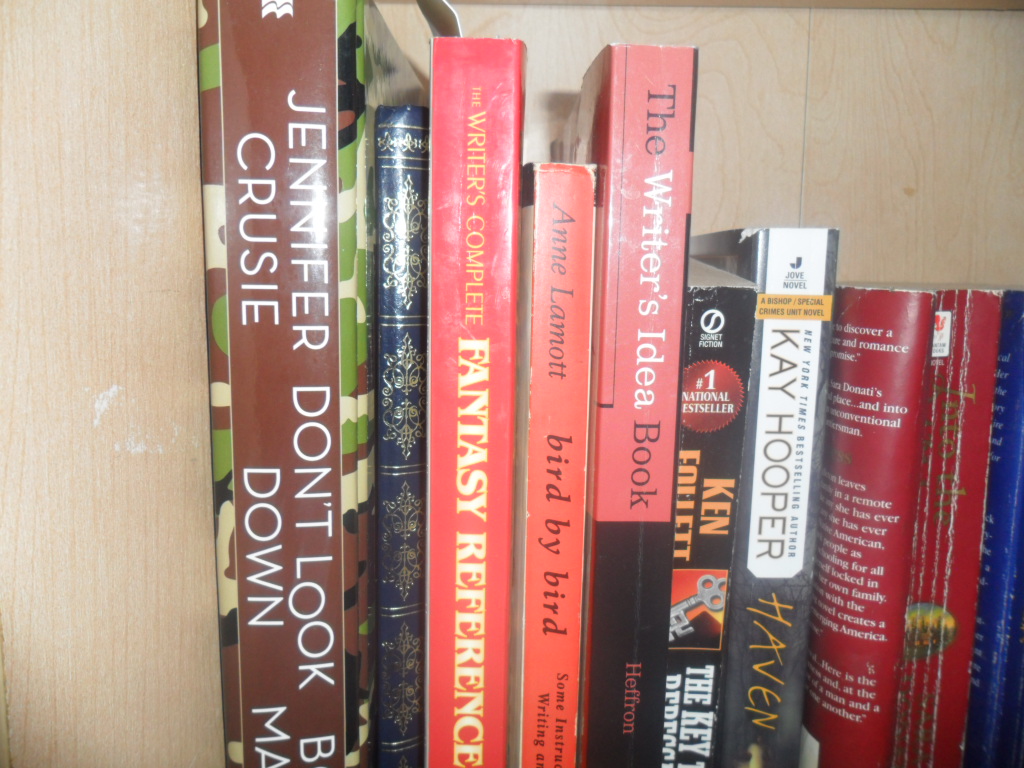
    Do you see it there?  Right between Jennifer Crusie and the Fantasy Reference Guide …

    It’s an old hardback notebook.  I kept squinting at it, trying to figure it out what in blazes it was when it hit me; it was the first notebook my mother ever gave me.  I’d already shown an interest in writing with “Noises Next Door” and “Noises in the Night” so she bought me this notebook to write in.

    Author’s note:  I was like twelve when I wrote those stories, people.  The titles are bound to suck.  And trust me, the stories were awful, too. 

    So I got up and pulled out that book and started reading the whole six chapter story I wrote in the sixth grade.

    It’s title?  Quest for Bravery … (with “bravery” spelled wrong, no less.)

    I used far too much punctuation and too many people were shouting, and for reasons I can’t understand I actually chose to write in cursive.  (I don’t think anyone writes in cursive anymore.  Not straight cursive, anyway.  I use a bastardized cursive-plain-text-print myself because I know that nobody else has a chance of understanding it.  It’s called author security.)

    The story was about a girl — yes, I’ve always written strong female fighters — who, for reasons I don’t explain in the story, is beholden to a wizard.  Said Wizard’s name was Henry because that was the oldest sounding name I could come up with at the time.  (Again, I was twelve.  And anyway, aside from Prince Henry how many “Henry’s” do you know that aren’t getting up there in years?)

    So anyway, the girl in the story was named Amanda Forcalmer (points to me for not using my own name that time) and she basically served Wizard Henry.  And for six whole chapters she got to meet a prince, fight a dragon, save a princess and then leave said prince.  (Again, points to me for not writing a romance.)

    It was really horrible writing-wise and I laughed as I read it.

    And then I started thinking about how many quests I have been privileged to go on both in my real life and in my writing life.  In real life I have jumped in the ocean in Alaska (that’s cold, by the way), swam in the Caribbean twice, lived in Hawaii, traveled from coast to coast, and been in the Army.  While none of those can be categorized as a “quest” per se, it has been an adventure in learning who I am as a person.

    In my writing life I’ve quested for the Ebony Blade in Sedition, fought against prejudice and for the safety of family in Saboteur.  I’ve hunted for nobility in Witch-Born and learned how fickle Fate can be in Dead Magic.  I confronted the demons of inner self in Deviation and am neck-deep in the quest for self-understanding in Persona as we speak.

    And I’m only 34 years old.

    We writers tend to bemoan how lonely our jobs can be.  We set out to tell a tale that no one else can.  We might get research and inspiration from the people around us, but in the end we’re alone as we write it.  And yes, the solitary act of writing can be hard sometimes.  But it is totally worth it.

    Because we writers are uniquely blessed.  We have quests like no one else in the world.  We create worlds in order to draw out and pinpoint certain aspects of human character.  We see reality differently.  We see people and what motivates them because we understand that the underlying motivation is what dictates what we do as human beings.

    So if you’re a writer then embrace that solitary time.  Take that quest that no one else can and share it.