Shen Hart tagged me in the “Meet My Character Blog Tour” and I’ve been sitting on this for a couple of days, trying to decide who I was going to “tag” in response. I’ve decided on Lisa (LJ) Cohen, RJ Blain, and Skye Taylor. Good luck and have fun!
1) What is the name of your character? Is she fictional or a historic person?
Johanna Rorry — otherwise known as Jorry. She is purely fictional.
2) When and where is the story set?
The story is set many, many, many years into the future. We get to go spelunking on Pluto, lay siege to a space station orbiting Neptune, and infiltrate a military base on Europa but in between all of that the characters are on board the hauler-class vessel known as the Zephyr.
3) What should we know about him?
Ahem. You mean “her.”
And you should know that when she sets her mind to something she doesn’t waver. She’s a complicated mix of soldier and mother, capable of hacking into computer systems and constantly focused on the safety of her family.
4) What is the main conflict? What messes up his her life?
Her son Devon wants to go to University, but because Jorry and her counterpart (Seach Barlow) are both deserters from the military this poses many problems. Sending Devon to school could reveal their whereabouts to the military they’ve been running from. So Jorry makes a black market deal to get Devon some security tags that won’t alert the Universe that she’s still alive and still allow him to go to school.
And … you know … things go very, very wrong.
5) What is the personal goal of the character?
She wants to see her son safe and happy.
6) Is there a working title for this novel, and can we read more about it?
The tentative title is Tapped and you can read a snippet of it on my main website ajmaguire.com. (HINT: It’s under the science fiction tab.)
7) When can we expect the book to be published?
Well, I have a rule that I send out everything to the traditional market first and if it doesn’t get any bites then I look into Indie publishing. So I’m really not sure. It could be out sometime in 2015 or it could be later.
Cover Art by Chris Howard. (Seriously, this dude’s got talent.)
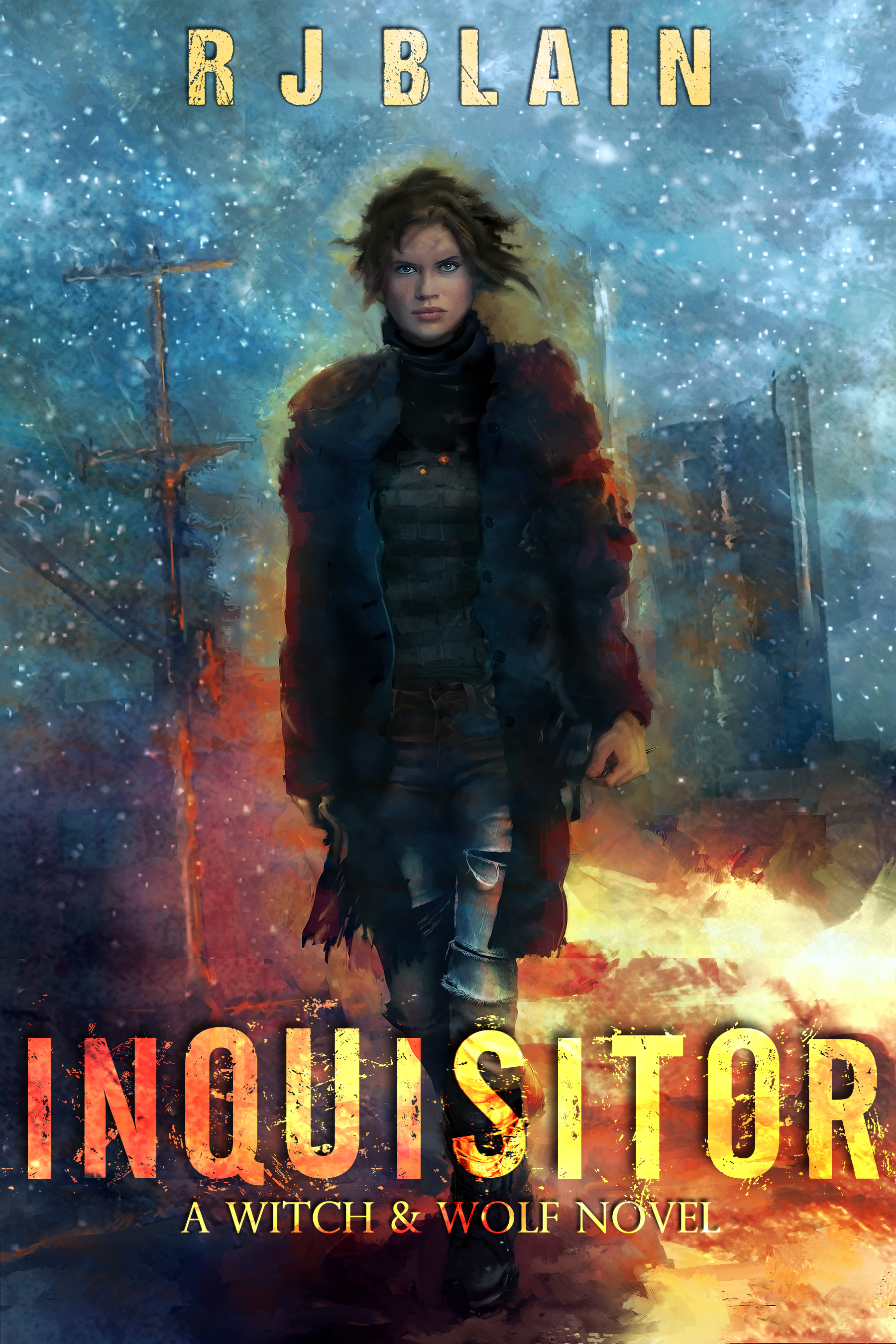
Today I have a guest post from RJ Blain, author of the newly released Inquisitor. There’s all sorts of goodies in this post, including a book blurb and excerpt, so I won’t be too long-winded in my introduction.
I asked Ms. Blain about how she made her werewolves different from other werewolves within the genre (since Inquisitor deals heavily with werewolves, as I’m sure you guessed) and this is her rather eloquent response …
Werewolves are one of the most frequently written about paranormal creatures in urban fantasy novels, second to the vampire. Writing unique werewolves is difficult. There are concepts that are considered appropriate for werewolves, and straying from these concepts can either confuse readers or earn the author scorn.
After all, wolves have Alpha, Submissive, and Omega ranks in the wild. It just makes sense that these variants exist in urban and paranormal fantasies. How these ranks are executed are one of the ways you can help make your werewolves become unique compared to the ones already out there.
Just remember, there’s nothing wrong with writing a stereotypical werewolf if you’re writing great, unique characters. Werewolves are a species, like humans. Look at how diverse people are.
There is no reason you can’t make your werewolves unique to you.
When I approached my werewolves, I knew I wouldn’t make a completely unique beast. After all, there are (realistically) a limited number of combinations you can use with werewolves and still make them werewolves. Most lycanthropy lore involves the stages of the moon, which adds a nice edge to the curse. Most myths and legends refer to lycanthropy as just that: a curse.
I like blending history and the myths and legends with my own take, so in order to create my werewolves, I had to research lycanthropy, history, and wolves. What sort of people would become werewolves? Why? Could my werewolves be created by choice rather than by random attack?
Those were the first questions I asked, and that’s how I started building my werewolves. I decided that the ritual needed to become a werewolf was a choice. But if lycanthropy is a choice, where did the first werewolf come from?
I then had to think about how a werewolf might come into existence naturally.
This became the foundation of my werewolf society. There are two types of known werewolves in the world: Natural born ones – wolves born to human parents – and changed ones. In Inquisitor, it is revealed there might be a third type of werewolf. I won’t spoil that, though.
Once I figured out what the dynamic between these subspecies of werewolves were, I looked at the type of real werewolves in the world, and decided that the breed of wolf made an impact on the type of werewolf created. Arctic werewolves are considered to be among the rarer breeds of werewolves, matching the rarity of their wild cousins. Grey wolves are the most common type. European werewolves align with European wolves.
The pedigree of werewolf created, I decided, would be determined by the pack transforming the new wolf, predominantly the breeding of the Alpha male and female of the pack. Because it’s a mix of the genetics of the pack as a whole, hybrids between species isn’t uncommon. Purebred wolves are far rarer on account of this, and prized by packs wishing to introduce a strong association with a specific type of wolf.
So, what’s the point of all of these details? What makes a werewolf unique in a world where there are hundreds (if not thousands) of werewolf stories is the details. The little things that make your werewolves unique to you is what is truly important.
Some things are difficult to avoid. Omegas serve a very specific role in canine packs. They serve this same role, amplified, in werewolf packs. How they do it is where the differences often lie. It is the same with submissive wolves and dominant wolves. How they function within the pack is the difference, not their specific function. If you stray too far from the natural roles of wolves within the pack, you end up with a werewolf that doesn’t feel like a werewolf.
Go ahead and write your werewolves. Just make sure you ask yourself what the details are that make them unique to you.
Author Information
RJ Blain suffers from a Moleskine journal obsession, a pen fixation, and a terrible tendency to pun without warning.
When she isn’t playing pretend, she likes to think she’s a cartographer and a sumi-e painter. In reality, she herds cats and a husband. She also has a tendency to play MMOs and other computer games.
In her spare time, she daydreams about being a spy. Should that fail, her contingency plan involves tying her best of enemies to spinning wheels and quoting James Bond villains until she is satisfied.
Inquisitor Blurb
When Allison is asked to play Cinderella-turned-Fiancee at a Halloween ball, the last thing she expected was to be accused of murder on the same night. She has to find the killer and quick, or she’ll be put to death for the crimes she didn’t commit. To make matters worse, the victims are all werewolves.
On the short list of potential victims, Allison has to act fast, or the killer will have one more body to add to his little black book of corpses.
There’s only one problem: One of the deaths has struck too close to home, and Allison’s desire for self-preservation may very well transform into a quest for vengeance…
— EXCERPT—
It was well enough our ‘relationship’ was nothing more than make-believe. Our friendship wasn’t much better off, either. Unfortunately, Mark didn’t know that. I shook my head to clear it, staring down at my watch.
3:59 pm.
I glanced eastward, at the glass-lined wall of the jewelry store I was in. Shoppers hurried about their business in the broad mall hallways, chatting to each other or talking on their too-expensive cell phones. Beyond the walls of the building, I could already feel the moon calling to me, birthing shivers under my skin. In a little over an hour, it would start to rise. I made a thoughtful sound, turning my attention back to the glass case in front of me.
It was a full moon on Halloween. Some people would don masks, confident in their superiority as a human, never realizing how close they’d tread to a very violent and bloody end. Others would remove the masks they normally hid behind, rejoicing in their one night of freedom.
A sad few would have no idea what horrors they had sowed come morning.
I was in a lot of trouble. My fellow boogeymen didn’t frighten me all that much. It was Mark who worried me. Mark, as well as the other humans he’d subject me to before the night was done. I hadn’t lost control in years — I doubted Mark’s mother had been born since the last time it’d happened.
But that didn’t change the fact that it could happen.
Old or not, I was still a bitch. Without pack or mate, it was only a matter of time before I lost control.
Mark wouldn’t stand a chance, and when I finally lost my grip on sanity, I wouldn’t even remember killing him. Why hadn’t I said no? Why had I agreed to travel to New York on Halloween? What had I been thinking?
I hadn’t been, and that was a big problem.
“Is there something I can help you with, miss?” A woman asked from beside me. I about jumped out of my skin.
Shit. I swallowed back my heart and improvised. Without really seeing the jewelry beneath the glass, I pointed at something shiny, and hoped it was a necklace. “May I see that please?”
“That’s a very expensive piece, ma’am.”
I glanced at the woman out of the corner of my eye. A pastel pink blazer was matched with a pencil skirt that showed off thin legs and knee-high black boots. Glittering bracelets clung to her wrists. “Is that so,” I murmured, focusing my attention on the piece I pointed at.
Rubies and diamonds winked at me, woven together in a Celtic knot trapped in the center of a web of delicate diamond-encrusted chains. My cheek twitched.
No wonder the woman was skeptical and eying me suspiciously. Here I was, in some luxury jewelry store poking around to waste time, dressed in a beat-up leather coat, a baggy sweater, and worn jeans, complete with mud splatter from my walk in Central park. As my luck had it, I pointed out a necklace worth more than any car or house I’d ever seen in person, let alone owned.
I felt the eyes of every customer in the store settle on me. Great. Just what I needed. An audience.
Maybe I should’ve acted more indignant. Maybe I should’ve walked away. Instead, I took out my wallet, pulled out my black platinum Amex card, and tossed it on the counter. “May I see that please?”
The sales woman stared at the card and then at me, her eyes narrowing. “Do you really think I’m going to believe this is your card?”
Half of the customers in the store cleared out in the time it took the sales woman to pick up my card.
“Is there a problem?” A man dressed in a business suit stepped forward. His blue eyes took in my clothes before settling on the black credit card in his coworker’s hand.
The woman glared down her nose at me, her gaze settling on my beat-up jacket. “I do believe we have a stolen credit card here, sir.”
The manager snatched my credit card. “Is this true, miss?”
Oh hell no. I felt my cheek twitch again. “It’s not. I’ll just take my card to a different store, then.”
“I think this can be resolved quickly and easily, miss,” the man replied. He frowned at me. “Can I see your ID please?”
I showed him my license. The manager winced. “I’m sorry, there have been a lot of theft of valuable jewelry lately by those with fraudulent credit cards and out of state driver’s licenses. This will only take a few minutes as I verify this is a real card.”
Well, at least he wasn’t going to call the police on me right away. I sighed. “Since when hasn’t my driver’s license been sufficient proof? What is this? LA?”
Just as I promised, I have a guest post from R.J. Blain today on serializing novels. For those of my awesome, wonderful, perfect Readers who don’t know what it means to serialize a novel I’ll go ahead and explain. Serializing a novel would be sorta like when stories were posted in the newspaper week after week. (Think Jo in Little Women, she did that for a while.)
Since I’ll be serializing Persona (that’s the WWII project I’ve been talking about and yes, I know I changed the title like five different times. I’m a writer. Until it’s published it’s subject to change.) But because I’ll be serializing Persona starting in June I asked the lovely and talented (and slightly crazy) R.J. Blain to talk a little bit about her experience serializing novels.
R.J. Blain has not one but TWO novels being serialized at present (which really blows my mind), and she has some great things to share.
There are a lot of things a writer needs in order to be successful. Having the ability to put words on the page is just the start of the journey. Reaching out and connecting with those who want to read your stories is almost as important as the words that you’ve put on the page.
It’s also a lot harder.
Let’s face facts: Most writers are introverts. Some of us are introverts with extrovert tendencies, and there is a reason for this – those who spend their time writing aren’t spending their time socializing. An extrovert often finds this process uncomfortable. Introverts find this process uplifting.
For some of us, it just caters to our special brand of insane, but that’s a different story altogether.
I have two different novel serializations on my website, and AJ asked me to step up to the plate and talk about the process of preparing and releasing a serialized story.
I might have winced a little when AJ told me of her plans to serialize a piece. A hundred and one thoughts fluttered through my head, and each subsequent one unsettled me even more. Then, after going through a gauntlet of eulogies for her sanity, I started to grin.
A post on the process of serialization? I can so work with that.
My name is R.J. Blain. If you spot my sanity anywhere, please return it to Montreal, Quebec. I’m sure someone from my household will retrieve it. Eventually.
I started serializing my story, Zero, (http://rjblain.com/zero-a-science-fiction-web-serial/) in January of 2013. Almost six months in, I was 5-10 minutes late on two updates, flirted with the devil many more times than that, and had posted two bonus scenes. I update every Wednesday.
When I set out to write Zero, I went in trying to accomplish three things: High-quality writing, consistent updates (every Wednesday), and telling a good story. That last point is important: It’s the manifestation of wanting to connect with people who want to read things I write.
The rule of three quickly crashed down on me. I had the updates in the bag. I’m pretty good about sitting down and doing what I need to do. I don’t work with a buffer, and I get quite the adrenaline rush when I realize it is 5 pm on a Wednesday afternoon and I haven’t even started my update for Zero.
I drove myself to epic-levels of stress trying to accomplish the quality I wanted. I want to write a story that people enjoy reading, and the requirement and desire to produce quality writing was equivalent to wearing concrete shoes while skydiving over the Hudson.
So, I admitted defeat and crossed high-quality off of the list. I just couldn’t spend the amount of time editing fresh draft. In exchange, I am having a lot more fun with the story now that I’m not as worried about the quality. Knowing myself as well as I do, I’ll never be able to totally abandon my desire for quality.
This is a good thing.
Songbird (http://rjblain.com/serial-a-romantic-fantasy/) is another experimental piece I’m serializing because of a dare. Terrible reason, but a fun story, and one that plays by different rules than Zero. When I went into Zero, I knew I wouldn’t be updating Songbird consistently. It’s a fly-by-night, pop out of a dark corner and shout, “I’m BATMAN!” at unsuspecting victims type of story. Like Zero, it’s an experiment: Could I write a traditional fantasy with strong romantic elements?
On the surface, these two stories aren’t that much different. Zero is a soft science fiction. Songbird is a romantic fantasy. One uses political sciences and some futuristic tech, the other includes magic. To me, most science is magic because I don’t understand it more than half of the time.
Realistically, these two stories are completely different. I don’t write them the same way. I don’t prepare them for serialization the same way. I didn’t even conceptualize them the same way. The most valuable lesson I’ve learned as a writer over the years is that while there are a few elements of my method that carry over from project to project, no one novel is the same as another, and these two stories are my proof of it. (Every writer is different, so this is commentary about me and me alone.)
Zero started with three days of plotting, planning, prepping, and world building. When I started scene 1, I had a good idea where I was going. I even had some ideas on how to get there. I had the main characters, and I had a rough idea of how they’d meet despite coming from such different worlds. I had Easter eggs prepared, puns planned, and a roadmap complete with a set of directions.
Songbird started with nothing. I sat down, picked up my pen, and I started to write. I knew nothing of Kara, even less about Ranik, and I really don’t know where they’re going or if they’ll make it to the same destination at the same time.
It took me three or four updates before I started loathing Zero due to how I was writing it.
I never fell out of love with Songbird.
I feel back into love with Zero, and I feel that the story has a whole-new dynamic because of it.
I don’t get to write on Songbird even a quarter of how often I’d like to.
Zero is a patient friend and companion, showing up for a date every 7 days, whether or not the weather is nice. It’s that guy, you know. The one that sits outside at a café on a rainy day waiting for his girl, who shows up disheveled and several hours late.
I’m convinced Songbird is staging a revolt as the result of neglect.
Zero is drafted directly to the computer. Songbird is written by hand in a moleskine journal and transcribed to the computer scene by scene.
One author, two stories, and two very different writing processes to bring these stories to life.
If you’re planning on releasing a serial, I strongly recommend that you do so knowing what you’re getting into. If you’re going in without a buffer, expect stress. Expect needing a hellish amount of dedication and enthusiasm to push through the bad days. Expect the strong desire to burn the project with fire when you are forced to work on it when you don’t want to.
Don’t expect the process to be easy. Don’t expect a high number of people coming back to your site week after week. Even if they do, most of them aren’t going to comment, aren’t going to notice you, and they aren’t going to hold your hand. Expect to have a silent audience, one that you engage only through the words you’ve written.
Expect to get a glimpse of the world of publication, where you are forced to forge connections with people without ever having the chance to talk to them directly.
Even if you only have one person who sees the story through to the end, that is one more person you have supporting you, even if you aren’t aware that they are there in the shadows. This was one of the hardest things for me when I started serializing Zero and Songbird. I’m an introvert with extrovert tendencies. I want to be noticed. I want my readers to reach out to me. I want to forge those connections.
I want people to read my stories.
For me, this was the most valuable lesson I’ve learned so far serializing my stories: I write because I want to be read. I want to entertain someone.
I want to forge connections with people.
The hardest lesson I’ve learned so far serializing my stories is that most of the time I’ll never know for certain if I succeeded at making these connections.
That’s okay, though. It’s okay because I don’t need to know that it’s happening to be aware of the fact that it is, even if I’m not told this is the case to my face.
In a way, novel serialization is a leap of faith. It’s a risk. It’s a challenge. Success is hinged on the will of others and my ability to connect with people I’ve never met.
Is novel serialization right for you?
Only you can answer that question. Just don’t make the mistake of thinking that knowing one person’s method (or lack thereof) will give you the keys to the universe and to success. It won’t.
If you decide to serialize, make your own way. Forge your own path, and never stop writing.
(Special thanks to R.J. Blain for luring me into a guest post with chocolate. I totally dove into the trap when she promised Godiva’s. And, just as a side note, I’m sooo glad I’m not crazy enough to jump into serialization without a buffer. I have no idea how she does it, but I would have slammed my head into a wall by now.)