Tag: Round Robin

  • September Round Robin – Reading is Cool!

    A couple of years ago my son informed me that he hated reading. Being an author, this made my heart hurt and I set out to fix this viewpoint by writing a story for him. I kept it short because he is young, but I did not spare him in language, plot, or character.

    41SPrUMbf+LI even published it myself so that he could have a real book to read in his hands, something he could point to on Amazon. The novelette featured a man cursed into wolf form by an evil witch and it’s titled Torven. You can find it on Amazon if you’re really curious.

    But I also had my son involved in the making of it. So he heard the rough draft as it was written, chapter by chapter. I paused frequently so he could ask questions, which often turned into suggestions. It amazed me how much he wanted to be part of the process, as opposed to simply reading it.

    I’d written him into one of my novels once already, and that had him at least partially interested. Mostly he wanted to hear the parts of the story that featured his character, but at least he listened as I read it.

    When it came to Torven, though, he was really excited to tell me where he thought the story was going and we ended every session with a conversation. He asked how Torven was cursed, and I reminded him that this was part of the story and if he wanted to know then we had to keep reading.

    And when we met the witch, he wanted to know if Torven killed her. Again, I told him he had to keep reading to find out. But with this one, he adamantly informed me that Torven HAD to kill the witch or it wouldn’t be a good story.

    Interestingly enough, he also went into how the witch became a witch. As an author, I like to twist things around and see how wicked people were good once and got corrupted, but in my son’s view, there was never any good there.  If I recall correctly, he said the witch was born from a bog.

    That never made it into the book but I remember praising him for such a creative backstory. The image of murky, stagnant water boiling and swirling until the deadly witch rose from its depths has always stuck with me and I may ask him for permission to use that one day.

    As for other people in my life who claim they either don’t have the time or don’t like to read, there isn’t much I can do. It seems to be popular to hate reading these days, people shrugging the task off and saying they’ll watch the movie when/if it comes out. I’m sure all writers find this attitude disheartening, but that doesn’t stop us from creating novels.

    Happily, I married a man who enjoys reading, and my son is warming to the written word. In the grand scheme of things, I think I’ve done all I can to remind my family that reading is cool and creativity shouldn’t be underestimated.

    Check out what my fellow authors do to help encourage reading in this month’s Round Robin:

    Skye Taylor http://www.skye-writer.com/blogging_by_the_sea

    Victoria Chatham http://www.victoriachatham.com

    Dr. Bob Rich https://wp.me/p3Xihq-1ly

    Connie Vines http://mizging.blogspot.com/

    Anne de Gruchy https://annedegruchy.co.uk/category/blog/

    A.J. Maguire  https://ajmaguire.wordpress.com/ (YOU ARE HERE)

    Anne Stenhouse  http://annestenhousenovelist.wordpress.com

    Helena Fairfax http://www.helenafairfax.com/blog

    Fiona McGier http://www.fionamcgier.com/

    Rhobin L Courtright http://www.rhobinleecourtright.com


  • August Round Robin – Creation of a Writer

    When we last visited the subject about what prompted our writing careers, I mentioned an assignment from the sixth grade where the teacher read the opening of a story and then told us to write what came next.

    While I still consider that assignment the launching point for my love-affair with the written word, there were other influences too. I’ve always been a dreamer, letting stories play themselves out in my head, but I didn’t always love reading.

    Or at least, I didn’t love finishing a book. I liked getting started, being introduced to impossible worlds with magic and mayhem, but I didn’t always connect with the characters on the page. When that happened, my happy brain took off and made the story my own, adding characters that I enjoyed better.

    I suppose that could be seen as an early form of fanfiction, but I was in grammar school so I can live with that. And really, I didn’t start writing them down until that fateful assignment in the sixth grade.

    I really should track that teacher down and thank her.

    Throughout high school, I kept a special notebook that held all sorts of stories in it. Mostly fragments, scenes that came to me in the middle of class that entertained me. It wasn’t a full novel, not even a short story because there was no structure to the notebook.

    To look at it now, it seems a testament to my own personal attention deficit disorder. A scene begun on page five was interrupted by a series of scenes about an earthquake rattling the school, forcing me to become the hero and help lead my fellows out of the rubble.

    So what got me from that chaotic fictional buffet to full novel writing?

    To be honest, I think it was my mother’s electronic typewriter. And I know mentioning that archaic bit of machinery is likely to date me, but I’ll own my age for the day.

    One of my earliest stories was written after we visited family in Alaska. I loved the cool air and rugged mountains and vast seascapes that we saw there and, per typical youthful exuberance, commemorated the visit in fiction. As with everything back then, I focused on the people in my life, so the main characters were none other than myself, my brother, and my cousins.

    But what I remember most about writing it, was sitting at the absurdly large desk in the living room and pressing the keys on that typewriter. Something about the whirring-snap sound it made every time I hit a letter filled me with absolute glee.

    There was a permanence to the story I was writing. It was there in the whirr-snap of every letter, my own personal mark in the world.

    This is probably why I have a very noisy keyboard. It may not have the same whirr-snap sound of the typewriter, and I can delete things almost as quickly as I write them now, but the sense of accomplishment is still there.

    Check out what my fellow authors have to say about what started their writing careers in this month’s Round Robin…

    Connie Vines http://mizging.blogspot.com/
    Victoria Chatham http://www.victoriachatham.com
    Skye Taylor http://www.skye-writer.com/blogging_by_the_sea
    Judith Copek http://lynx-sis.blogspot.com/
    Dr. Bob Rich https://wp.me/p3Xihq-1ke
    Beverley Bateman http://beverleybateman.blogspot.ca/
    A.J. Maguire  https://ajmaguire.wordpress.com/ (YOU ARE HERE)
    Fiona McGier http://www.fionamcgier.com/
    Margaret Fieland http://margaretfieland.wordpress.com
    Rhobin L Courtright http://www.rhobinleecourtright.com

  • Violence in Writing – July Round Robin

    Anyone who’s read my writing can tell you that I use violence a lot in my work.

    We don’t call it that, though.

    We say it’s “action-packed” and full of conflict because the word violence tends to connote negative things. And really, it should.

    As a parent, I find myself repeating the mantra that it is never all right to hit, that there are better ways to solve our problems. Because I don’t want to visit my son in prison one day.

    But in my writing, the violence runs rampant.

    My first novel, Sedition, starts with a duel in a tavernesque place. My second novel, Witch-Born, starts with an assassination attempt on the main character’s life in the middle of a crowded cafe.

    Deviation begins with a hold-up in a bookstore.

    Granted, those are all early works and there are a lot of things wrong with them. I really held to the “in medias res” concept and I recognize that it’s hard to care about a character being shot at if you don’t know who they are.

    These days I try to focus on how the violence affects my point of view character in any given scene. While it was fun following Dorian Feverrette through the steampunk world of Magnellum as he hunted witch-assassins, I can admit that I never stopped to consider what sort of man that made him.

    The truly interesting heroes are the ones who commit to violence and are then affected by that violence. We see them walk a tightrope between wanting to live in peace and needing to fight for that peace.

    This tightrope holds a great deal of tension and opens up the character for deeper development. I’m still trying to find the right balance between action and the effect that action has on the character, but I hope to learn it soon.

    Check out how my fellow authors work with violence in their novels.

    Dr. Bob Rich https://wp.me/p3Xihq-1i2
    Victoria Chatham http://www.victoriachatham.com
    Connie Vines http://mizging.blogspot.com/
    Anne Stenhouse  http://annestenhousenovelist.wordpress.com/
    A.J. Maguire  https://ajmaguire.wordpress.com/ (YOU ARE HERE)
    Marci Baun  http://www.marcibaun.com/blog/
    Skye Taylor http://www.skye-writer.com/blogging_by_the_sea
    Fiona McGier http://www.fionamcgier.com/
    Anne de Gruchy https://annedegruchy.co.uk/category/blog/
    Rhobin L Courtright http://www.rhobinleecourtright.com

    Judith Copek, //http://lynx-sis.blogspot.com/

  • Faking Originality – June Round Robin 2018

    IMG_1806Slogging through the middle of my current work in progress I ran into a wall.
    Not just a wall, but a fortress insurmountable complete with lichen-covered stones and drizzles of what is likely the dumpings of the privy pot. I think my Muse lives up in that tower and takes great pleasure in the fact that I keep smacking my nose into her waste.

    The book that I have loved for twelve chapters suddenly feels bland, lacking all sense of originality, and it is a chore to sit down and open the document every day.

    Wherein we come to the tragic but predictable plight of the author and I begin to wonder why I bother with this writing thing. What could I possibly have to offer the world by way of this story, or any story ever?

    This is a normal thing and I thank every author who has revealed their own insecurities regarding the writing life. You give me hope.

    I actually just got to spend some time with a local author (L.J. Cohen who writes amazing science fiction and you should totally check her out) and we discussed this very issue. Most authors hit this wall in the writing process and, for some of us, it only seems to get worse with each project.

    So what do I do when I hit this wall?

    Well, to be honest, this wall was different from the others. All the other walls I’ve hit have been about the language and the writing style and all those things I knew I could clean up in the next draft.

    This one…

    This refuse-drizzling, moldy fortress wall barring my path insists that medieval fantasy novels are so last century.

    “Nobody wants to read another Kid in King Arthur’s Court. Ugh, everything is so grey and blah and already done, and there’s no amount of editing that’s going to cure this thing. ”

    It is possibly the hardest wall I’ve ever come up against.

    And the only way I have been able to barrel through is my outline.

    That’s right, my outline saved my butt. Because I put my headphones on and pulled my manuscript up and read through the whole of my outline, start to finish, and it made me remember why I started writing this thing in the first place.

    Because I love Kevin and I want him to survive. And I want him to come to that moment in the end where he confronts his own grief and learns how to live with it. Because the genre may be tired and maybe some people will groan at the idea of another medieval fantasy, but there’s enough new in it to breathe life into the setting.

    And if, when I’m revising, I feel like it needs something more to set it apart, then yes, I can still do that.

    Check out what my fellow authors do to keep moving forward in those tough moments…

    Dr. Bob Rich https://wp.me/p3Xihq-1gQ
    Marie Laval http://marielaval.blogspot.co.uk/
    Connie Vines http://mizging.blogspot.com/
    Beverley Bateman http://beverleybateman.blogspot.ca/
    Marci Baun  http://www.marcibaun.com/blog/
    A.J. Maguire  https://ajmaguire.wordpress.com/ (YOU ARE HERE)
    Helena Fairfax http://www.helenafairfax.com/blog
    Anne Stenhouse  http://annestenhousenovelist.wordpress.com/
    Diane Bator http://dbator.blogspot.ca/
    Fiona McGier http://www.fionamcgier.com/
    Skye Taylor http://www.skye-writer.com/blogging_by_the_sea
    Margaret Fieland http://margaretfieland.wordpress.com
    Rhobin L Courtright http://www.rhobinleecourtright.com


  • The 3/4 Mark – May Round Robin

    This month’s round robin is open for a bit of interpretation. The main thrust of the question is how you maintain continuity from start to finish in a novel. Which brings me to the title of the post – The 3/4 Mark.

    Over the years, I’ve discovered that my personal writing process requires a break in the rough draft that comes about the 3/4 mark. This is the point where I stop writing and I go back and start revising from the start, making little notes along the way.

    I know a lot of people will boo and hiss at this, saying I need to get the first draft done and then go back and edit lest I suffocate my creative muse.

    However, I’ve found that this process fuels my muse more than hinders it. And to be fair, most of the naysayers are focused on writers who have yet to complete a novel because they continually go back and revise rather than completing a draft.

    If you happen to be a writer who falls into this category – don’t do it my way. Finish a draft and then go back and revise. There is nothing like the feeling you get when you finish a book and you owe it to yourself to push through.

    Now then, a lot of things happen at the 3/4 Mark Break, which isn’t really a break.

    At this point in the book, I have a deeper understanding of the characters and know what the story is really about. This allows me to go through the beginning of the book and edit the character voices, sharpen the focus of each chapter, and move things around.

    Which adds to the flow and sense of continuity for the book as a whole.

    This also allows me to make notes in the margins, pinpointing subplots that I need to either remove or complete in the last quarter of the novel.

    And then, when I go to write that last quarter, my brain has had a nice refresher of the novel as a whole. More often than not, the outlined ending is drastically changed because of this. Which is a GOOD thing because my first draft endings are always horrid.

    Take a look at what some of my fellow authors do to keep continuity from start to finish in their works…

    Skye Taylor http://www.skye-writer.com/blogging_by_the_sea
    Marci Baun  http://www.marcibaun.com/blog/
    Judith Copek http://lynx-sis.blogspot.com/
    Margaret Fieland http://margaretfieland.wordpress.com
    A.J. Maguire  https://ajmaguire.wordpress.com/ (YOU ARE HERE)
    Beverley Bateman http://beverleybateman.blogspot.ca/
    Rhobin L Courtright http://www.rhobinleecourtright.com

    Anne de Gruchy  https://annedegruchy.co.uk/category/blog/

  • April Round Robin Discussion – How do you establish a story/character/setting?

    When I started Tapped I knew I was going to be working with a larger series. I knew I wanted religion outlawed and an underground railroad put in place for refugees. I wanted to pose questions that would take more than one book to fully answer.

    But I wanted it to mean something.

    You can run out and find thousands of essays on the subject of religion, but those can only touch the surface and very rarely come with the emotional impact one can find in fiction.

    Thus entered Devon Barlow, a young man travelling with his parents on a hauling vessel called Zephyr. I knew he was young enough to still be considered a minor, but old enough to chafe under that restriction. And I knew his parents were hiding big secrets.

    Beyond that, Devon showed me who he was with each draft. I didn’t know he was courageous until the end of the first draft, when he insists on saving his mother against hopeless odds.

    Once that first draft was finished, I had the basic shape of the story, so the only thing I can say about establishing a story is to write the rough draft. Once that’s done, you have round upon round of editing to help tighten and sharpen the story until it resembles something decent.

    Establishing the character is a little different. The rough draft is a first date, so to speak. You have coffee or a light lunch with your main character, listening to them as they give basic highlights of who they are as people.

    With Devon, learning he was courageous meant I had to show that possibility earlier in the book. Thus entered the spelunking scene on Pluto where we get to see him react to a horrible accident.

    The second draft is like reaching the third month of a relationship. You know their basic personality from before, but now you start to find all those quirks that seem to have no explanation.

    Devon noticed ships and blueprints in the first draft, but it wasn’t until the second draft that I understood why. He wants to learn how to design space vessels, which leads to a conflict over schooling (aka – a major plot point) and reveals his talent as an engineer.

    By the third draft you’ve entered into the permanent status of your relationship with this character. You not only know who they are, you can anticipate what the absolute worst scenario will be for them – and if you’re evil like me, you then plop them in the middle of that scenario and watch them scramble.

    Establishing setting is an altogether different beast. I confess that this is a weak spot in my writing. I am working to remedy that and envy authors who are able to describe their settings with a few brilliantly placed words.

    That being said, a trick I often use is to make sure the settings are described in the character’s POV. For example, Devon views Zephyr as a labyrinth of secrets. His parents are hiding things from him and that is proven even in the vessel’s blueprints.

    But when Jorry (his mother) describes the ship it is always in terms of a safe haven, and a home. She lingers on the notches in the wall where she measured Devon’s height as he grew up, and the security measures put in place to keep him safe.

    Take a peek at what some of my fellow authors do to help establish their characters and stories…

    Skye Taylor http://www.skye-writer.com/blogging_by_the_sea
    Dr. Bob https://wp.me/p3Xihq-1eg
    A.J. Maguire  https://ajmaguire.wordpress.com/ (YOU ARE HERE)
    Marci Baun  http://www.marcibaun.com/blog/
    Beverley Bateman http://beverleybateman.blogspot.ca/
    Margaret Fieland http://margaretfieland.wordpress.com
    Connie Vines http://mizging.blogspot.com/ 
    Rhobin L Courtright http://www.rhobinleecourtright.com

  • What I Learn from my Characters – February 2018 Round Robin

    Characters are a bit like the writer’s pox. Instead of itchy red dots all over our skin, we have itchy personalities peppering our minds. Some are louder than others and we end up scratching those first because no matter how many times we’re told we shouldn’t scratch, the itch cannot be ignored.

    As we scratch, fleshing that character out on the page, their voice becomes clearer and their story apparent. Often the process draws blood, a mix of fiction and fact that bleeds onto the page until it is difficult to distinguish between character and author. Neither would exist without the other, after all.

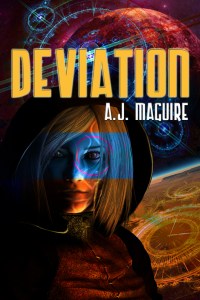
    In my novel Deviation I have two women abducted through space and time, one a writerdeviation-510.jpg and one a mother. The writer finds herself being hailed as a prophet for things she wrote in her fiction, which was a horrifying thought for both the character and me, the author.

    If you’ve read any of my work, you’ve seen the horrible things I put my characters through. I’m pretty sure most would want to kill me if they were real and standing in my apartment.

    The other character, the mother, is desperate to get home to her family. She has a young son who needs her and she has to get back.

    Midway through my revision of the novel I realized I had written my real life struggle into the plot. You see, at the time I was a new mother. My son was only months old and I felt like I was two people – a devoted mother who wanted nothing more than to see to the needs of my son, and an author who needed to carve out time to write.

    As I completed my revision of the novel, I came to an understanding that has carried me through the last ten years of my son’s life; both the writer and the mother are essential parts of who I am as a person.

    While the novel never addresses this personal journey, the ending still reminds me of the lesson Reesa and Kate taught me. I will always find a way to write, and I will always be a mother.

    See what lessons my fellow authors have discovered through their characters in this month’s round robin…

    Skye Taylor http://www.skye-writer.com/blogging_by_the_sea
    A.J. Maguire  https://ajmaguire.wordpress.com/  (YOU ARE HERE)
    Marci Baun  http://www.marcibaun.com/blog/
    Marie Laval http://marielaval.blogspot.co.uk/
    Judith Copek http://lynx-sis.blogspot.com/
    Dr. Bob Rich https://wp.me/p3Xihq-1c1
    Rachael Kosinski http://rachaelkosinski.weebly.com/
    http://rachaelkosinski.weebly.com
    Beverley Bateman http://beverleybateman.blogspot.ca/
    Rhobin L Courtright http://www.rhobinleecourtright.com

    Fiona McGier http://www.fionamcgier.com/

  • Naked Characters – January Round Robin (2018)

    Among the very first decisions I have to make when I come to the blank page is what point of view to use. Some people come up with a cool idea for the world their building or a new technological advancement they want to display, but for me it is always the character.

    Normally I go with third person limited, because that is what I enjoy reading. I like knowing exactly whose head I’m in and learning more about that particular character in the scene. To me this just seems orderly and natural.

    I have great respect for people who can write in the Third Person Omniscient (aka – they can be in any character’s head at any time, even in the same scene) but my brain simply can’t focus when there’s all that head jumping. Sadly, this includes reading.

    With the exception of Dune, I haven’t been able to read anything Third Person Omniscient. It confuses me.

    Third Person Limited gives me the freedom to explore multiple personalities in a given story and allows me to “zoom in” with the narrative, which I really enjoy.

    This idea of “zoom in” with the narrative is relatively new to me, in my early works I was… Well, I was winging it, to be honest.

    But to give a running definition of how “zoom” works in a narrative, anything that the character is doing (running, kicking a computer, glaring at their partner) would have the “zoom out” and anything that deals with the internal aspects (why they are kicking said computer, imagining themselves strangling said partner, and all the reasons why they have to run because they absolutely must not be late… Character B will be dead if they are late… Character B, who knows exactly how much honey to drizzle on their oatmeal and labels their socks for each day of the week and life would be sucked dry of all meaning and hope if they are dead…)

    OK, I got carried away there, but I think you get it.

    Zoom Out = Physical world

    Zoom In = Internal world.

    If you read any work of fiction you will see a dance between this “zoom in” and “zoom out.” For me, I’m still learning how to balance this out. It’s something I end up layering during the editing process, but I try to have fun with it.

    How much of my characters do I expose?

    I strip them bare. I want their naked thoughts on the page as much as possible. I want everything that makes them uncomfortable and why.

    Because that’s when I know I’ve got a real character. That’s when I know I have touched on something true. If I’m not digging into their guts then they will always be a two-dimensional bit part in a shallow story.

    Check out what my fellow authors have to say about how they reveal their characters on the page in this month’s Round Robin…

    Dr. Bob Rich https://wp.me/p3Xihq-1ag
    Connie Vines http://mizging.blogspot.com/
    Helena Fairfax http://www.helenafairfax.com/blog
    Fiona McGier http://www.fionamcgier.com/
    Judith Copek http://lynx-sis.blogspot.com/
    Marci Baun  http://www.marcibaun.com/blog/
    Anne de Gruchy https://annedegruchy.co.uk/category/blog/
    A.J. Maguire  https://ajmaguire.wordpress.com/  (YOU ARE HERE)
    Skye Taylor http://www.skye-writer.com/blogging_by_the_sea
    Anne Stenhouse  http://annestenhousenovelist.wordpress.com/
    Beverley Bateman http://beverleybateman.blogspot.ca/
    Rhobin L Courtright http://www.rhobinleecourtright.com

  • Haunting Characters

    Good characters should haunt you. They should linger with you long after you’ve finished the novel. If a character has been written correctly, you should see traces of them in the people you meet day to day. Perhaps your mother has a similar laugh or your friend at work has that same habit.

    Whatever it is, you see it.

    The whole purpose of writing is to expose humanity, to dredge through all the nonsense we fill our lives with and highlight the different aspects of being human. We remember characters precisely because they echo our humanity and we identify with them. That’s why it is so hard when we see them struggling or when one of them perishes in the novel.

    Jem Carstairs and Will Harindale from Cassandra Clare’s Infernal Devices series always pop to my mind when I see my son playing with his friends. I want him to have that kind of friendship, the kind that hooks deep and shapes who you are. He’s only nine, so he doesn’t understand any of that, but I do.

    Elizabeth Bonner from Sara Donati’s Into the Wild constantly challenges me to stand firm in what I believe and not to shy away from hardship. I tend to read this one every spring. There’s something about the descriptions that lets me breathe deep of another time and place.

    Jamie Fraser from Diana Gabaldon’s Outlander series reminds me that men and women are very different, and it helps me to communicate and better understand my significant other. And I do mean the books, not the show. Although I’ve enjoyed the show quite a bit too.

    My own characters are harder to pin down here. They are essentially part of who I am, even the bad ones, so they haunt me quite a lot. Some of them, such as Liana from the upcoming novel Usurper, are difficult for me to understand and I find myself lingering over her more often than the others.

    I’ve come to the point in my life where I recognize that a lot of my writing is an effort to know people. If you’ve ever said; “Ugh, I just don’t know why people are like that.” Or “I will never understand people like that.” Then you know what I mean. I write to understand, and I understand more with every character I write.

    My current work in progress, a fantasy revolving around a world divided by war, was originally going to be written with just two voices. My protagonists are both from the poorer faction of society, the slaves/servants, and the outline has them surging through all the prejudice and hate in the effort to bring about peace. But I realized early on that I could not tell a story about forging peace without bringing to light the other side of society.

    Thus, I added two more voices to the book. One is a high-ranked official in the government who is working hard to keep things as they are. The other is a lower ranked official who has very good reason to hate the people he is subjugating. Through these two voices, the book is shaping into something a bit more meaningful and, while there is a part of me that will never understand the desire to keep people in slavery, I do understand the fear these men have.

    Not merely a fear of losing power, but a fear of losing their homes and their families. With bitterness on both sides of the war, it is hard to imagine that anything less would be done to them and theirs should they lose.

    Characters linger, they teach us and help us to see the world we are living in for what it is. And they help us cope, reminding us that humanity is more complicated than good versus evil. Check out what characters haunt my fellow authors in this month’s Round Robin Discussion…

    Anne Stenhouse  http://annestenhousenovelist.wordpress.com/
    Heidi M. Thomas http://heidiwriter.wordpress.com/
    Victoria Chatham http://www.victoriachatham.com
    Diane Bator http://dbator.blogspot.ca/
    A.J. Maguire  https://ajmaguire.wordpress.com/ (YOU ARE HERE)
    Judith Copek http://lynx-sis.blogspot.com/
    Beverley Bateman http://beverleybateman.blogspot.ca/
    Fiona McGier http://www.fionamcgier.com/
    Skye Taylor http://www.skye-writer.com/blogging_by_the_sea
    Rachael Kosinski http://rachaelkosinski.weebly.com/
    Rhobin Courtright http://www.rhobinleecourtright.com

  • What I Write vs. What I Read – July Round Robin

    I haven’t always loved to read. As a writer that seems like a scandalous admission but honestly, there had been too much going on inside my head for me to fully appreciate the work of other writers.

    In my defense, this was sometime between grammar school and high school, so when I say “younger” I mean pigtails and Barbie dolls. That isn’t to say I didn’t enjoy writing back then because I did. And in fact, I have a cousin who used to swear I made Barbie dolls more interesting than anyone else. Instead of just going to work and coming home, Barbie (who was given a different name because honestly, who wants to be called Barbie?) we would go on adventures through time or try to avoid dying in some major natural disaster.

    I don’t mean that to sound pretentious. At the time I had no idea that the way I played with my toys was any different from other girls.

    But all of these stories and “play” in my imagination where I created the rules made reading about someone else’s rules and worlds a little more difficult. And then … Wait Til Helen Comes traumatized me in the 6th grade. I read the whole thing in a day, hiding it under my desk during school because I absolutely had to know what happened.

    I’m pretty sure the teacher knew and didn’t say anything.

    After that, it was like reading exploded into my life. My Aunt Debi has always been a big reader and every now and then I’d get one of her books. That’s how I found Jurassic Park. And The Hobbit. And this one novel whose title I can’t remember but it was about a big octopus/squid thing that ate people.

    Genre’s didn’t matter, and they still don’t. I will read anything and everything, which is probably why I write in various genre’s as well. I broke into this business with Fantasy novels, moved to science fiction, then historical fiction, and I have a horror novel waiting to be edited in October.

    The one thing I haven’t been able to write, but I will certainly try it again at some point, has been the murder mystery. I’m not sure why, since I love Sherlock Holmes and intelligent mysteries of that ilk, but those books tend to linger in a dark place. You have to understand your murderer, after all, and I find that unsettling.

    I used to watch Criminal Minds but stopped because it was leaving me with that unsettled, distrustful sense too.

    Anyway, I’m not sure what attracts people to read any one particular genre. I’ve never been able to restrain myself to just one, so I find it a trifle bizarre anyone could say; “Oh, I only read Urban Fantasies.” Or, in the most snobbish voice I’ve ever heard; “Fantasy and Science Fiction aren’t real fiction. You should read literary fiction. Or at least the classics. Anything else is just drivel.”

    … No, really. I’ve heard that.

    My response to that was to avoid the literary fiction section of the bookstore for a couple of years. Which I suppose wasn’t fair to literary fiction authors.

    See what my fellow authors have to say in this month’s Round Robin …

    Skye Taylor http://www.skye-writer.com/blogging_by_the_sea/view/542

    (YOU ARE HERE) A.J. Maguire  https://ajmaguire.wordpress.com/

    Marci Baun  http://www.marcibaun.com/blog/

    Anne de Gruchy https://annedegruchy.co.uk/category/blog/

    Heather Haven http://heatherhavenstories.com/blog/

    Dr. Bob Rich https://bobrich18.wordpress.com/rhobins-round-robin/

    Helena Fairfax http://www.helenafairfax.com/blog

    Connie Vines http://mizging.blogspot.com/

    Rhobin Courtright http://www.rhobinleecourtright.com

    Fiona McGier http://www.fionamcgier.com/

    Kay Sisk http://www.kaysisk.com/blog