Tag: Science Fiction

  • Women and Science Fiction

    So … apparently there’s this thing about women writing science fiction. I think I’ve read five or six articles about a couple of male science fiction authors (I really don’t know how many there are or even who they are)  who are displeased by women writing science fiction.

    The general arguments I have encountered in these articles are that women are somehow incapable of writing “real” science fiction. That women tend to muddy the waters of what should be science fiction with romance instead. That somehow this romantic tendency was damaging “real” science fiction.

    (Please tell me I’m not the only one who sees the oxymoron in that sentence. I mean … “fiction” … “real” … C’mon, people.)

    Well, in August of this year my first science fiction — Deviation — will be released by Double Dragon Publishing.

    I am also a woman.

    So I imagine that gives me reason enough to make a response to these naysayers.

    Here it goes …

    When I was in the Army I was trained to roll my socks a particular way. They had to be little balls of white and black (only white and black socks; white for physical training and black for the uniform) and they had to sit side-by-side in perfect arrangement so that when the drill sergeant did a locker check he or she would be pleased.

    Granted, I did this because I wanted to avoid doing push-ups, but the habit eventually became so ingrained in my person that when I got out of training I still folded my socks that way.

    And then one day my (ex)husband folded the socks. It drove me nuts.

    He did it completely the wrong way. There was no tight little ball of black or white. There was no dress-right-dress in the top drawer. There was chaos; little flappy tongues of white and black that only proved what a civilian he was.

    It was offensive, I tell you.

    If I heard the dryer go off I would dash for it, praying I got there before he did so that I could fold those socks the right way. The Army way. Because God help me if my First Sergeant decided to come visit my home and check my sock drawer.

    And then I realized … they were socks.

    It didn’t matter how they were folded or who folded them. Unless, of course, I was about to go out on assignment, in which case the socks really did need to be folded into those little balls to save space in my duffle bag. But that’s besides the point.

    The point is … you’re looking at socks. If you don’t like the way a woman folds them, don’t pick them up. They probably won’t fit you anyway.

    But you know what? They’ll fit somebody. And that’s who they’re for.

    My science fiction is not a romance. It does, however, feature women. A lot of women. This does not make it less science fiction. It just makes it mine.

    Respect the craft regardless of its form. And respect the authors around you.

    Because really, this argument is about as pointless as fighting over socks.


  • Series Review – Fringe

    I stumbled upon Fringe in Netflix and started watching it back in November because … Well … Because I was writing a science fiction that dealt with some strange occurrences. The show followed along similar lines as my writing so I was able to stay on track.

    (By similar I mean it was modern science fiction at play. Other than that the show has absolutely no resemblance to my story at all.)

    I fell in love with this show. The overarching story was beautiful. The relationships on the screen were deep and powerful.

    Since the series finale is already out I’ll go ahead and do a small spoiler and say that I enjoyed the love story. It was complicated, it had hiccups, and yet it wasn’t so paramount that it got cheesy.

    (Though I have to say that the episode when alternate Olivia gave birth had a moment of pure, heart-wrenching beauty in it. Thank you Seth Gable and Anna Torv for that.)

    But there was one character in particular who truly stole the show for me; Walter Bishop. John Noble’s portrayal of this broken man was both delightful and heartbreaking. He was both vulnerable and brilliant, and I spent half the time wishing I could be Astrid in the lab with him.

    There were a couple of things that made me twitch — the lack of Charlie at one point, and the smudging of the subplot for Massive Dynamic’s darker side at another — but on a whole I enjoyed this series. The series finale had a bittersweet taste, something I had come to expect from this story.

    So if you like science fiction then I happily suggest this show to you. It can get a little gory at places so I wouldn’t suggest trying to eat while you’re watching, but it’s well worth your time. Just save the popcorn for a safer show.

  • Good Lord, is 2013 almost over?

    Looking at my blog schedule I realized that I have all of 3 weeks left in the year. 3 weeks and 2013 is over!

    Well, three weeks and a few days if we want to be technical. But since the end of this year is actually going to be supremely crazy for me (5-year-old + Christmas = Mayhem) I thought I’d better write my year-in-review now. Because honestly, apart from making New Years goals this happens to be one of my absolute favorite posts to make. (Uber loves and thanks go out to Lisa Cohen for getting me hooked on this.)

    So! What did I say I wanted to do in the year 2013?

    1) Submit my edited copy of Dead Magic to DDP on my deadline of March 1st.

    There’s a big check mark in that particular box. Dead Magic was sent in, edited twice over by the fine people at DDP, and will be released in 2014.

    2) Finish Usurper.

    To be totally honest, I’m still working on this one. But if I follow my schedule I will have it done on December 3oth. Which is cutting it a little close but … eh … at least it’ll have a completed draft.

    3) World Build and (hopefully) complete Tapped.

    Another big check mark. Tapped has a completed draft AND went through the hands of an editor. I’ll be editing Tapped using the editor’s notes starting January 2nd.

    4) Climb 2 Mountains.

    …….. Well, you see, my car broke. I couldn’t drive up to the mountains in a car that kept breaking, so I couldn’t climb any mountains. But I totally made up for this, I swear!

    Those are the 4 goals I planned out for 2013. Here’s what I did in addition to all of that;

    1) Re-wrote and serialized my first historical fiction — Hurray Persona!

    2) Participated (and lost) NaNoWriMo, leaving me with 37 thousand words of a truly entertaining ghost/science fiction story.

    3) Edited Deviation per DDP notes — subsequently Deviation will also be released in 2014.

    4) Wrote a short story for a new DDP anthology — which I imagine will come out soon. (The Nano-Fisherman’s Wife)

    5) Wrote another short story for a completely different anthology which will hopefully come out around Christmastime. (Countdown to Goodbye)

    6) Started lifting weights. (This is not a joke. I totally have started lifted weights and my arms look incredible. If I weren’t allergic to the whole “selfie” picture thing I would totally post one just of my biceps.)

    7) Started researching the Civil War era for a prospective historical novel.

    And that’s all on top of the whole school work thing. Which, by the way, I will graduate in the Spring. But I’ll post next week about all the fun things I get to do in 2014. For now, I’m just happy to see what I managed to accomplish in 2013. It was truly a year of hard work, but it was work I enjoyed doing so that made it worth all the hours in front of an empty page.

    I hope everyone else had a wonderful year and I’m looking forward to a fruitful 2014.

  • NaNoWriMo Week 2 Roundup

    Woot! My NaNo project — tentatively titled Residual Haunting — is just shy of 25k, which means I’m halfway there. I think I might actually win this year.

    I deserve more chocolate.

    I’ll admit that I keep having to shove my internal editor away. There are lots of things I’m going to have to change when I go to edit the story. But I am having a blast.

    The man I thought was my main character turned out to be a secondary character. The man I thought was the secondary character turned out to be the main. And there’s a woman named Rachel who reminds me of a modern Trenna.

    (Trenna fans — Yes, I am still writing on Usurper. She’s currently breaking into a military outpost. You’ll see next year, I promise.)

    I had a eureka moment yesterday for Residual Haunting’s plot, too.

    I love eureka moments. It’s when I discover where the story is going. I don’t know how it all ends yet, but knowing where it is going and knowing what the characters want will help me with that.

    Oh! And I found my monster.

    I knew there was a monster coming to eat people but I didn’t know what it was going to be. I have a friend to thank for directing me to the witiko (thanks, Jared!) and I’m excited to see how I can get it to play out on the page.

    And that’s my NaNo Week 2 Roundup. If I want to stay on task I need to run off and do some writing. Luckily it snowed last night so I’ve got the perfect excuse to stay inside all day.

    To everyone else participating in NaNoWriMo this year … Good luck and keep going!

    And don’t forget to have fun! If you’re not having fun then you’re not doing it right.

  • I am Doctor Who

    I’m finally on a bit of a break from school so I had the pleasure of writing a quick short story in the science fiction realm several days ago. Then when I was done with that story I pulled up my document for a Civil War based novel, prepared to delve into all things blue and grey when it hit me …

    I am Doctor Who.

    All of time and space is my playground.

    As an author I’ve already visited Mars (in Deviation) and walked through a medieval world (Sedition/Saboteur/Witch-Born). I visited ancient Greece in The Man Who Loved Medusa and have been dodging bullets in Nazi Germany with Persona. In Tapped — a novel that I will be editing very, very soon — I even got to stand on Pluto.

    I may not have a blue box that’s larger on the inside than it is on the outside, but I’m 5’9″ and trust me … I’m way bigger on the inside.

    Considering how close we are to NaNoWriMo — Nation Novel Writing Month, for those not aware — I felt it was necessary to shout this wonderful fact out to every author getting ready for the 50,000 word sprint.

    You’re all Doctor Who too.

    Embrace your playground — remember, that’s all of time and space. The only limits here are the ones you bring to the table.

    For those of you who don’t know who Doctor Who is … look him up. He’s frigging fantastic. For those of you who know the good Doctor, prepare your own personal T.A.R.D.I.S. (pen, paper, computer, napkins, or whatever else you might write on) and get ready for an adventure.

    You’re all awesome. You win the moment you start the journey.

  • Endings and Hate Therapy

    Carver Edlund said it best in Supernatural; “Endings are impossible.”

    You have to tie everything up, bring all of the characters into a place of resolution and no matter what you do it will always feel like you missed something. In fact, on the next few edits it’s very likely that you’ll find one or two subplots that never got resolved.

    Don’t panic. It happens. That’s what editing is for, after all.

    My first published book Sedition went through four different endings. Witch-Born had three and Deviation (due to release in 2014) had five. That’s a lot of re-writing and re-plotting. It was frustrating and I went through weeks of what I like to call my “hate therapy.”

    Basically, “hate therapy” is when I become disgusted with everything I’ve written. From what I understand every writer has this problem at some point. We all come to a place where we stare at our work and can find nothing salvageable about it.

    The inner critic comes out in full force, identifying poorly worded sentences, cliché’s we hadn’t noticed before, and weak characters that suddenly remind us of tin soldiers. You know, identical soldiers made of tin with no inner workings, no motivation, and no reason to exist.

    By now you’re wondering why I call this “therapy.” There doesn’t seem to be anything therapeutic about loathing your own work.

    I learned a couple years ago to embrace this natural period of a writer’s life. When I’m in the middle of “hate therapy” I know I am being too hard on myself and, at the same time, am able to identify some very important things.

    Like tin soldiers running rampant on the page.

    But instead of dwelling on how bad it is I embrace it as a challenge to fix those things I’ve done wrong.  That’s when it becomes therapy. When I turn all that angst into a productive outlet I almost always find myself enjoying the work again.

    Persona is coming near to its ending. For those following it online you’re still in chapter fourteen, but I am in the middle of chapter eighteen. (By the way, I dislike chapter fourteen and will be editing it.)

    I’ve always had a particular place in mind for Persona’s ending. In fact, I have stubbornly re-worked and worked again and altered my outline in order to preserve this ending. Timelines are crazy hard to keep in check when writing fiction, especially if you’re dealing with something as well documented as World War II.

    But about a week ago I had a eureka moment and figured out how my characters get from point A to point B (the ending) without screwing anything up. The timeline is mostly preserved. The actions make sense. More importantly, this ending leaves a profound impact on the characters and, hopefully, the reader.

    Persona and Saboteur are the only two books I’ve written where I knew the ending before I got there. To be honest, I don’t know if this is a good or bad thing. Knowing the ending still gives me a struggle because I find myself working harder to make sure the entire book deserves the ending that I’ve planned.

    I still have to go through “hate therapy”, it just happens earlier on in the book. But at least I don’t have to re-write several scenes like I did with Sedition, Witch-Born and Deviation.

    So … Yes. Endings are impossible. They’re heartbreaking, irritating, and hard work but if we do it right then it’s all worth it.


  • Bad TV

    I can’t literally watch television because I’m in school and all that, but I do have Netflix so I can watch various shows.

    (Alas, no Castle on there at the moment.)  So I decided to watch some Star Trek.  There are lots of choices out there for me, but I picked Star Trek: Enterprise because the concept interested me and I liked Scott Bakula.

    Now, my mother always taught me that if I didn’t have anything nice to say then I shouldn’t say anything at all.  So … while I can’t say that the show was awesome and go wildly fan-spastic about it … I can say that it taught me a lot.  And since anything that teaches me how to be a better writer is awesome in my book, this show falls into a strange category of “So Much Potential, So Little Follow Through.”

    (That’s a new category I just made up for stories that fall short of greatness.)

    So here’s what I learned from Star Trek: Enterprise …

    1) You cannot make a hero look good by making all the supporting characters look bad.  

    Captain Archer was repeatedly put into positions where he had to save his senior staff from certain doom, thus weakening his senior staff until one had to wonder how these people got chosen for the first space exploration mission.

    Point in case, an early episode where his tactical officer – Lieutenant Reed (who really wasn’t given enough screen time, by the way) – gets pinned by a mine on the outside of the hull.  And because it makes TOTAL sense that the Captain would be the right man for the job, Archer goes out to have a heart-to-heart with Reed while he tries to disarm the mine.

    It was a blatant appeal to the audience that Archer was supposed to be “the man” on this trip and the story could have been so much better if Reed had been given the opportunity to show what he was made of.

    And that isn’t even the first time a supporting character had been undercut.  I can’t count how many times poor Commander Tucker was made to look stupid.  I get the “good ol’ boy” thing he had going for him, but “good ol’ boy’s” aren’t necessarily weak.  In fact, I could have loved this show so much more if Tucker had been allowed to really be as brilliant as he could have been.

    By the middle of the first season I actually waited to see which character was going to be sacrificed on the altar of Archer’s Awesomeness in every episode.  And in fact, by season three we still don’t know anything more about Archer as a character than what was revealed in the first four episodes of the show; he has a beagle, he likes water-polo, and his dad built the engine.

    Which brings me to point number two;

    2)  Pets do not a character make.   

    Yes, Porthos is cute.  In fact, my son thought he was the best little puppy in the world.  And yes, you can reveal a lot about a person by putting them in the room with an animal.

    Do they pet the animal?

    Do they talk to the animal?

    Do they show compassion and get gushy?

    Or do they run in fear?

    However likable a pet might make a character, you cannot rely on the audience to make a connection with them based solely on this likability.  A hero needs to have more oomph to them.

    3)  Flaws!  Gimme some flaws, please!

    As much as I love Scott Bakula, Archer needed some flaws.  And I don’t mean his over-fraternization with his senior staff.  That’s not a flaw.  That’s a non-military man in command of something that has distinct military aspects (come on, Navy).

    For as much as I hated the way Tucker was massacred in season one, he’s my favorite character in the show.  Why?  Because for every weak moment he had with the Captain, he had some tremendously wonderful moments on his own.  I loved him because he had flaws that I could relate to, moments of indecision and moments of strength that made him who he was.

    4)  When working in a known and beloved Universe tread carefully. 

    I say this because of the weird way the show dealt with Vulcans.  Any Trekkie worth their salt knows that Vulcans are the most repressed beings in the universe.  Yet this show … I mean … it just …

    Ugh.

    Don’t mess with beloved tropes.  If you use them at all, respect the audience you’re going to be using them on.  You’d better have a very, very good reason for turning a culture on its head in a show like this.  And make sure you make it right again when you’re done.

    Because fans will murder you.

    And that’s it.  That’s what I gleaned from watching Star Trek: Enterprise.  Honestly, I did enjoy Tucker’s character.  I didn’t think I would because his accent drove me nuts the first couple of episodes, but after a while I fell in love with him.  In fact, he and Reed made the show bearable for me.  I wish it could have been Archer, but that just wasn’t in the cards for this one.

  • What I Love to Read – Round Robin Blog Post

    I have boxes of books everywhere in my apartment.  Some are hidden in my closet, some in the storage unit outside, and there’s even one under my bed.  I normally rotate the books on my shelves twice a year just to keep my library choices “fresh”.  So it goes without saying that I love to read.

    When I visit the bookstore I tend to linger in the fantasy/science fiction section.  (That makes sense since I am primarily a fantasy/science fiction author.)  There’s just something about walking on another planet that appeals to me.  I love seeing familiar things made unfamiliar.

    Like dragons, for instance.  How many different variations of dragons are out there now?  Eragon gave us a feathery version, The Smoke Thief gave us a strange misty-version, and there was one I read a while back that had a really cool wyrm hiding in the center of the earth.  (Forgive me, I can’t remember the title of that one.  It’s in one of my buried boxes and I won’t get it out until October.)

    But as much as I love science fiction and fantasy, I also love Ken Follett and all his World War II books like The Key to Rebecca or The Eye of the Needle or, my particular favorite, Jackdaws.  Mr. Follett has a real grasp of strong, complicated women.

    Oh!  And I can’t talk about my favorite books without mentioning Diana Gabaldon and the Outlander series.  Those books let me walk in another time and really breathe life as it once was.

    And finally, when I want to laugh and escape for a little while, I’ll buy a Jennifer Crusie novel.  She’s a romance author but her characters have so much sass and approach life with enough verve that I actually want to sit down and have lunch with them.

    Round Robin Continues!

    Billie A. Williams is a mystery suspense author.  Check out what she loves to read on her Blog at http://printedwords.blogspot.com/.

  • Story Bibles (aka – Consistency, People!)

    A friend of mine uses a Wiki to keep all her files straight while she’s writing a book.  I’ve seen software designed to help maintain little “sticky-notes” to help authors as they’re in the middle of creating their fiction.  Both would fall under what I define as a “story bible”.

    Basically, that’s the spot the author goes to in order to remember all the crap … uh … I mean brilliant details … they have written to help keep their story feeling real.  Because those details are important.  Details are what keep us grounded in a particular work.

    (I heard a rumor George R.R. Martin got skewered for renaming a beloved horse in one of his books.)

    Easy example … Harry Potter’s round-framed glasses.  If those glasses had changed at any point in the books I think Rowling would have been deep-fried by her fans.  You see those glasses and immediately you’re on the lookout for jumping chocolate frogs (also a detail) and people running for a brick pillar, heading for Hogwart’s train (yet another detail).

    Now then … Until I started writing sequels to my books I never kept a story bible.  The characters and worlds were fairly clear in my head and I was stupid enough to think I wouldn’t really need one.

    Saboteur isn’t really a good example of my needing a story bible because it took place in a part of the Dyngannon world that I’d never visited before.  But as I am currently writing the third book in the series (Usurper) and I am revisiting places both in Saboteur and Sedition

    Yeah.

    I’m wishing I’d went ahead and written one out.

    It’s not so much the characters that worry me — I know who I want to show up where and why and what impact that’s going to have on the story — but the descriptions, the landmarks … those I might have some trouble with.

    My solution?  A notebook.

    I love that people can use technology to make Wiki’s and such, but there is just something about having my scribbles in weird margins, writing running vertical across the page, and using multiple colors that just appeals to me.

    What can I say?  It’s a jumbled mess in my head, it’s going to come out bizarre on the page, too.

    The only exception I have here is the notebook for Tapped.  That story bible is far more organized than any of my others.

    Then again, it does have the outlines and big plot points for 7 novels and novellas in it.  That’s right.  I said 7.  There might even be more than that.  I’m not sure.  I think I could do it in 6 but the whole series has a very episodic feel to it.

    And I’m looking forward to the novellas.  There are at least two of them.  So, technically, I could do the series in 4 books with 2 novellas tacked on.

    I think.

    But really, who wants to put a limit on a series about rescuing refugees?

  • Quests

    So there I was trying to take a nap because I’m either coming down with something nasty or have finally developed allergies — Hopefully I’m just getting sick.  I really don’t want to look forward to a seasonal allergy every year — when I opened my eyes and saw something strange on my bookshelf.

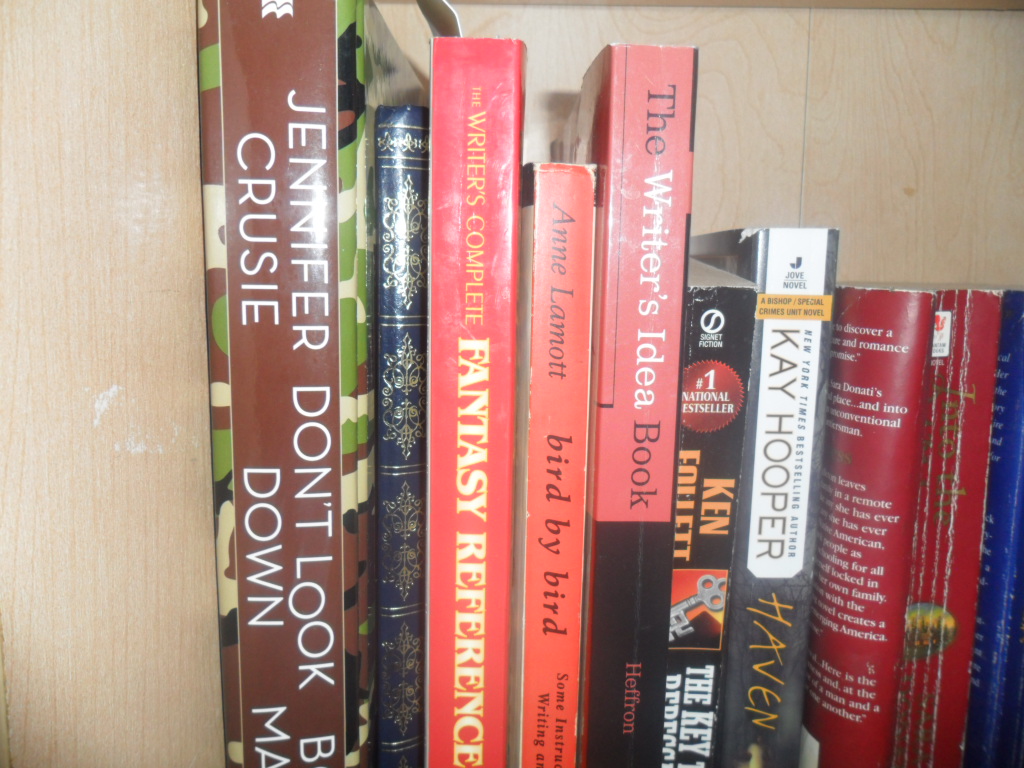
    Image

    Do you see it there?  Right between Jennifer Crusie and the Fantasy Reference Guide …

    It’s an old hardback notebook.  I kept squinting at it, trying to figure it out what in blazes it was when it hit me; it was the first notebook my mother ever gave me.  I’d already shown an interest in writing with “Noises Next Door” and “Noises in the Night” so she bought me this notebook to write in.

    Author’s note:  I was like twelve when I wrote those stories, people.  The titles are bound to suck.  And trust me, the stories were awful, too. 

    So I got up and pulled out that book and started reading the whole six chapter story I wrote in the sixth grade.

    It’s title?  Quest for Bravery … (with “bravery” spelled wrong, no less.)

    I used far too much punctuation and too many people were shouting, and for reasons I can’t understand I actually chose to write in cursive.  (I don’t think anyone writes in cursive anymore.  Not straight cursive, anyway.  I use a bastardized cursive-plain-text-print myself because I know that nobody else has a chance of understanding it.  It’s called author security.)

    The story was about a girl — yes, I’ve always written strong female fighters — who, for reasons I don’t explain in the story, is beholden to a wizard.  Said Wizard’s name was Henry because that was the oldest sounding name I could come up with at the time.  (Again, I was twelve.  And anyway, aside from Prince Henry how many “Henry’s” do you know that aren’t getting up there in years?)

    So anyway, the girl in the story was named Amanda Forcalmer (points to me for not using my own name that time) and she basically served Wizard Henry.  And for six whole chapters she got to meet a prince, fight a dragon, save a princess and then leave said prince.  (Again, points to me for not writing a romance.)

    It was really horrible writing-wise and I laughed as I read it.

    And then I started thinking about how many quests I have been privileged to go on both in my real life and in my writing life.  In real life I have jumped in the ocean in Alaska (that’s cold, by the way), swam in the Caribbean twice, lived in Hawaii, traveled from coast to coast, and been in the Army.  While none of those can be categorized as a “quest” per se, it has been an adventure in learning who I am as a person.

    In my writing life I’ve quested for the Ebony Blade in Sedition, fought against prejudice and for the safety of family in Saboteur.  I’ve hunted for nobility in Witch-Born and learned how fickle Fate can be in Dead Magic.  I confronted the demons of inner self in Deviation and am neck-deep in the quest for self-understanding in Persona as we speak.

    And I’m only 34 years old.

    We writers tend to bemoan how lonely our jobs can be.  We set out to tell a tale that no one else can.  We might get research and inspiration from the people around us, but in the end we’re alone as we write it.  And yes, the solitary act of writing can be hard sometimes.  But it is totally worth it.

    Because we writers are uniquely blessed.  We have quests like no one else in the world.  We create worlds in order to draw out and pinpoint certain aspects of human character.  We see reality differently.  We see people and what motivates them because we understand that the underlying motivation is what dictates what we do as human beings.

    So if you’re a writer then embrace that solitary time.  Take that quest that no one else can and share it.