Tag: Writer

  • Dead Magic Release!

    Witch-Born fans can rejoice today! (That’s right, I said “rejoice” because we really don’t use that word often enough these days.) The sequel and (likely) final chapter of the steampunk-magic-imbued saga has been released through Double Dragon Publishing. 

    Yes, yes, I know … “But you just had your first science fiction (Deviation) released last week!”

    Quiet, mongrels! You’re not rejoicing like I told you to! 

    (I might be a little spirited today. The strap on my favorite purse broke and I am torn between grieving it and celebrating the new release. I apologize for any and all shenanigans.)

    But no, seriously, Dead Magic is officially released. See its understated and quietly brilliant purchase link at the side of this post … Or if you don’t like sidebars you can follow this link to its brand new Amazon page

    Marvel at the steampunky cover art (created by the ever-so talented Deron Douglas)

    deadmagic-510

    Why yes, that does appear to be a naked man in the background. See the tattoos? Witch-Born fans should automatically recognize them!

    Bask, my lovelies, in the blurby thingy that must be placed on all books … 

    Return to the Steam Punk world of Magnellum for the second book in the “Witch-Born” series.

    Magic is gone and Valeda Quinlan knows it, she just can’t prove it. Determined to learn the truth, Valeda finds herself at the mercy of Elsie Delgora, the last known Witch to have ever seen Magic. Scrambling for survival amidst the noble Houses of Magnellum, Valeda agrees to help Elsie in return for Magic’s location. But the help Elsie needs is more than Valeda bargained for. Sent on a mission to find Lord Winslow Agoston, Valeda is confronted by powers far beyond any Witch-Born and forced to take on an even larger role in the fate of Magnellum.

    In all seriousness this book was a joy to write. I had fun with Valeda and Winslow and I sincerely hope everyone else will too. 

  • Space Ships and The Suspension of Disbelief

    Who would win in a space battle; the Millennium Falcon or the U.S.S. Enterprise?

    I know, I know, that’s basically asking if a smuggler can best an explorer when the guns are drawn. Not to mention it dives headlong into the rift of animosity between Star Wars and Star Trek fans. (Personally I enjoy both, but whatever.)

    Whichever space ship you believe would win they both bring to mind a particular structure, a particular image that has become iconic in the science fiction industry. And one of the unique challenges of writing science fiction (space travel science fiction, anyway) is making sure that you don’t copy what has already been done.

    Plus … you know … maintaining some form of realism within the book.

    This requires answering a list of questions from “how does your ship have gravity” (if it has it, of course) to “where’s the restroom” and “what powers the ship” and … The list goes on.

    In the movies we don’t really get those questions answered. Not in specifics anyway.

    Does the Millennium Falcon have gravity? Well, they’re walking normal and there are no floating Wookies so … yeah, it does.

    In books we aren’t given quite as much freedom. While there are some assumptions that can be made, relying on those assumptions too heavily can be seen as lazy writing. Now there are arguments to be made between “soft” and “hard” science fiction, but no matter how “soft” your novel is you still have to walk the tightrope between fiction and reality here.

    There’s only so much a Reader can take before their “suspension of disbelief” is irrevocably lost. Don’t insult their intelligence. They know people can’t breathe in the vacuum of space without some help. They know another planet is going to have a difference in gravity. And they know a space ship has to be uniquely designed for space travel.

    When beginning work on Deviation I knew I was going to have to build a space ship. A ship capable of flight both in the atmosphere and out of it. Thus was born the Lothogy. I do all sorts of things wrong with it and I know it. (I even take the silly thing under water, though in my defense I do address how wrong it is for the ship to go there.)

    I will confess to cheating. My two main characters (Reesa and Kate) are not scientists and are fairly thrown into the world against their will. Most scenes dealing with how the ship functions are done through their point of view because they are really clueless.

    And when things got really tough and my research was making me twitch and I didn’t know how to explain it all, I went back to Kate’s core motivation — getting home to her son alive — which meant she really didn’t care how it worked so long as it didn’t explode around her.

    (Writer’s Cheat #1 — when all else fails, focus on your character instead.)


  • Life Sans Two Fingers

    As pointed out in my previous post, I made a stupid mistake with an avocado and managed to cut the nerves in two of my fingers. Given my chosen profession, this has been problematic.

    While I can hand-write everything still fine (because I’m right-handed and all that), I cannot type with the speed and duration that I used to. The Doctor said it would be six weeks to three months before I started to feel anything in those fingers.

    (Yes, apparently I was really, really aggressive with that stupid avocado. What can I say? I was hungry.)

    The plans I had to start serializing Residual Haunting on June 1st obviously didn’t work out. I’ve decided instead to begin serialization in October. Which, let’s be honest, is likely a better choice given the theme of ghosts and what have you.

    Editing has been slow-going.

    And I do mean slooow going. However, I am beginning to make progress again. All those lovely words I have on paper are coming to the screen. I have, in short, managed to train myself into typing sans two fingers. It’s been difficult, but I’ve managed it.

    Here’s what else I’ve managed to train myself to do without two fingers;

    1) Wash my hair.

    Believe it or not, this is a very difficult process when you’re missing two fingers. I no longer have the full-on scalp massage during the soaping process and must compensate with the other hand in order to make sure everything gets clean.

    2) Drive.

    Now, let me explain that.

    The location of the puncture wound was in my palm, about three-quarters of an inch below the two offending fingers. For a very long time I found myself having to use the heel of my palm to drive. More often than not I drove with one hand, but turning the vehicle became slightly more difficult.

    3) Wrestle with my son.

    He’s a boy. He’s active. He likes to play. For the first little bit I had to learn to wrestle one-handed since … you know … bumping a puncture wound kinda hurts. Now it’s a lot easier. I just can’t feel those fingers and have to be certain nothing untoward happens to them mid-play.

    4) Carrying in Groceries.

    Mhmn. This was a pain. But I worked out a system where I looped several bags on the left forearm and went from there.

    5) … Type.

    I already said it but it can be said again. This was the real kicker, after all. Learning to type without two fingers was quite difficult. There were moments where this really horrible ache would set in and I would have to sit back for a minute or two. That ache is mostly gone now, which is why I’m able to start working again.

    So! This is me … halfway through 2014 and way behind on all my writing deadlines. But I think with a little determination and a couple dozen sleepless nights I might catch up again.

    Deviation and Dead Magic will both be released in August. Persona still has a tentative release date of December 2nd, though for marketing purposes and what have you I might delay that release in 2015. (Hey, it’s my first self-published. I get to pick the time-frame.)

    Usurper is in the middle of the editing process. Sorry, Trenna fans, you’re gonna have to wait a little bit longer.

    And Tapped … Oh, my. Tapped is nearly finished with this latest round of edits. Once that is done, I’m sending it out on submission.

    Yes, good old fashion submission. Because I love rejection. It’s like my favorite thing in the whole world and I can’t get enough of it.

  • Blurbs & The Hated Synopsis

    As of today I have 38,643 words edited in the Tapped novel. According to my calendar I should be on Chapter 11, but I’m actually moving into Chapter 13 next week. I’m supremely pleased with the way it is turning out. Thanks to my developmental editor I’m having a blast fleshing out all those places that were too lean before and bringing more color to the characters/relationships on the page.

    Author’s note : Developmental editors are editors who look at the story as a whole and tell you what works and what doesn’t work. They often note in the manuscript if there are serious grammatical errors because … well, because I think they probably twitch whenever they see you’ve abused every literary device known to man. 

    I also managed to write a new working synopsis to help reflect the changes going into the book. It’s a horrible draft and it’s a mite too long, but at least it’s started so that when I begin the querying process I won’t have to start at square one.

    I’ve decided that blurb and synopsis writing require a different sphere of my brain than my normal writing. And it’s a sphere of my brain that absolutely does not like to work. It’s like a koala when you wake it up in the middle of the day (they’re nocturnal and eucalyptus leaves do fun things to their chemistry so they’re kind of drunk) so what you get when you rouse my koala-like marketing sphere is a hung-over grouch that can barely function.

    So!

    I utilized a marketing professional to help me. She went through my website and suggested several changes that I’ve already implemented (Yay! I’m officially ajmaguire.com!) and helped me draft a blurb for Tapped that looks professional and manages to capture the core of the book.

    The experience working with this professional was quite interesting. She was extremely helpful, kept the dialogue pointed in the right direction, and didn’t admit to cringing when she had to go through the working synopsis to get a feel for Tapped. (Though I’m sure she did cringe at least twice.) She was also reasonably priced and I will certainly be going back to her.

    I highly recommend both developmental editors and marketing professionals to any aspiring authors/writers out there. Both have given me invaluable insight into the business side of novel-writing.

    Tapped – Blurb

    Jorry thought winning a galactic war would be enough to buy a peaceful life. She was wrong. Running from the government she fought so hard for, she carves a simple life out for herself and her family. When her family is dragged into a black market deal Jorry finds herself directly in the sights of those she’s been hiding from and must decide how far she’s willing to go to protect the people she loves.

  • Writing the Unpopular

    Persona is almost finished. In fact, I’ve got approximately two chapters left to write. This is three chapters more than I had outlined, but something happened near the end that surprised me and, now that I look at it, really makes sense for the story. 

    It’s always fun when things work out this way. It means my subconscious brain probably knew this was coming and it took a while for my conscious self to recognize it.

    Anyway, I’ve mentioned before that Autumn tends to spur me into creative-mode. I get new ideas for different stories, or better ideas for current projects, and I start to have a crap-ton of fun. September through December tend to be my happiest months because I am in the middle of this surge of creativity.

    I don’t know why, I don’t know how, I just know it works.

    And this year, having tackled my first historical fiction with Persona (heavy on the emphasis with fiction) I have come up with a new project dealing with the Civil War.

    Well, the Civil War and the frontier. The two tend to go hand in hand since soldiers who fought in the war and survived would head West out of some instinct to get as far away from the battlefield as possible.

    This will be challenging on several fronts. First of all, I really don’t know much about the Civil War. I’ve picked up some documentaries to help remember what I was taught in history class and, funnily enough, have been enjoying them whenever I have a minute between homework and housework and the kiddo.

    Secondly, Dan Wells joked about the fact that nobody reads Westerns anymore. (He’s one of the authors on Writing Excuses, a podcast I sincerely hope every author listens to.) Given that this project would eventually find its way into the West I had to cringe a bit. But, I’d rather write a book that I would love to read than write a book based on trends.

    Even if that trend is several years long.

    No, really. I checked out the Western shelf in Hastings to discover it was drastically smaller than every other section and had all of five prominent authors on it — including Louis L’Amour.

    And I suppose I shouldn’t be surprised by this since I’ve never actually read a Western myself. I watched Lonesome Dove when I was a kid, and High Noon in school, but I can’t say I’ve actually picked up a book that followed gunslingers and the like.

    I did read a truly terrible romance novel based in the Old West. I won’t name the author or anything, but I will say that I scoffed through the first fifty pages and then stopped reading.

    So I am faced with a new challenge here. I love the story concept and the character — I always start with a character and this one is named Alex Huntly — and I’ve wanted to write something that dealt with the West and pioneers since I was in High  School. But the truth is that it probably won’t find a home with a publisher.

    My gut instinct is to write it anyway. I imagine a lot of people would tell me it is a waste of time, but then I have to examine why I write in the first place. And the truth is, I don’t write to please other people. I write the story in front of me because it’s the story that inspires me; be it fantasy, science fiction, historical fiction or, Heaven help me, a Western.

    So! As soon as Persona is done I’ll start the groundwork on this new novel. If only three people in the world read it then that’s fine.

    On a side note, I’ll be using NaNoWriMo to complete the last 15,000 words of Usurper. Trenna fans will be happy to know that this third book in the Sedition series should be out next year, barring any complications with the publisher.


  • Bad TV

    I can’t literally watch television because I’m in school and all that, but I do have Netflix so I can watch various shows.

    (Alas, no Castle on there at the moment.)  So I decided to watch some Star Trek.  There are lots of choices out there for me, but I picked Star Trek: Enterprise because the concept interested me and I liked Scott Bakula.

    Now, my mother always taught me that if I didn’t have anything nice to say then I shouldn’t say anything at all.  So … while I can’t say that the show was awesome and go wildly fan-spastic about it … I can say that it taught me a lot.  And since anything that teaches me how to be a better writer is awesome in my book, this show falls into a strange category of “So Much Potential, So Little Follow Through.”

    (That’s a new category I just made up for stories that fall short of greatness.)

    So here’s what I learned from Star Trek: Enterprise …

    1) You cannot make a hero look good by making all the supporting characters look bad.  

    Captain Archer was repeatedly put into positions where he had to save his senior staff from certain doom, thus weakening his senior staff until one had to wonder how these people got chosen for the first space exploration mission.

    Point in case, an early episode where his tactical officer – Lieutenant Reed (who really wasn’t given enough screen time, by the way) – gets pinned by a mine on the outside of the hull.  And because it makes TOTAL sense that the Captain would be the right man for the job, Archer goes out to have a heart-to-heart with Reed while he tries to disarm the mine.

    It was a blatant appeal to the audience that Archer was supposed to be “the man” on this trip and the story could have been so much better if Reed had been given the opportunity to show what he was made of.

    And that isn’t even the first time a supporting character had been undercut.  I can’t count how many times poor Commander Tucker was made to look stupid.  I get the “good ol’ boy” thing he had going for him, but “good ol’ boy’s” aren’t necessarily weak.  In fact, I could have loved this show so much more if Tucker had been allowed to really be as brilliant as he could have been.

    By the middle of the first season I actually waited to see which character was going to be sacrificed on the altar of Archer’s Awesomeness in every episode.  And in fact, by season three we still don’t know anything more about Archer as a character than what was revealed in the first four episodes of the show; he has a beagle, he likes water-polo, and his dad built the engine.

    Which brings me to point number two;

    2)  Pets do not a character make.   

    Yes, Porthos is cute.  In fact, my son thought he was the best little puppy in the world.  And yes, you can reveal a lot about a person by putting them in the room with an animal.

    Do they pet the animal?

    Do they talk to the animal?

    Do they show compassion and get gushy?

    Or do they run in fear?

    However likable a pet might make a character, you cannot rely on the audience to make a connection with them based solely on this likability.  A hero needs to have more oomph to them.

    3)  Flaws!  Gimme some flaws, please!

    As much as I love Scott Bakula, Archer needed some flaws.  And I don’t mean his over-fraternization with his senior staff.  That’s not a flaw.  That’s a non-military man in command of something that has distinct military aspects (come on, Navy).

    For as much as I hated the way Tucker was massacred in season one, he’s my favorite character in the show.  Why?  Because for every weak moment he had with the Captain, he had some tremendously wonderful moments on his own.  I loved him because he had flaws that I could relate to, moments of indecision and moments of strength that made him who he was.

    4)  When working in a known and beloved Universe tread carefully. 

    I say this because of the weird way the show dealt with Vulcans.  Any Trekkie worth their salt knows that Vulcans are the most repressed beings in the universe.  Yet this show … I mean … it just …

    Ugh.

    Don’t mess with beloved tropes.  If you use them at all, respect the audience you’re going to be using them on.  You’d better have a very, very good reason for turning a culture on its head in a show like this.  And make sure you make it right again when you’re done.

    Because fans will murder you.

    And that’s it.  That’s what I gleaned from watching Star Trek: Enterprise.  Honestly, I did enjoy Tucker’s character.  I didn’t think I would because his accent drove me nuts the first couple of episodes, but after a while I fell in love with him.  In fact, he and Reed made the show bearable for me.  I wish it could have been Archer, but that just wasn’t in the cards for this one.

  • Fact vs. Fiction — Chapter Three (Persona)

    For those following along with the serialization of Persona, here is the Fact vs. Fiction page for Chapter Three.

    So far this whole experience has been incredibly fun!  If you’re just hearing about it, Persona is my WWII novel that is currently being serialized online for free.  You can find it at its Wattpad address or at its story blog.

    But here’s the battle of Fact vs. Fiction in Chapter Three!


    Chapter Three – Fact vs. Fiction


    Fact:  When I was in high school I took German as my second language.  (We totally watched The Sound of Music and The Great Escape during school.  It was awesome.)  But I remember our teacher Mr. Vanburen (yes, I totally snagged his name because he was one of my favorite teachers and I wanted to immortalize him somehow) said that there were different dialects in the German language.  It is much like anywhere else, I imagine, with different accents coming out.


    Doctor Who fans will remember the Ninth Doctor being accused of coming from the north (of Britain) and his response was; “Lots of places have a north!”


    So!  The idea of Uncle George’s “language game” isn’t too far-fetched.  It’s a little weird, but that gets explained as time goes on.  Uncle George isn’t the most honest of fellows, after all.


    Fiction:  I shoved Megan into a converted storage room on board the ship because I really didn’t know where they would keep a stranded girl on board.  I always imagined it was positioned just beside or inside the sick bay so that Herr Schuler could see to her.  Let’s face it, this sequence of events is very fictional and I doubt they had a manual for what to do when they picked up a half-drowned woman.


    Fact:  There really is a place called the Jade Bight.  In Germany it’s called Jadebusen and it’s a bay just south of Wilhelmshaven.  I had to mention it somewhere because, quite frankly, that’s the coolest sounding name in the world.


    Fiction:  This is only a quasi-issue because Megan isn’t in the military and really doesn’t know what’s going on, but in the event someone was taken on board a ship like this they would most likely be kept alive.  The whole “remand her into custody of the port authority” is semi-realistic.  VanBuren would need to give her to his superiors, who would then direct her to military intelligence for interrogation and then relocation to a camp.  (More about this in Chapter Four.)


    Fact:  My original draft of this story had four other POW’s on board the ship, which Megan was kind of interrogated through because Wycoff forced her into the same room with them and then listened to see if she revealed anything.  She then set about trying to help rescue these four men, which she managed during a bit of a battle, but she still got stuck going to Germany because she had to act as a distraction in order for the men to run.


    It was a fun sequence, but after quite a bit of research I dug up the fact that it was very unlikely for prisoners to be taken on board ships like this.  Which meant if I had Megan rescued then I had to dump the other four guys.  I mean, I was already stretching the whole suspension of disbelief, so I needed to trim it down.


  • Story Bibles (aka – Consistency, People!)

    A friend of mine uses a Wiki to keep all her files straight while she’s writing a book.  I’ve seen software designed to help maintain little “sticky-notes” to help authors as they’re in the middle of creating their fiction.  Both would fall under what I define as a “story bible”.

    Basically, that’s the spot the author goes to in order to remember all the crap … uh … I mean brilliant details … they have written to help keep their story feeling real.  Because those details are important.  Details are what keep us grounded in a particular work.

    (I heard a rumor George R.R. Martin got skewered for renaming a beloved horse in one of his books.)

    Easy example … Harry Potter’s round-framed glasses.  If those glasses had changed at any point in the books I think Rowling would have been deep-fried by her fans.  You see those glasses and immediately you’re on the lookout for jumping chocolate frogs (also a detail) and people running for a brick pillar, heading for Hogwart’s train (yet another detail).

    Now then … Until I started writing sequels to my books I never kept a story bible.  The characters and worlds were fairly clear in my head and I was stupid enough to think I wouldn’t really need one.

    Saboteur isn’t really a good example of my needing a story bible because it took place in a part of the Dyngannon world that I’d never visited before.  But as I am currently writing the third book in the series (Usurper) and I am revisiting places both in Saboteur and Sedition

    Yeah.

    I’m wishing I’d went ahead and written one out.

    It’s not so much the characters that worry me — I know who I want to show up where and why and what impact that’s going to have on the story — but the descriptions, the landmarks … those I might have some trouble with.

    My solution?  A notebook.

    I love that people can use technology to make Wiki’s and such, but there is just something about having my scribbles in weird margins, writing running vertical across the page, and using multiple colors that just appeals to me.

    What can I say?  It’s a jumbled mess in my head, it’s going to come out bizarre on the page, too.

    The only exception I have here is the notebook for Tapped.  That story bible is far more organized than any of my others.

    Then again, it does have the outlines and big plot points for 7 novels and novellas in it.  That’s right.  I said 7.  There might even be more than that.  I’m not sure.  I think I could do it in 6 but the whole series has a very episodic feel to it.

    And I’m looking forward to the novellas.  There are at least two of them.  So, technically, I could do the series in 4 books with 2 novellas tacked on.

    I think.

    But really, who wants to put a limit on a series about rescuing refugees?

  • Fact vs. Fiction Chapter Two – Persona

    Chapter Two – Fact vs. Fiction


    Fiction:  I have Megan on board the SS Ceramic and for all intents and purposes she’s headed for London to meet her Uncle George.  However the SS Ceramic was actually headed toward Australia, not England.  Which, of course, is a bit of a problem.  But because I wanted to highlight the tragedy of the Ceramic I went ahead and kept it.

    Fact:  The SS Ceramic had just gone past the Azores when it was hit.  Here’s another little site about this event in history — It even has a big picture for you.


    Fiction:  Here in Chapter Two I have Megan picked up by the Germans.  Let’s go ahead and admit that this was unlikely to happen.  Granted, Henke of the U-515 did pick up Mr. Munday, but that wasn’t a normal scenario.  (Note that in Chapter One Denton does mention to Megan that prisoners were not often taken on board a ship.)  But as this is a fiction book, I went ahead with this section in the hopes that readers could suspend their disbelief long enough to get Megan into Germany.

    Author’s Note:  Because of how controversial the whole sinking scenario felt to me as the writer, I do have a draft of this novel where Megan is shown already in Germany when the war starts.  I have her in a big rush for the border but by the time she gets there everything has closed down.  However, I like this opening better  and since I’m giving it away for free it I decided to keep it.  

    Fact:  The fate of Sapper Eric Munday!  After being rescued from the sea by the enemy, Sapper Munday was interrogated and then taken as a Prisoner of War, where he remained until the end of the war.  There are some books out there about him (which I admit I have not read but fully intend to.)

    Fiction:  The timeline of the sinking is off.  Apparently Ceramic sustained its first hit somewhere around 8 PM but didn’t actually sink until the final torpedo’s struck it around midnight.  Also, here in the second chapter I have the storm abating in the morning when in fact it was around 8 AM when the really big winds started up and the stranded passengers started capsizing.

  • Quests

    So there I was trying to take a nap because I’m either coming down with something nasty or have finally developed allergies — Hopefully I’m just getting sick.  I really don’t want to look forward to a seasonal allergy every year — when I opened my eyes and saw something strange on my bookshelf.

    Image

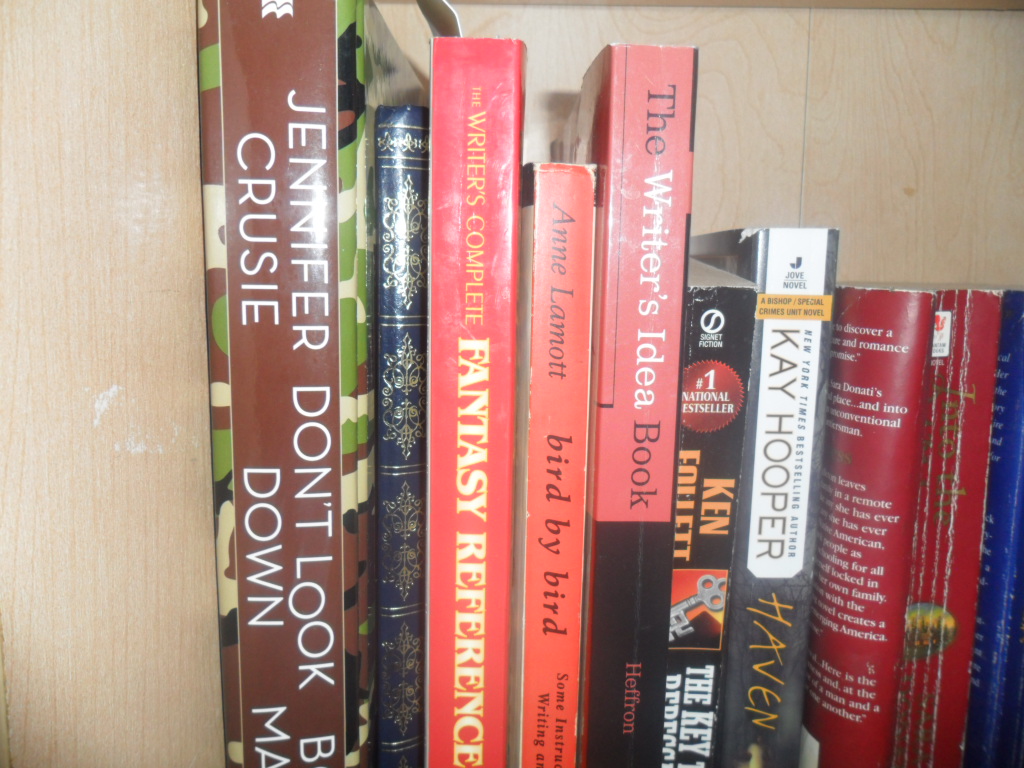
    Do you see it there?  Right between Jennifer Crusie and the Fantasy Reference Guide …

    It’s an old hardback notebook.  I kept squinting at it, trying to figure it out what in blazes it was when it hit me; it was the first notebook my mother ever gave me.  I’d already shown an interest in writing with “Noises Next Door” and “Noises in the Night” so she bought me this notebook to write in.

    Author’s note:  I was like twelve when I wrote those stories, people.  The titles are bound to suck.  And trust me, the stories were awful, too. 

    So I got up and pulled out that book and started reading the whole six chapter story I wrote in the sixth grade.

    It’s title?  Quest for Bravery … (with “bravery” spelled wrong, no less.)

    I used far too much punctuation and too many people were shouting, and for reasons I can’t understand I actually chose to write in cursive.  (I don’t think anyone writes in cursive anymore.  Not straight cursive, anyway.  I use a bastardized cursive-plain-text-print myself because I know that nobody else has a chance of understanding it.  It’s called author security.)

    The story was about a girl — yes, I’ve always written strong female fighters — who, for reasons I don’t explain in the story, is beholden to a wizard.  Said Wizard’s name was Henry because that was the oldest sounding name I could come up with at the time.  (Again, I was twelve.  And anyway, aside from Prince Henry how many “Henry’s” do you know that aren’t getting up there in years?)

    So anyway, the girl in the story was named Amanda Forcalmer (points to me for not using my own name that time) and she basically served Wizard Henry.  And for six whole chapters she got to meet a prince, fight a dragon, save a princess and then leave said prince.  (Again, points to me for not writing a romance.)

    It was really horrible writing-wise and I laughed as I read it.

    And then I started thinking about how many quests I have been privileged to go on both in my real life and in my writing life.  In real life I have jumped in the ocean in Alaska (that’s cold, by the way), swam in the Caribbean twice, lived in Hawaii, traveled from coast to coast, and been in the Army.  While none of those can be categorized as a “quest” per se, it has been an adventure in learning who I am as a person.

    In my writing life I’ve quested for the Ebony Blade in Sedition, fought against prejudice and for the safety of family in Saboteur.  I’ve hunted for nobility in Witch-Born and learned how fickle Fate can be in Dead Magic.  I confronted the demons of inner self in Deviation and am neck-deep in the quest for self-understanding in Persona as we speak.

    And I’m only 34 years old.

    We writers tend to bemoan how lonely our jobs can be.  We set out to tell a tale that no one else can.  We might get research and inspiration from the people around us, but in the end we’re alone as we write it.  And yes, the solitary act of writing can be hard sometimes.  But it is totally worth it.

    Because we writers are uniquely blessed.  We have quests like no one else in the world.  We create worlds in order to draw out and pinpoint certain aspects of human character.  We see reality differently.  We see people and what motivates them because we understand that the underlying motivation is what dictates what we do as human beings.

    So if you’re a writer then embrace that solitary time.  Take that quest that no one else can and share it.