Tag: Writing

  • Fact vs. Fiction – Historical Novels

    Persona is my first attempt at the historical fiction genre and while I love history, I found writing within the confines of known facts difficult. This isn’t too surprising given all my other novels are fantasy or science fiction, but it was still an eye-opener for me.

    Take, for instance, the very first chapter of the novel.

    Without giving too many spoilers, I can tell you that my main character – whose name underwent several changes throughout the editing process – is traveling to England. Young Megan Shepherd couldn’t stay home, not with her father breathing down her neck about the engagement she just called off, so she answers the call to help translate papers for the war effort in Europe.

    The very first version of this novel had Megan in a big, noisy, military airplane.

    Said airplane was shot down. There was a lot of action in that first chapter. It was exciting and fun and I loved it.

    But …

    Given that Megan is not in the military, she would not have been on such a plane. And even if she had been in the military, they did not often fly personnel like Megan to and from their respective workplaces.

    SO … I had to change it.

    Thus, the opening chapter of Persona has Megan on board a boat – the SS Ceramic.

    And yes, that’s a real boat. I know the name is a trifle alarming. I’m not certain I would have boarded a boat called Ceramic, but it existed and it became one of the wonderful things I learned about while researching for this book.

    Still, this serves as an example of one of the things History made me change about the novel. While I was able to stretch a few things elsewhere in the book or gloss over some of the others, I couldn’t risk losing the reader’s trust in the very first chapter of the novel. I had to find an alternative, something to show that I really had done my homework and that I was going to be respectful both to the history I was working in and to the reader’s intelligence.

    I admit that historical fiction feels like more of a gamble to me than many of the other genres. When we’re dealing with science or fantasy, readers automatically walk into it with the sense that they are going to “suspend disbelief” for a portion of the book. They accept that they are walking into the fictional world and want to see what we can make of it.

    Not so with historical fiction, and especially not so with something as well known and documented as World War II. While I need the reader to suspend disbelief a little, to accept that Megan Shepherd is not a real person, many of the events she walks through ARE real. And I had to treat them real.

    Because people died there.

    A lot of people died there, actually. And to treat it with anything less than the utmost respect would have been wrong.


    Persona is scheduled to be released on May 2, 2017
     

  • Endings

    I am on the final chapter for Usurper. There’s an epilogue I’ll write next week (whilst on a plane headed East) but this is the … oomph! chapter. It’s been a long, hard ride for Usurper, but I finally feel confident with what I’ve done.

    Several weeks from now I’ll hate it, that’s just the way my writer-brain works, but for now I’m confident.

    Endings are … difficult.

    I always knew where this book ended, I had a clear picture of that in my mind, but getting there and pulling out the details and digging deep into each character to present how they changed and whatnot …

    Yeah, that’s hard.

    Usurper is the third installment of my Sedition series. Trenna fans have been waiting a super long time for this one so it was important to me that I get it right. Without giving any spoilers, I can say that there is at least one more book – tentatively titled Warpath – and that there may even be another.

    I’ll know more once I do the outline for Warpath.

    For now, however, I will have Usurper completed by March 31st and will move into the edits for Dead Weight – the second installment of the Tapped series.

    Why yes, I’ll be using Camp NaNoWriMo to really push my batoosh into gear when it comes to these edits. With any luck, I’ll have a completed 2nd draft of Dead Weight by June and then a 3rd revision completed in July and then … Polishing/Galley proofs done in August and then …

    I hope to release Dead Weight the first Tuesday of September.

    This is me throwing confetti for goals and deadlines. Now excuse me because … that’s a lot of work and I should get to it.

  • March Round Robin – Emotional Rollercoasters

    Topic: Are you ever emotionally drained by writing certain scenes, and how real are your characters to you?

    Every once in a while there is a solid thumping sound emanating from my desk. It alarms the cats most days but I think my son is mostly used to it.

    Alright, so three or four times a week there’s an incessant banging going on in my little corner. This is the sound my head makes as it smacks repeatedly into my keyboard. It generally happens when I’m having to deal with one of the “problem” characters.

    Right now that character happens to be Liana, who I’ve talked about before. She’s just too full of angst for me to deal with and I can’t handle her for more than a few minutes at a time. But I’ve had other characters that drain me. Brodis Windringham from Saboteur was a deeply bitter man who put me through a ringer.

    Generally speaking, having to write in the antagonist’s voice is always difficult. Their scenes only ever range between 600-1000 words long but once I’ve finished, I have to run off to soak in a bath or take a long walk through the park. Anything to refresh my mind.

    Death scenes drain me too.

    One particular character died near the end of a book and it took me a week to recover. I gorged myself on mint chocolate chip ice cream and Netflix that week, and once I got back to work it was still traumatic for me.

    I suppose that if the death of a character can affect me in such a way then my characters feel very real to me. And in truth they are all, in some fashion or another, a part of who I am. Or at least a sample of traits I would like to inhabit; Trenna with her fearlessness, Megan with her gentle bravery,  Seach’s selflessness, Elsie’s sense of duty …

    You get it.

    The characters on the page are alive because they display the gamut of human behavior. I imagine this is the same as when you’re reading a favored book. Take, for instance, The Infernal Devices series by Cassandra Clare. I recently reread this series from start to finish (it’s 3 books long and includes Clockwork Angel, Clockwork Prince, and Clockwork Princess) and I was asking myself why I loved them so much.

    These books can be found in the young adult section, which I rarely read but in this instance I find the books beautiful. Clare’s handle of language, the way she weaves classics into the narrative and lets books affect the characters on the page, never ceases to impress me.

    Beyond that, however, are the characters themselves. Tessa and Will and Jem are unique and yet, they couldn’t possibly exist without each other. Together they tell a story of love and loss and grief and hope; a story I am very grateful to have been able to read.

    It is my hope, and I imagine it is the hope of every author out there, that their characters come alive for those who take the time to read. It’s only when those characters really breathe on the page that they have any hope of being memorable.

    So, essentially, if the characters didn’t feel real to me, then I think I would have missed the whole point of being an author.

    Join our Round Robin discussion this month and take a peek at what some of my fellow authors have to say about emotionally draining scenes and the realness of characters on the page …

    Participants:
    Victoria Chatham http://victoriachatham.blogspot.ca
    Marci Baun  http://www.marcibaun.com/blog/
    Margaret Fieland http://margaretfieland.wordpress.com
    Judith Copek http://lynx-sis.blogspot.com/
    A.J. Maguire  https://ajmaguire.wordpress.com/ (YOU ARE HERE)
    Connie Vines http://mizging.blogspot.com/
    Rachael Kosinski http://rachaelkosinski.weebly.com/
    Dr. Bob Rich htt  http://wp.me/p3Xihq-Wo
    Heather Haven http://heatherhavenstories.com/blog/
    Beverley Bateman http://beverleybateman.blogspot.ca/
    Kay Sisk http://www.kaysisk.com/blog
    Diane Bator http://dbator.blogspot.ca/
    Helena Fairfax http://www.helenafairfax.com
    Skye Taylor http://www.skye-writer.com/blogging_by_the_sea
    Rhobin Courtright http://www.rhobinleecourtright.com

  • Camp NaNoWriMo


    IMG_0494
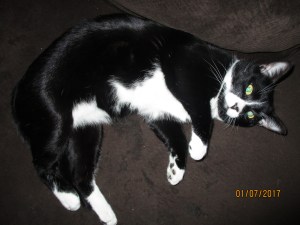
    Nuisance will likely keep me from working too much this April.

    April 1st signals the start of another Camp NaNoWriMo, which is one of those events I look forward to. If you’ve never heard of it, you can visit their page here. In short, they’re kind of an offshoot of National Novel Writing Month, they just take certain months throughout the year to have another little get-together for writers.


    You can work on a brand new novel or you can do what I’m going to be doing this year … Editing/rewriting a novel. I hope to have all of the original work edited by April 30th so that all of May can be spent on new chapters.

    Currently, I am wrapping up the last 3 chapters of Usurper and will have that manuscript completed on March 28th.

    Why March 28th?

    Well, because I’m going on vacation that day. I could get some work done on the plane if I

    IMG_0498
    Pest will likely crawl in my lap and force me to work. 

    wanted, and likely will, but I’d rather have the bulk finished before the first boarding call. That way I can enjoy said vacation and return home relaxed and ready to tackle Camp NaNoWriMo.


    If you’ve never tried any of the writing months and you’ve been toying around with the idea, I highly recommend one of the camps. They are a bit more relaxed than the big event in November and, at least for me, I tend to celebrate any work that gets on paper that month.


  • Old School Textbooks

    Alright, so I graduated in 2014 and the textbooks aren’t that old. Still, I did graduate (cum laude, thank you very much)  and I haven’t touched them since. In fact, the whole school thing feels very distant to me now.

    Did I really manage to go to school for three straight years, no summer breaks, all while holding down a full-time job, caring for my child as a single parent, and somehow finding the time to write?

    How in blazes did I do that?

    I must be a superhero, seriously. Or I had divine Grace on my side.

    It’s probably divine Grace.

    Anyway, I decided to pick up one of the old history books this week and start re-reading it, this time for fun.

    Yes, reading a textbook can be fun. And in this case, it was both fun AND inspiring. While reading The Heritage of World Civilizations, I stumbled over one sentence that threw my creative muse into a whirlwind.

    It was about plastered skulls as memorial art in the Neolithic Period and I decided I had to use that somewhere. It has become a detail I’ll be putting in Swans (the Fantasy I’ve been working on) and with a little brainstorming with a very handsome and intelligent man, I have sealed it into the outline.

    One line in a history book and suddenly I have a really cool, fun detail and sequence of events to follow through my novel.

    Old textbooks are fun. Really. If you have some lingering at home you should pick one up. I’m not sure how Accounting 101 or Trigonometry might help in a novel, but I have every faith in your creative powers. There might be something in there you can use, you just have to take the time to look.

  • A More Textured Story

    Stories are not just about the characters on the page. True, they hold the bulk of our attention, but they would not exist outside of the world in which they live. We’re taught as authors that in order to sell the books that we write, we have to have character and conflict.

    There are even formulas we are given while attempting to write query letters that focus solely on the character and the plot. But when push comes to shove, a lot of us aren’t reading a novel to see character and plot.

    No, we’re there to experience a new culture. We’re there to meet more than just the protagonist, we’re there to see the kind of world that only the author could dream up.

    We want to explore big ideas, such as the Trappist system that was just discovered by NASA. How many people are already imagining what it might be like to live there?

    I certainly know I am.

    But then, I did the same thing with Gliese – which is about 20 light years away from Earth and has several little planets orbiting it.

    Gliese became the “shadow of the Big Bad” for my book Tapped. Rather than Earth being the host of civilization, I moved humanity to Gliese and made Earth a backwater town.

    I have plans for Gliese. Big plans. Epic plans that I’m excited to implement in the coming novels. (And with Trappist just being discovered and all, you can bet I’ll be finding a way to nudge them into the Tapped series too.)

    But beyond exploring new places, novels are also supposed to highlight the complexities of human nature. We read them to help us understand ourselves and the world around us. We just get to do it while jumping from planet to planet or befriending a dragon.

    The texture of our stories is what makes them memorable. Harry Potter would not be nearly as memorable without Hogwarts and its talking paintings, moving stairwells, and history. Sure, we got a story about good vs. evil, but we got on broomsticks and with wands.

    So how do you create this texture in a novel without info-dumping or making the book so long nobody will dare pick it up?

    Well … I can tell you what I do.

    I write the first draft.

    And I don’t think about how long it is. I just write it. Anything and everything. Flashbacks, lengthy info-dumps, whatever I need to understand the depth of my own story.

    And then … I edit.


  • Description – February Round Robin

    TOPIC:

    Description. What is your saturation point? What is not enough? How do you decide what to include and when to hold back to allow the reader to fill in the blanks? 

    With several books under my belt now I’m going to have to admit that … each work is different when it comes to description. I’ve found that Fantasy novels tend to be very description heavy, relying on your ability to craft a picture with words in order for readers to really plant themselves in your work.

    However, science fiction tends to be different. Or at least for me it is. While I still have to describe what it’s like to be spelunking through Pluto, it comes off quite different from when I’m describing a character crawling through caves in a fantasy world.

    This might be because the basics of Pluto are already given to me by science so I don’t have to reach very far to bring out those descriptions, whereas with a fantasy novel I’m trying to link the reader’s mind with something familiar and yet strange to evoke a unique picture.

    Or it might be that the readership is just plain different.

    A lot of people read science fiction for the possibilities it inspires and a lot of people read fantasy to escape and immerse into a new world. Which means that description has to be tackled in such a way that you’re giving the reader what they were hunting for.

    Here, lemme give two examples …

    FANTASY – Torven 

    The snow muffled his steps through the wood, chilled the pads on his feet and made the fur on his legs plaster wetly against his skin. An aching stillness was in the forest today, broken only by the whisper of branches high overhead and the distant gurgle of a half frozen stream somewhere to the west of him. He would need to go there soon, it had been too long since he’d had a drink and Torven had been travelling some distance since the morning.

    Still he tarried, continuing his lonely trek for several meters before diverting toward the stream. Snow began to drift soundlessly from the sky, catching on the leaves and piling on the ground in large, fat flakes. Some fetched up in the fur on his back but he could not feel them, would not feel them until his body heat finally melted them down to run icy rivulets over his skin.

    Being a wolf did have some advantages, he supposed. It would not be as cold for him as it would be if he’d been a man.

    SCIENCE FICTION – Debriefing (novelette under construction)(Mild language warning)

    “This is bullshit,” Seach said from his bunk.

    The tight confines of their transport vessel made his commentary unavoidable and Jorry sighed, pinching the bridge of her nose. Thirteen years at war hadn’t managed to temper Seach Barlow’s penchant for insubordination and she was beginning to believe he might never be cured. Her navigation chair squealed as she turned to face him.

    The back of the ship consisted of four bunks standing parallel to each other with one small space to walk between them. The low ceiling curved into a semi-circle and one set of thick yellow bracings separated the pilot’s nest from the main hold of the transport. Seach lounged in the top left bunk, one booted foot hanging over the side and she could see his frown through the holographic screen created by his personal computer. His amber eyes glared at the information he was reviewing and her stomach knotted with new worries.

    He was reading their new orders.

    See how the descriptions differ? The fantasy work is very focused on painting the picture whereas the science fiction gives more of a basic view of where the characters are standing.

    Beyond that, we’re also having to look at what’s going on in the scene. If it’s an action scene we obviously don’t want to pause for a lengthy description of what the opposition is wearing. But we also don’t want to be so sparse with our descriptions that the reader doesn’t quite understand what is going on.

    For me personally, I try to focus on the character in front of me. The descriptions can’t just be there to look pretty, they have to affect the character too. I’ve found that description says more about character than many people realize because, while I might see the dawn as a sign of hope and inspiration, to a character whose execution has been scheduled for the morning it would be something far more sinister.

    This is how I decide what to include and what to take out. If the description doesn’t add to the tone of the character, if it doesn’t somehow reveal something about that character, then I cut it.

    Take a look at what some of my fellow authors think about description …

    Marci Baun  http://www.marcibaun.com/blog/
    Skye Taylor http://www.skye-writer.com/blogging_by_the_sea
    Beverley Bateman http://beverleybateman.blogspot.ca/
    Anne Stenhouse  http://annestenhousenovelist.wordpress.com/
    Dr. Bob Rich  https://bobrich18.wordpress.com/2017/02/18/description
    A.J. Maguire  https://ajmaguire.wordpress.com/ (YOU ARE HERE)
    Rachael Kosinski http://rachaelkosinski.weebly.com/
    Diane Bator http://dbator.blogspot.ca/
    Rhobin Courtright http://www.rhobinleecourtright.com

  • Character Building

    So I’ve been talking a lot about all this world building stuff and it occurs to me that the creation of character is intimately involved in this process. Elizabeth Bennett would not be the character so many women love if not for her house full of sisters, her loud mother, and her bookworm of a father.

    Nor would she be the poised, respectful woman that we know if not for the society in which she was brought up.

    Claire Fraser from the Outlander series would not be the character we enjoy if she hadn’t survived WWII as a nurse. Nor do I think she could have survived half as well in Jamie Fraser’s life without that experience.

    Last week I discussed how I was using both my antagonist and my protagonist to help form the political spectrum of my upcoming fantasy novel Swans. I have a series of questions that I pose regarding how much or little power each of the characters have, where they got that power, and how they can use it.

    That’s all plot and world building.

    To understand the character, I have to ask the question of why they would or would not use said power.

    Example:

    Antagonist – Why is he pushing for slavery laws? Beyond what he can gain monetarily, why is he alright with the concept of people owning people?

    Well, these two societies have been at war before. He’s seen first hand what can happen when two ultimately similar cultures come to blows and in his mind, keeping one culture enslaved is the lesser of two evils.

    What does this tell me as the author?

    It tells me he’s a veteran. It tells me he’s lost a lot of people he cared about. And it tells me he never fully approved of the marriage between his cousin (the King) and the Arundan Queen. Which means he has no qualms killing my hero and squashing any claim the Arundan people might have to the throne because, in his eyes, it’s the only way to preserve his own way of life and his own people.

    It also tells me that this society is going to have a lot of bitter, frightened people. The division between these two cultures is deep and painful. And it tells me that there will be historical sites, battlefields and such, in the landscape that my characters can cross.

    Again, I start with my antagonist. This is a new process for me as I’ve almost always started with the protagonist and built everything around them, but I have to say that it is clearly working. I have a much, much better handle on the plot and what this story is truly about than I normally do at this point in the process.

    For any authors out there, I’d highly recommend building from the antagonist first. Keep the protagonist and antagonist side by side in the process. Whatever you ask for one, you need to ask for the other to keep it balanced and, ultimately, to keep the story interesting.

  • January Round Robin

    When I was in the sixth grade my teacher gave us an assignment that would change my life forever. She began by reading an excerpt from a Fantasy where a person was climbing a mountainside, desperate to get to the cave near the summit.

    Only then she stopped.

    The assignment was simple; we had to write a page and a half continuing the story. What was in the cave? Who is this person climbing and what are they trying to accomplish?

    I took to the assignment with zeal, possibilities exploding in my little sixth-grader head as my pencil did the nearest approximation of cursive writing across the page. Only, I couldn’t stop at a page and a half. Before I knew it, I had an entire notebook filled with the adventures of Amanda Call, a princess warrior from a mythical race of beings whose only purpose in life was to complete tasks divvied out to her by her Wizard.

    SAM_2191Its title was A Quest of Bravery and I still have it on my bookshelf today. It’s just a little thing and my cursive was atrocious back then, but seeing it always makes me smile. It reminds me of that moment in the sixth grade when I realized that magic really does exist.

    That’s the moment I got started with writing and that magic has followed me ever since. I sense it every time I start a new book, all those endless possibilities swirling around in my head until I find the one that needs to be said, the one that highlights something important about what it means to be human.

    That’s why I write.

    That’s why I can’t stop writing.

    Every book teaches me something, be it about the craft of writing itself or about some aspect of humanity that I struggle to grasp. I think that if I ever stopped writing, it would be tantamount to saying I knew everything and had no need to learn more.

    So every book becomes a quest for me, a journey that I must take to better understand myself and the world around me. It’s hard work and sometimes I want to quit, but I’ve found that the harder it is, the more rewarding the ending will be.

    Check out what got my fellow authors involved in the craft of writing and what helps them move forward!

    Skye Taylor http://www.skye-writer.com/blogging_by_the_sea
    Margaret Fieland http://margaretfieland.wordpress.com
    Heather Haven http://heatherhavenstories.com/blog/
    Dr. Bob Rich http://wp.me/p3Xihq-SK
    Connie Vines http://mizging.blogspot.com/
    Victoria Chatham http://victoriachatham.blogspot.ca
    Helena Fairfax http://www.helenafairfax.com
    Beverley Bateman http://beverleybateman.blogspot.ca/
    Marci Baun  http://www.marcibaun.com/blog/
    Judith Copek http://lynx-sis.blogspot.com/
    Rachael Kosinski http://rachaelkosinski.weebly.com/
    Diane Bator http://dbator.blogspot.ca/
    A.J. Maguire  https://ajmaguire.wordpress.com/  (YOU ARE HERE)
    Rhobin Courtright http://www.rhobinleecourtright.com

  • Weather and World Building

    img_0486
    So much snow.

    It seems that Mother Nature has decided to kick off 2017 with a laugh. My son has not been back to school since leaving for Christmas break and we’re both getting a trifle antsy about that.

    I got stuck in the snow twice already and we just got even more, which is just … glorious.

    But as with everything, this brings to mind writing problems and techniques. Specifically weather patterns.

    Weather has an impact on characters and setting and even plot in a novel so it’s important to pay attention. Currently I’m world building for a novel tentatively titled Swans, which is a High Epic Fantasy … if you want to get technical.

    As I was world building I came to a mountain range and at first I envisioned tons and tons of snow because … I’m currently surrounded by the stuff. But then I remembered that scene from Lord of the Rings where they’re climbing the mountain through the snow and Legolas is leaping lightly on his elegant elf feet and snow is matting in Gandalf’s manly beard and …

    img_0482
    Nuisance looking quite unsure about the snow

    Yeah.

    I think just about every fantasy novel takes a walk through waist deep snow on a summit somewhere.

    Well, not every one. But certainly a lot of them. And while it might be a beloved cliche, it’s also something I want to try to avoid. I don’t want readers thinking; Same old, same old. Girl hasn’t got an original thought in her head.

    So!

    I changed some of the weather patterns for the novel. Not tons, but enough to make it different (I hope).