Tag: Writing

  • How to Write a Dude

    Devon Barlow is a headstrong young man nearing his twenty-first birthday. He’s highly intelligent, very physically active (he goes spelunking on Pluto, how cool is that?) and he has a strong suspicion that his parents might just be pirates. Save for brief forays on Mars or Earth during the holiday seasons, Devon has lived the bulk of his life on board Zephyr, a hauler-class space ship. 

    I am a thirty-something single mother who reads too much and spends an embarrassing amount of time on video games. (Hey, games help keep my creative brain fresh and stuff. Don’t judge.)

    So how does a thirty-something single mother find the “voice” of a twenty-year-old boy in order to believably display his character on the page?

    Well … I read a lot. 

    I did say I read too much, didn’t I?

    In this case I deliberately hunted for books with young male points of view (really not that hard to do, you can find them in just about every book you pick up) and I studied them. I looked at what they thought or felt or did differently from how I might have reacted in any given situation and I jotted it down in a notepad. 

    I also talked to guy friends. If there was a situation happening on Zephyr in the book that could be easily translated into day-to-day life, I would nudge a guy and ask; “Hey, when you were twenty what would you have done if …”

    Disclaimer: These friends know I am an author. They find it highly amusing when I quiz them about what it’s like to be a dude and are more than happy to help out. However … most of them still think I’m crazy so … do this at your own peril. 

    That said, Devon Barlow might be a twenty-year-old young man but he is also a human being. He may think and feel differently from me but that does not mean I cannot relate to him. (Except for the pirate thing. I never suspected my parents of being pirates.)

    Fiction is the place where we can mind-meld with the world around us. It helps us understand people precisely because we find ourselves relating to characters vastly different from us. It teaches us to look at the core motivation in people because we know that, male or female, that motivation is what’s going to define them as a person.

    So!

    How to write a dude when you’re a girl?

    1) Read. (You should be doing this anyway if you’re a writer.)

    2) Observe and/or ask your guy counterparts.

    3) Find the core motivation.

    … and if anyone else has tricks to writing the opposite gender I’m happy to hear them. I’m sure I missed a few.  
  • Deviation Release!

    If I had spaceship shaped confetti I would totally be throwing it everywhere right now!

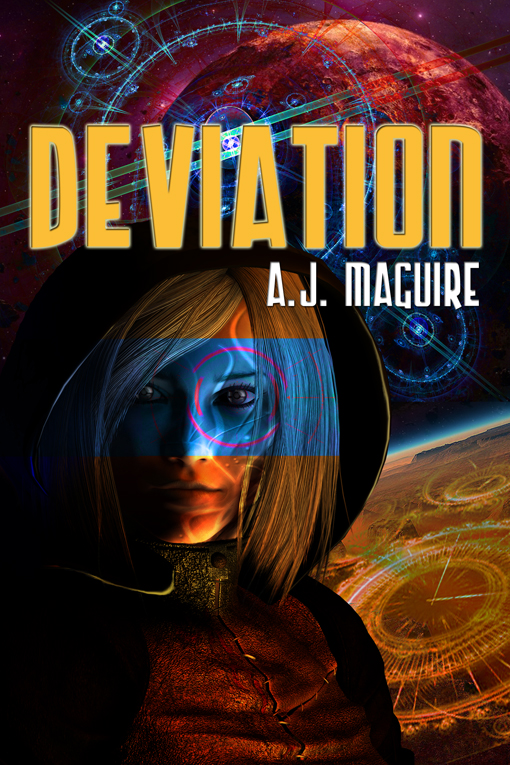
    My first ever science fiction, Deviation, has been released by Double Dragon Publishing. For right now I only have the publisher’s purchase link but as soon as it becomes available on Amazon and Barnes&Noble I’ll be certain to shove those links up everywhere.

    Look at the pretty, shiny cover!

    Look at all the pretty colors!

    See the pretty shiny blurby thingy! (OK, so this is the longer version. You can see the shorter version everywhere else.)

    On the brink of a religious war between Makeem and Novo Femina, Celeocia Prosser’s struggle for gender equality leads her to Reesa Zimms; the one woman in all of history who can identify the first Mavirus victim. Believing the information surrounding this patient zero to be pivotal in the fight against the Makeem, Celeocia sets her sights on Reesa Zimms, also known as Caresse Zimmerman.

    There’s just one problem; Reesa Zimms is a science fiction novelist who lived and died hundreds of years in the past.

    Utilizing wormhole travel and antimatter discs, Celeocia sends her son Hedric and the crew of the Lothogy careening through time. When Hedric finds Reesa, the novelist is accompanied by her best friend Kate, who just happens to look like his recently murdered wife.

    Stunned and reeling, Hedric abducts both women, bringing Reesa and Kate on a not­so­gentle ride into the future.

    Time travel might be easier for Reesa to accept because Hedric Prosser, the High Priestess, and the very ship they’re traveling on, all belong in Reesa’s novels. Confused and pretty sure she’s going insane; Reesa tries to prepare her friend Kate for the very male­dominated society they’ve been dumped into. When she finds herself abandoned by Hedric, Reesa must rely on Matthew Borden, the villain of her books, to rescue Kate and fight their way home.

    Hear my squeal of delight to finally see this work out in the open!

    No, seriously, Deviation and I have a rather long history. I started writing it in 2008 through Lazette Gifford’s Two Year Novel Course — which I highly recommend for anyone who has been toying with the idea of writing a novel but feels they don’t have the time.

    I actually took the class, which started the first week of January so when I say I started writing it in 2008 I really mean I started writing it in 2008. Which means I’ve been working on/editing/shopping this book around to various publishers for six years now.

    Six!

    I could blame this on the fact that I was in school for three of those years, but the truth is that I was just nervous. This is my first science fiction ever and I wanted to at least try to get it right.

    So … I did a lot of research. Granted, I deliberately ignored some of said research because … you know … FICTION … and I needed things to work with the story. But still, I did a LOT of research.

    Mars in particular was fun but I’ll make a whole post dedicated to Mars and all the things I broke while trying to make the planet habitable.

    Not today, though.

    Today I’m throwing confetti and marveling at the artistic talents of my publisher and enjoying general revelry.

  • Favorite Scenes — Dead Magic Edition

    I promised I’d post my favorite scene from the upcoming novel Dead Magic so … here we go.

    Once again, I’m not one of those people who likes spoilers  … Unless I get invested in a character, then I have to know if they survive the book/story. No, really, I flip to the end of books and hunt for names just to make sure they’re still there. I won’t read the whole thing, I’ll just check if they still have dialog and then go back to reading like normal.

    I know, I’m terrible.

    Anyway, I won’t give any spoilers but I will post my favorite scene. I’ll give the barest amount of setup for this one — this scene happens early(ish) in the book and I cut it off before anything major can be revealed. Fans of Witch-Born will recognize the two characters (Dorian and Elsie). These two do play a major part in Dead Magic but as I’ve said before the book itself is more focused on Winslow Agoston and Valeda Quinlan.

    Why do I love this scene in particular?

    I think because it’s honest. Dead Magic takes place eight years after the ending of Witch-Born. Things have changed. Relationships have strained and while the love between Elsie and Dorian is still every bit as strong as in Witch-Born, all is not perfect.

    Please note that this is an unedited version of the scene. 

    Dead Magic: 

    “Why would you promise that woman something you know you can’t give her?” Dorian half chased Elsie around the western perimeter of the ark, thoroughly annoyed that he’d been forced to hunt her down again.

    “Who says I can’t give her what she wants?” Elsie kept a brisk pace, lithely avoiding the overgrowth of jungle around them. Her black hair was pinned up in a tight bun, making the exotic, angular curves of her face more prominent. If he hadn’t been suppressing the desire to strangle her Dorian might have given her a compliment.

    “The Council says you can’t.” He had to catch himself on a fallen bit of tree when she abruptly stopped. The moist ground slid away from his left foot and he quickly found a better standing spot.

    The ark was built precariously close to the edge of the ridge-line, its entire circumference taking up a four mile wide, three and a quarter mile long declivity in the mountain range. The egg-shaped monolith of iron and steel was far enough from any towns that it looked like a shadowed lump of hillside at a distance. Up close, however, it was big and bulky and looked quite impenetrable. Which, he thought with a frown, was the point.

    Elsie turned to an iron ladder built into the side of the wall and prepared to climb. Dorian grabbed her elbow to stop her. There would be people wherever she was heading and they needed to do this conversation in private.

    “You promised, Elsie.”

    “No,” she said. “As I recall it, you are the one who promised silence, not me. I stood there like an idiot, trying to remind myself why I didn’t kill them all where they stood.”

    “Elsie. Think of the hysteria that would happen if word got out.” Dorian moved closer to her, glancing at her gloved hand and preparing himself for the battle he’d just stepped into. “If Valeda Quinlan publishes the fact that Magic is dead, the Untalented will panic. There will be riots and mayhem and a lot of innocent lives will be lost.”

    “Even the Witch-Born will panic, Dorian. Talented or not, all of Magnellum’s fate rests on the Warding Pillars. Panic is exactly how the people should be reacting.” Elsie scowled at him but didn’t move, still poised to climb the ladder. “The Wild is coming, Dorian. It’s coming and there’s very little we can do about it.”

    “The Wild has been ‘coming’ for eight years now, Elsie!” Exasperated, he let go of her and shoved his fingers through his hair. “By Fates! I’ve been listening to you for eight long years. I’ve watched you build this … this …” He waved at the side of the ark in frustration, “this insanity using resources you shouldn’t have. Don’t try to deny it, either. Delgora was rich when you ascended to House Witch, but it wasn’t this rich. You’ve been spending more money than we’ve got, insistent that world is about to end, and for what?”

    Elsie blinked up at him, her caramel eyes glimmering with an emotion he couldn’t recognize.

    “The Warding Pillars haven’t failed, Elsie. There’s peace in Magnellum right now. You cannot overturn society on a whim.”

  • Favorite Scenes — Deviation Edition

    Someone asked me what my favorite part of Sedition was the other day and I sort of stood there, struggling for an answer. I finally said that Trenna was my favorite part of the book, but she shook her head and asked for a specific scene and then proceeded to tell me hers.

    Which, let’s be honest, flattered me beyond all hope because Sedition has been out for several years now and she’s still gushing to me about it. (And berating me for not having Usurper in her hot little hands yet. I promise, it’ll be out next year.) It was a nice little ego-stroke and I’m trying hard not to let it get to my head.

    At the risk of spoiling the beginning of the novel I’m going to go ahead and say what my favorite scene of Sedition is. Well, it’s not much of a spoiler because it is so early in the book and it doesn’t give much away. My favorite scene is when Trenna gets knighted and tells Nelek he’s going to regret it.

    But I have loads of favorite scenes in all of my books. It’s why I keep writing, these scenes just keep cropping up. (I think that’s normal, actually. If I didn’t have a ton of favorite scenes then I wouldn’t be able to write the books.)

    Since Deviation and Dead Magic will be coming out this month I’ve decided to post snippets of my favorite scenes from both. We’ll start with Deviation today. I’m not going to give any setup for the scene because that might spoil the book, and I’m not going to explain why I love this scene so much because honestly … I’m not sure myself.

    Deviation:

    Reesa swallowed hard and forced herself to look him in the face.

    He had read the book.

    His blunt jaw was held tight, his lips pressed so hard that the edges went white with strain, and there was the tell-tale tick at the corner of his left eye.  God help her, she knew him well enough to know that her life was in danger.  Flawed characters made the best characters, so she’d made Hedric a mess of reckless behavior.  He was an unstable, quixotic, volatile, walking bringer of death.  Mesa had been his saving grace, a counterbalance, and now she was gone.

    For long minutes he just stood there, probably hoping she would fall over dead with the way he was looking at her.  Misery and torment contorted the long, jackal-like features she’d made him famous for.  She needed to do something, explain herself, apologize, anything to ease him before he struck her.

    When he finally spoke, hoarse and low, she felt fear like a rod of lightening in her spine. “You did this,” he said.

    Because she didn’t know what to say, Reesa lifted her chin and fought for a brave glare.

    “How could you?” he asked.  When she still didn’t respond he closed the gap between them, slamming a fist into the wall behind her with enough force to make it dent. “How could you?” he shouted again.

    “It was a book! Fiction!”

    Hedric gripped her tank-top and lifted until she lost footing, levering her body against the wall and bringing his face inches from her own. “Does this feel like fiction to you?”

    ***

    And … I’ll stop you right there, because I’m cheeky like that. When the book comes out you’ll get to see where in the story that scene is.


  • Book Review – Incantation by Annamaria Bazzi

    The beginning of this book was a little rough. I had a hard time understanding what was going on, which might have been done on purpose since the character didn’t know what was going on either. As a reader this was a trifle frustrating since I prefer to know just a little bit more than the character on the page. After having finished the book, however, I understood a bit better and can appreciate the way the beginning was crafted.

    I’m not one for giving spoilers so I’m having to refrain quite a bit on what I say here. The magic system was glossed over a bit, but given that the main character had no idea how to use magic it doesn’t detract from the story. After I got the hang of what was going on I really enjoyed the characters and the story being told. There was a moment near the end where I got very uncomfortable due to the general nastiness of the antagonist in the book, but the author managed to yank the story away from the precipice just in time. (Though that rescue did come via magic and the author risked Deus Ex Machina in that regard, but given that the whole story was based on wizards and magic it did make some sense.)

    But my favorite part was the end. I was more than satisfied with the way the story concluded and with that in mind would have to give this book four out of five stars. (Or whatever symbol floats your boat. On Goodreads and Amazon I’ll be using stars so I might as well carry that over here.)

    Book Blurb:

    Magic is an illusion. It doesn’t really exist. Or does it?

    A horrible car accident destroys Dolores Reynard’s life. But instead of waking up in a hospital bed, she awakens in a teenager’s body. Soon, she discovers she is at the heart of the murderous mystery surrounding the death of Mona, the young girl whose body she occupies. Caught between an evil greater than she ever imagined and a wizard who heals her tattered heart, she is forced to play a dangerous game of intrigue in the hopes of finding a way to return to her previous life.

    Will magic be her ally, or will it lead to her demise once and for all.

    Book Links:

    Amazon / smashwords / B&N

    ~ABOUT THE AUTHOR~

    Although born in the United States, Annamaria Bazzi spent a great deal of her childhood in Sicily, Italy, in a town called Sciacca. Italian was the language spoken at home. Therefore, she had no problems when she found herself growing up in a strange country. Upon returning to the states, she promised herself she would speak without an accent. She attended Wayne State University in Detroit Michigan, where she obtained her Bachelor of Science in Computers with a minor in Spanish.

    Annamaria spent twenty years programming systems for large corporations, creating innovative solution, and addressing customer problems. During those years, she raised four daughters and one husband. Annamaria lives in Richmond Virginia with her small family where she now dedicates a good part of her day writing.

    You can visit Annamaria at:

    blog http://annamariabazzi.com

    website http://www.annamariasbooks.com

    facebook page https://www.facebook.com/Author.annamariabazzi

    email annamariascorner@yahoo.com

    twitter https://twitter.com/AMBazzi

    goodreads https://www.goodreads.com/author/show/6890526.Annamaria_Bazzi

    Check in on Kendíka’s facebook page https://www.facebook.com/kendika.burkeshire


  • Steampunk Flavor

    So there I was trying to write a straight romance novel for National Novel Writing Month in 2008, bored to tears because … well, I guess I’m just not made to write romance novels … when my friend suggested I make the story “steampunk.”

    I had no idea what “steampunk” was at the time, but in the spirit of NaNoWriMo I took up his challenge. The world of Magnellum, where Witch-Born and Dead Magic take place, was given a distinctly “steampunk” flavor in all its trains and dirigibles and telegrams, but it does fall short of being an actual “steampunk.”

    Real steampunk would focus more on the steam-powered technology and how it works and how it affects the characters and … you get it. Witch-Born and Dead Magic do not do this. They focus more on the magic in the world, thus detracting from the steam-tech on the page.

    That being said,  I enjoyed the flavor. It opened me up to new possibilities within the novels like the dirigible — because who doesn’t love a good dirigible? And it gave me Valeda Quinlan.

    Valeda is a newspaper reporter. The distinctly steampunk flavor of the novels sort of threw the concept of a reporter at me. I mean, if they have telegrams then they have newspapers. If they have newspapers then they have reporters.

    Yes, Valeda is unabashedly a character trope. She’s as nosy and tenacious as they come. But she gets thrown into a situation where her talents as a reporter can’t help her, which is what makes her so fun. I do love “fish-out-of-water” stories.

    Valeda is also more at home with the steam-technology prevalent in her world. Where the Witches of Magnellum tend to avoid mechanical contraptions, Valeda sees nothing wrong with them, so Dead Magic explores these things a trifle more.

    The original draft even had a massive clock with all its gears and shifts for me to play with, but in the end that was edited out of the book. It distracted from the main storyline and had no real purpose than to blare “STEAMPUNK FLAVOR” at you.

    In fact, there were many such instances like that one where I had to walk the tightrope between too much flavor and not enough. Perhaps one day I will make a revised edition of Dead Magic that puts all of that flavor back in, should Readers desire it and I feel so inclined. For now, however, the work will stand as it is.


  • Space Ships and The Suspension of Disbelief

    Who would win in a space battle; the Millennium Falcon or the U.S.S. Enterprise?

    I know, I know, that’s basically asking if a smuggler can best an explorer when the guns are drawn. Not to mention it dives headlong into the rift of animosity between Star Wars and Star Trek fans. (Personally I enjoy both, but whatever.)

    Whichever space ship you believe would win they both bring to mind a particular structure, a particular image that has become iconic in the science fiction industry. And one of the unique challenges of writing science fiction (space travel science fiction, anyway) is making sure that you don’t copy what has already been done.

    Plus … you know … maintaining some form of realism within the book.

    This requires answering a list of questions from “how does your ship have gravity” (if it has it, of course) to “where’s the restroom” and “what powers the ship” and … The list goes on.

    In the movies we don’t really get those questions answered. Not in specifics anyway.

    Does the Millennium Falcon have gravity? Well, they’re walking normal and there are no floating Wookies so … yeah, it does.

    In books we aren’t given quite as much freedom. While there are some assumptions that can be made, relying on those assumptions too heavily can be seen as lazy writing. Now there are arguments to be made between “soft” and “hard” science fiction, but no matter how “soft” your novel is you still have to walk the tightrope between fiction and reality here.

    There’s only so much a Reader can take before their “suspension of disbelief” is irrevocably lost. Don’t insult their intelligence. They know people can’t breathe in the vacuum of space without some help. They know another planet is going to have a difference in gravity. And they know a space ship has to be uniquely designed for space travel.

    When beginning work on Deviation I knew I was going to have to build a space ship. A ship capable of flight both in the atmosphere and out of it. Thus was born the Lothogy. I do all sorts of things wrong with it and I know it. (I even take the silly thing under water, though in my defense I do address how wrong it is for the ship to go there.)

    I will confess to cheating. My two main characters (Reesa and Kate) are not scientists and are fairly thrown into the world against their will. Most scenes dealing with how the ship functions are done through their point of view because they are really clueless.

    And when things got really tough and my research was making me twitch and I didn’t know how to explain it all, I went back to Kate’s core motivation — getting home to her son alive — which meant she really didn’t care how it worked so long as it didn’t explode around her.

    (Writer’s Cheat #1 — when all else fails, focus on your character instead.)


  • About Dead Magic

    That’s right … I have TWO books coming out next month. I’m not even sure what order they’ll be in. I do know I wrote Deviation first, which probably means Dead Magic will come out first … just cause that’s how things go most of the time.

    Dead Magic is the sequel to Witch-Born. That’s my steampunky fantasy thing about … you guessed it … witches.

    Well, not the sorts of witches you and I might be accustomed to. When I set out to write the book I was tired of the stereotypes witches tend to be sequestered to. You know; old, warty, pointed hats, eating children. I was even tired of the beautiful and misunderstood witch constantly having to hide who they were to avoid burning at the stake.

    So! I made my witches nobility. Not only were they revered as the upper echelon of society, their magic had a purpose — sustaining the wards that kept the people safe.

    Witch-Born was a joy to write. I wrote it for the 2008 National Novel Writing Contest and, funnily enough, it was the first year I won. (Brief shout-out, if you don’t know about NaNoWriMo then please, please click through. Go see what they’re about. Because they’re awesome.)

    I had no intentions of making a sequel to Witch-Born, really I didn’t. Until one day I was fiddling with an old pocket watch and it broken in my hands. I know that seems like an odd reason to start a sequel but … hey, I’m a writer. I can’t explain why inspiration hits when it does. All I know is that I was staring at the little cog-work bits in my hands and Lord Winslow Agoston’s plight against the Wild began telling itself in my head.

    As far as sequels go, Dead Magic was supremely difficult to write. I knew that I wanted it to conclude the story I began in Witch-Born, I didn’t want it to be a massive series like Sedition and Tapped are turning out to be. I wanted a pair of books that fit neatly together, but I also wanted to tell a fresh story.

    So, while Dorian and Elsie have a major part to play in Dead Magic, this is mostly Winslow and Valeda’s story. Fans of Witch-Born will recognize Winslow’s name, but Valeda is a new creature entirely. She’s a newspaper woman hunting down the story of Magic’s disappearance. I fell in love with her from the first scene I wrote and I hope readers will feel the same way. She’s spunky and strong without being one of those overt-fighter-women that … ahem … I tend to write a lot of.

    I learned a lot of things while writing Dead Magic but perhaps the most important aspect was the issue of time. Magnellum (the world in which Dead Magic and Witch-Born takes place) has changed in years between each book. There are new buildings and new people and new conflicts brewing throughout. Focusing on how Magnellum had changed helped me immensely as I was writing, but focusing on how those changes affected each character helped the world come to life.

  • About Deviation

    Every writer has to ask themselves the question of what makes their book different from everyone else’s work. What makes their style stand out, or why should anyone get interested in the book they’ve written.

    Bear in mind that I do not mean the internal critic that is always saying the work isn’t good enough. Every writer has this irritating voice in their head saying that their work is crap and needs to be burned in the nearest available metal container.

    No, what I mean is the honest, professional question; What makes this story different?

    Well, for Deviation I’m going to have to say the characters.

    We have time travel and space travel and terraformed Mars and big beasties trying to eat people, but the core of this story is about two women. (That in and of itself might be different from the typical science fiction novels out there since much of science fiction seems to revolve around men and their exploits across galaxies. Or at least, that’s the science fiction I have encountered. I would be happy and excited if someone could point me to some stories that hedge outside of this stereotype.)

    So what makes Reesa and Kate different from other science fiction heroines?

    Well, they’re both kind of anti-heroes. Reesa is a novelist on the brink of a nervous breakdown and Kate is mother desperately trying to get home to her son. Neither wanted adventure, nor were they prepared for it, and yet they find themselves ripped out of time and space into a dramatically different world.

    But if we’re completely honest then we can see that most books have anti-hero’s in them; people who did not go out seeking whatever trouble they happen to be in, but are dealing with it just the same. (That’s using a very loose definition of the word “anti-hero” and I know it, but you get what I mean.)

    Still, even with character tropes and stereotypes I think it’s the characters on the page that make every story different. I hope that’s what sets Deviation apart in readers minds. There’s plot-stuff like the male versus female war going on, genocide, business morals conflicting with humanity, and the bottomless pit of grief in the book, but when push comes to shove it’s all about two women trying to get home.

    So for any writers out there I would ask you the same question; What makes your story different? Are you concentrating on that aspect of the book? If not, I think you might be missing the whole point of writing it in the first place.

  • Science Fiction vs. Fantasy Take 1

    My first official Science Fiction will be released next month through Double Dragon Publishing. (That’s Deviation, for those of you just joining us.) Also, the sequel to Witch-Born will be released next month as well through the same publisher. (That’s Dead Magic.)

    One science fiction, one fantasy. (Yes, I count Dead Magic as fantasy even though it has steampunk tendencies in it. I mean, it deals with witches and magic, it just makes sense.)

    It’s interesting to me to see the differences between Science Fiction and Fantasy. I know that you can find both right next to each other in the bookstore. They’re categorized as Speculative Fiction and in some cases you can find them all on the same shelf/shelves.

    But they are very, very different to write.

    That’s probably obvious since they’re also very different when you’re reading them. Still, there are unique challenges in both genres when you’re writing. For example, you have a little more leeway in Fantasy. Everything still has to make sense, you can’t just explain everything away through magic. Magic itself should have rules and everything in your fantasy world reacts to those rules.

    However, the cultures, lands, people and other aspects of a fantasy world are primarily yours to decide. You just have to stick to your set of rules.

    With Science Fiction — or at least the science fiction I found myself writing — there are already rules and parameters that you have to stick to. Such as our planetary system. I only visit one other planet, Mars, but trust me … the research involved in knowing that planet well enough to put people on it was astronomical.  (You can kill me for the pun later.)

    Mars is a real place. It has terrain. It has features. (It has Mount Olympus. Seriously. Look it up. It’s this volcano that just kept erupting and grew to a major height. I totally swiped it for the book.) But because Mars is a real place all those features, all that terrain, had to be taken into account. I did terraform the planet to sustain life in the book, which altered the terrain a bit (aka — gave it plant life) but the mountains and the ridges and the canyons are all still there.

    This isn’t to say that you can be lax in Fantasy. If you build a world and put The Lonely Mountain on one section of the map, you certainly cannot go relocating that mountain halfway through the book.

    It’s more like this; in Fantasy you’re creating everything. In Science Fiction you’re finding ways to break or otherwise mold what already exists.